
Vox Populi
A curated webspace for Poetry, Politics, and Nature with over 20,000 daily subscribers and over 8,000 archived posts.
Sarojini Naidu: In the Bazaars of Hyderabad
What do you sell, O ye merchants?
Richly your wares are displayed.
Turbans of crimson and silver,
Tunics of purple brocade,
Mirrors with panels of amber,
Daggers with handles of jade.
What do you weigh, O ye vendors?
Saffron, lentil, and rice.
What do you grind, O ye maidens?
Sandalwood, henna, and spice.
What do you call, O ye pedlars?
Chessmen and ivory dice.
What do you make, O ye goldsmiths?
Wristlet and anklet and ring,
Bells for the feet of blue pigeons,
Frail as a dragon – fly’s wing,
Girdles of gold for the dancers,
Scabbards of gold for the kings.
What do you cry, O ye Fruit merchants?
Citron, pomegranate and plum.
What do you play, O ye musicians?
Sitar, Sarangi and drum.
What do you chant, O ye magicians?
Spells for the eons to come.
What do you weave, O ye flower-girls?
With tassels of azure and red?
Crowns for the brow of a bridegroom,
Chaplets to garland his bed,
Sheets of white blossoms new-garnered
To perfume the sleep of the dead.
Public Doman. This poem first appeared in The Bird of Time, a collection of 47 poems by Sarojini Naidu, published in 1912.
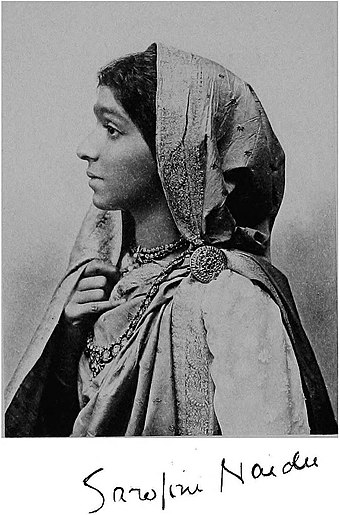
Sarojini Naidu (née Chattopadhyay; 1879 – 1949) was an Indian political activist and poet. A proponent of civil rights, women’s emancipation, and anti-imperialism, she played an important role in the Indian independence movement against the British Raj. She was the first woman to be president of the Indian National Congress and the first woman to be appointed governor of a state.
Born in a Bengali family in Hyderabad, Naidu was educated in Madras, London and Cambridge. Following her time in Britain, where she worked as a suffragist, she was drawn to the Congress party’s struggle for India’s independence. She became a part of the national movement and became a follower of Mahatma Gandhi and his idea of swaraj (self rule). She was appointed Congress president in 1925 and, when India achieved its independence, became Governor of the United Provinces in 1947.
Gandhi named her the “Nightingale of India” because of the musical quality of her poetry. She wrote mainly in the English language and was influenced by 19th century British Romanticism. Her oeuvre includes both children’s poems and others written on more serious themes including patriotism and tragedy. Published in 1912, “In the Bazaars of Hyderabad” remains one of her most popular poems and is still taught and recited in Indian schools. (source: Indian History Notes)
Discover more from Vox Populi
Subscribe to get the latest posts sent to your email.

Perhaps because her verse was frequently in my school textbooks, and we were tested on it, I grew up not liking her poetry very much! But many thanks for posting her on VP!
Sarojini was much celebrated, not least because of her proximity to Gandhi and other luminaries in the Indian freedom movement. She is very much alive in the public consciousness, at least in Hyderabad city (my home town until recently) — there is at least one major road and an eye hospital named after her.
Here, she is describing her Hyderabad. In Sarojini’s time, the pre-independence ruler of Hyderabad (the province), the seventh Nizam, Mir Osman Ali Khan was the richest man in the world.
LikeLike
Thanks, Ram!
LikeLike
I’ve long wanted to know more about Naidu and her poetry.
LikeLike
Thanks, Tom. She’s a new discovery for me for which I’m grateful.
>
LikeLike
I love musicality in poetry and this one dances. What a fascinating person I never heard of. Once again, thank you for the introduction.
LikeLike
Thanks, Barbara. I’m reading a lot of work from Southern Asia now. A friend just sent me a book of poems he translated from the Telugu language of India.
>
LikeLiked by 1 person
I look forward to perhaps seeing some here. I am back to the MFA after stroke and cancer detour. Loving a visiting professor from Israel. She gently burrows into my poems and pulls out my beloved bugs to see which ones I can release.
LikeLike
Hahaha. Well-said, Barbara. Welcome back.
>
LikeLiked by 1 person
Thanks, for this poem. Particularly liked the last stanza; a reminder of life’s brevity. I just started reading The Covenant of Water by Abraham Verghese; how did you know?
LikeLike
Leo, I work for the NSA. We know everything about you.
>
LikeLiked by 1 person
Oops!
LikeLike
Love his books met him at a conference for premedical advisors years ago
LikeLiked by 1 person
I loved the poem– I really did — but her remark that: “It took a lot of money to keep Gandhi poor” even more!!
LikeLiked by 1 person
I love that quip as well.
>
LikeLike
Thank you, Michael, for introducing us to Sarojini Naidu.
LikeLiked by 1 person
Thank you, faithful reader and editor!
LikeLike
I like the feel of this poem – the way it taps into the senses. Equally, or perhaps even more, I like her life as a political activist. Thank you, Michael, for including that too. Moved my response from a Like click to a Comment!
LikeLiked by 1 person
Yes, she was a remarkable woman. Not evident in this post is that she was known as a great wit. She said, for example, that it took a lot of money to keep Gandhi poor.
>
LikeLike