
Vox Populi
A curated webspace for Poetry, Politics, and Nature with over 6,000,000 visitors since 2014 and over 9,000 archived posts.
Norell Edwards: Seeking Safety as a Black Woman in New Cities
.
I have moved three times in the past 13 months. My academic career-climbing has propelled me across the country from my longtime residence near Washington, D.C., to the Dallas–Fort Worth metro area, followed by a brief return to living New York City–adjacent. Now that I’ve finally secured a coveted tenure-track job, I have landed in upstate New York—Syracuse, to be precise. With each new move, I think about my safety as a young Black woman living on her own. The first rule is to never look too out of place; my vigilance is heightened in areas where I know I look like I don’t belong. “Belonging” is a complex concept, but I try to stay in areas that have rich diversity, from race and ethnicity to age, dress, and gender identity.
When I first began looking for an apartment in my new city, an older, white woman realtor was recommended to me. With her best intentions, she shuttled me and my mother around Syracuse’s white suburbs–ignoring my demands to see whatever apartments the downtown area might offer. Syracuse, like many cities across the United States, is in the midst of a gentrification process. For older, white Americans who left the “inner city” decades ago, downtown still connotes the remnants of that history and populace—a dangerous milieu of working poor and unhoused individuals. And housing insecurity does plague my new city; I am struck by the number of people I see wandering the streets in this snowy, frigid climate. While I’ve lived in large cities with sizable homeless populations before, this moment feels different. As a Black woman college professor, who has opted to live in overpriced apartments just a block or two from the rescue mission—I have to think about my own complex and intersectional identity. As I adapt to this new space, I ask myself: What does allyship look like while protecting my own safety?
I am faced with dire statistics: More than 20% of Black womenexperience rape in their lifetime, and in 2019 Black women accounted for 28% of females killed by males in single-victim/single-offender situations. More broadly, Black Americans make up the majority of gun violence victims in the U.S. From 2019–2021, gun homicide rates of Black girls and women rose 78%.
Less than one month after moving into my Syracuse apartment, I pulled into the lower dungeon of my building’s parking garage (which I pay a $98 monthly premium to access). In the last available parking spot, there was a white man, rocking back and forth, surrounded by his possessions. I had seen his belongings before, and suspected someone had claimed the corner by the staircase landing as their home. Leaving the garage at night always makes me nervous—the gray cement staircase and tiny elevator feel claustrophobic and would be difficult to escape an assailant from. I made a habit of mapping out an exit strategy before exiting my car. This time I didn’t strategize at all; I just reacted. I expeditiously reversed my car and drove back up from the basement to the ground floor, hurriedly parking in a “management only” spot in view of the entrance—the unoccupied tollbooth at the entry gate taunting me.
Cognitively, I know those without shelter are often stigmatized as dangerous and bad; these things are not necessarily true. I recognize that I am privileged in this equation; I have always had a place to call home and food to eat. Even when my parents divorced, my mother and I lived with my grandmother in her two-bedroom apartment until we got an apartment of our own a year later. Now, I have decent employment, a car, and a garage to house said car. I am new to this city. I couldn’t begin to imagine what this man was experiencing. For all I knew, this man had lived in Syracuse his whole life—regularly and reliably failed by its institutions. Who was I to say where he could and couldn’t lay his head to rest at night? I emailed my apartment building’s management to make them aware of the situation and hoped they wouldn’t take any extreme actions. While I was afraid, I didn’t want any harm to come to this man.
Garage management suggested I call the police if I ever felt unsafe. In the wake of George Floyd, Elijah McClain, and countless other cases of police brutality, that did not feel reassuring. And Black women are not afforded the same protection from the police as white women—just ask Breonna Taylor, Rekia Boyd, Sandra Bland, and, again, countless others. The management company representative explained that the man I saw had schizophrenia, and she was trying to help him move back in with his mother and return to treatment. She also shared that he, Paul, was a “good one,” but warned me that there were two “bad ones” also living in the garage. I didn’t ask what differentiated good from bad, but I figured I would take her word for it. I was told because we live in a “sanctuary city,” the police shouldn’t harm unhoused people—just tell them to leave. But still, engaging with cops unsettles me. Calling the police would not guarantee more safety for me or Paul.
Speaking with some Black women I met at an event shortly after this incident, I was discouraged from calling 911. “You never know what kind of response you’ll get,” was the consensus. One woman recommended I call a different crisis number that connects callers to non-police responders. I wished such a number had been available during another encounter I’d had a few months earlier. On my last day living in Fort Worth, I cradled my dying phone while waiting for a Lyft to pick me up. A young, disheveled-looking Black man came up to me, seeming to offer his water bottle. I told him “no thank you,” and crossed to the other side of the street. He began thrusting his arm out and pouring water in different spots in front him. He crossed over to where I was, but I quickly crossed back to my original side of the street. We switched sides again, zigzagging across the road. I wanted, needed the street to keep us separate. I breathed a sigh of relief when he finally walked down the block. But a few short minutes later, I saw several cops gathered in the area. There was the same young Black man, now lying face down in the middle of an intersection, with an officer’s knee digging into his back. The image upset me, even though moments before I had feared for my own safety from this same man. I wondered whether the knee hurt him. I asked a nearby man what happened.“That man hit one of my hotel guests in the face!” he exclaimed. My jaw dropped; that easily could have been me. My sidewalk crisscrossing antics had been worthwhile. Although relieved that I escaped harm, I still felt a tinge of concern for this man; he had been carted off to the local jail, and who knew what awaited him there?
As the United States continues its attempt to diversify historically white professions, we must also diversify our communities and community solutions. Policing—an institution rooted in the legacy of slave patrols and white supremacy—cannot be the solution for Black people’s safety. Certainly, policing cannot be the solution for the safety of Black women, who must navigate the line between white supremacist violence and its toxic violent byproducts that overwhelm the Black community. Too often, moving to a new city means survival in a space of racial marginalization and microaggressions, or assimilation into a community blighted by disenfranchisement, underemployment, poverty, violence, and crime. In both scenarios, you remain the interloper.
Investing in community safety and a world without police looks like offering social supports and eradicating poverty. It means universal health care, universal basic income, and guaranteed housing; it means affordable child care and better mental and maternal health services; it means diversion, violence interruption, and restorative justice programs; it means equitable education and growth-oriented jobs and careers. Our current haphazard, inchoate, piecemeal policy attempts are not enough. No matter where you go in this country—north, south, east, or west—the desperate need for structural community investment remains the same.
| NORELL EDWARDS is an assistant professor of English and the 75th Anniversary Endowed Professor at Le Moyne College in Syracuse, New York. Her work has been published in several peer-review journals and edited collections, as well as the LA Review of Books, Electric Literature, The Grio, and the Black Westchester. |
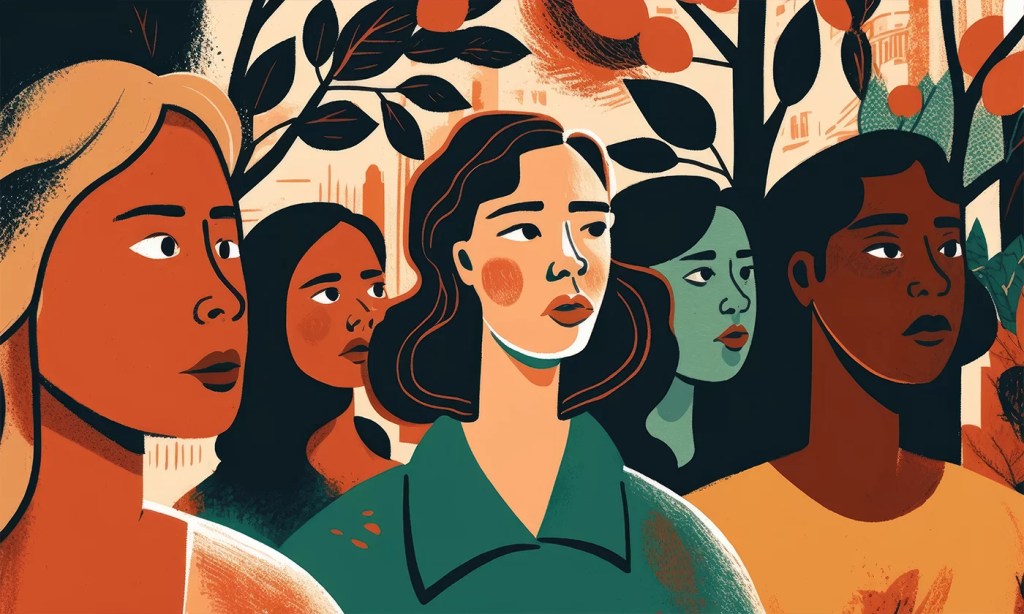
First published in YES! Magazine. Included in Vox Populi with permission. Illustration by Adobe Stock.
Discover more from Vox Populi
Subscribe to get the latest posts sent to your email.

“Investing in community safety and a world without police looks like offering social supports and eradicating poverty. It means universal health care, universal basic income, and guaranteed housing; it means affordable child care and better mental and maternal health services; it means diversion, violence interruption, and restorative justice programs; it means equitable education and growth-oriented jobs and careers.“
Oh, how I would love to see this happen in these *united* states in my lifetime! 🙏
LikeLike
Yes, we need these reforms for all of our sakes.
>
LikeLike
Powerful article. Thank you so much. Prof. Edwards’s words instantly threw me back in time, as I am neither young nor single. We black women have a distinct experience; Prof. Edwards has hit the nuanced complexity of race, gender, age, history, and systems of injustice beautifully. I truly resonate. From 1983-1986, I lived in San Francisco, in the Fillmore. I would don shapeless grey clothing, three sizes too big, to go about my Saturday chores. One morning, two men in a car drove right onto the sidewalk to block me. They were laughing and one said, “You think those baggy clothes hide who you are? Wanna date a couple’a old guys today?” That same day, I signed up for Taekwondo. If I couldn’t “blend in,” I’d better bulk-up on self-protection skills.
Syracuse also resonated. Back around 1987-1988, we drove from Ithaca to downtown Syracuse for a Bobby McFerrin (“Don’t Worry Be Happy”) concert, arriving early, at dusk, because we didn’t know what to expect. Downtown was empty, bleak, eerie. No place to linger. Bobby McFerrin would perform here?? I can’t imagine what downtown Syracuse looks like 35 years later, when urban life is much more daunting than back in my day. My own young adulthood held these helps: I have always trusted in God; my mother taught, “Never be anybody’s ‘good’ victim,” and “Always look like somebody’s beloved child.” The later was to radiate an aura that consequences would be severe if anybody tried to mess with me. I mentioned this strategy to an older cousin who had a truly rough life (rejection, undiagnosed mental illness, addiction, homelessness). His reaction was, “Auntie was always right on. I wish somebody had told me that!”
Lastly, since Edwards is a scholar, I’d like to mention something else. My favorite professor (we’re still in touch) sent me an article around 1995 about the heightened risk of heart attack and stroke among black women scholars. (Me? I’m a nursery school drop out!) I’m closing with this because black women’s life stressors often go unaddressed. We’re supposed to adapt to everything whether or not we can “name it” in real time. Take extra care always and be safe. Learn what it takes to thrive. Blessings and peace.
LikeLike
Thank you for this, Desne. You’ve brought up a number of issues worth thinking about. Blessings, Michael
>
LikeLike
I can’t begin to imagine what it is like to be young, female AND black in a big US city. It’s good to hear these accounts and become aware of a different world out there. But I am British and heard it once said, that being black begins at Dover. Not that racism doesn’t exist in the UK, of course it does, it would be quite naive of me to think otherwise. But I have always lived in mixed neighbourhoods and my circle of friends was quite rainbow coloured in every sense of the word. I wish it could always be thus.
LikeLike
Thank you again and again for posting articles such as this one, dear Mike.
LikeLike
Thank you, Laure-Anne, for your enthusiastic participation.
>
LikeLike