
Vox Populi
A curated webspace for Poetry, Politics, and Nature with over 6,000,000 visitors since 2014 and over 9,000 archived posts.
Conrad Aiken: Summer
Absolute zero: the locust sings:
summer’s caught in eternity’s rings:
the rock explodes, the planet dies,
we shovel up our verities.
.
The razor rasps across the face
and in the glass our fleeting race
lit by infinity’s lightning wink
under the thunder tries to think.
.
In this frail gourd the granite pours
the timeless howls like all outdoors
the sensuous moment builds a wall
open as wind, no wall at all:
.
while still obedient to valves and knobs
the vascular jukebox throbs and sobs
expounding hope propounding yearning
proposing love, but never learning
.
or only learning at zero’s gate
like summer’s locust the final hate
formless ice on a formless plain
that was and is and comes again.
From Collected Poems (1953). Public domain.
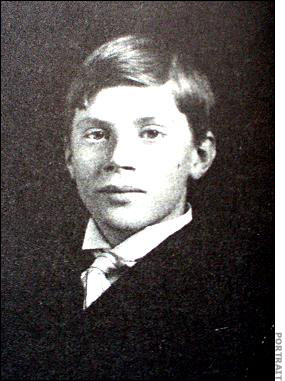
Conrad Potter Aiken (August 5, 1889 – August 17, 1973) was an American writer and poet, honored with a Pulitzer Prize and a National Book Award, and was United States Poet Laureate from 1950 to 1952. His published works include poetry, short stories, novels, literary criticism, a play, and an autobiography. Aiken was the eldest son of William Ford and Anna (Potter) Aiken. In Savannah, Aiken’s father became a respected physician and eye surgeon, while his mother was the daughter of a prominent Massachusetts Unitarian minister. On February 27, 1901, Dr. Aiken murdered his wife and then committed suicide. According to his autobiography, Ushant, Aiken, then 11 years old, heard the two gunshots and discovered the bodies immediately thereafter.
After his parents’ deaths, he was raised by his great-aunt and uncle in Cambridge, Massachusetts, attending Middlesex School, then Harvard University. At Harvard, Aiken edited the Advocate with T. S. Eliot, who became a lifelong friend, colleague, and influence. It was also at Harvard where Aiken studied under another significant influence in his writing, the philosopher George Santayana.
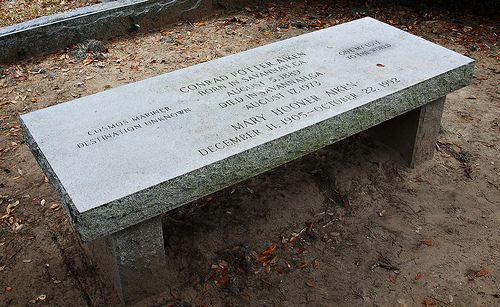
Knowing that mental illness ran in his family, he was always battling the notion that he too would succomb to madness. In the 1930s his second wife saved him from suicide. Twelve years before his death, Aiken returned to Savannah and bought the house next door to his boyhood home. He spent a considerable amount of time at the Bonaventure Cemetery where his parents are buried. He decided that when he died, his tombstone would be a bench for others to enjoy. One day, he was sitting in the beautiful Bonaventure Cemetery, when he noticed a ship going by. It bore the name Cosmos Mariner. He decided to read the local paper and find out where the ship was going, but didn’t have any luck. That incident stuck with him and became his tombstone epitaph: “Cosmos Mariner, Destination Unknown.”
Conrad wrote about his childhood home in his poem, the Coming Forth by Day of Osiris Jones:
The house in Broad Street, red brick, with nine rooms
The weed grown graveyard with its row of tombs
The jail from which imprisoned faces grinned
At stiff palmettos flashing in the wind
The engine house, with engines and a tank
In which alligators swam and stank
The bell tower, of red iron, where the bell
Gonged of fire in a tone from hell
Discover more from Vox Populi
Subscribe to get the latest posts sent to your email.


Wow, just wow! That ending is so intense, so terrible and beautiful at once! Thank you for this, and do you recommend a particular biography of Aiken?
LikeLiked by 1 person
Ushant, Aiken’s autobiography linked in the bio, is quite powerful.
LikeLiked by 2 people
Why do I love this so much? It makes me want to dance and do foolish things. After meditation, before breakfast, time to let the dog out.
LikeLiked by 1 person
Thanks, Barbara. I love the music of this poem as well
>
LikeLiked by 2 people
that was and is and comes again.
LikeLiked by 1 person