
Vox Populi
A curated webspace for Poetry, Politics, and Nature with over 6,000,000 visitors since 2014 and over 9,000 archived posts.
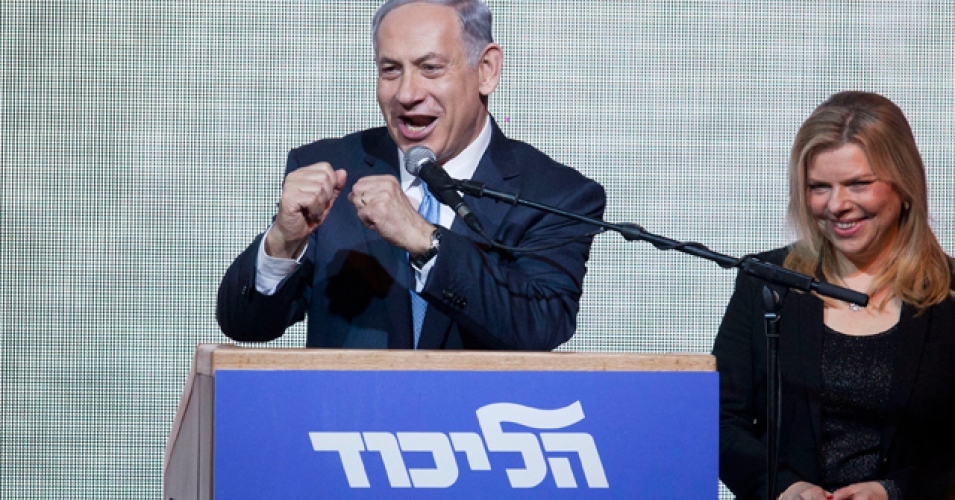
Michael Winship: Netanyahu’s “Us or Them” Is Nothing But Trouble
For a long time now, American political consultants have benefited from a lucrative sideline, selling their alleged expertise to politicians in Israel. (It was Democratic strategist James Carville who, after working on a campaign for former Prime Minister Ehud Barak, joked that the key to victory in Israel was who won “that all-important Jewish vote.”)
It was no different during this past week’s Israeli election. Benjamin Netanyahu’s winning Likud Party had Republican Vincent Harris, the 26-year-old whiz kid who helped engineer Senator Ted Cruz’s victory in Texas. Veteran Democrats Paul Begala and Stan Greenberg were working for the Zionist Union coalition of Labor and other political parties, and the anti-Netanyahu group V15 hired President Obama’s campaign field director Jeremy Bird. That led to charges by Likud of Obama meddling in Israeli affairs — as opposed to, oh, say, Netanyahu coming here at the behest of Republicans and addressing a joint session of Congress about our no nukes negotiations with Iran. In any case, the accusations were strongly denied by the White House.
What can’t be denied is that Netanyahu has learned some other lessons from American politics that are far uglier and more brutish than polling techniques and media training; deeply cynical lessons in how to use anger, fear and hate to churn your base into a frenzy, while disregarding real, bread-and-butter issues of economic hardship and worst, ramping up prejudice and discrimination against millions you see as less than human.
Historically, he has said whatever needed to be said to advance his blatant careerism. In 1997, at the beginning of his first term as prime minister, Netanyahu declared he was opposed to a separate Palestinian state: “This is the land of our forefathers, and we claim it to the same degree that the other side claims it.” Then in 2009, Netanyahu spoke at Israel’s conservative Bar-Ilan University and famously stunned the audience by announcing his support of a two-state solution: “In my vision of peace,” he said, “in this small land of ours, two peoples live freely, side by side, in amity and mutual respect. Each will have its own flag, its own national anthem, its own government. Neither will threaten the security or survival of the other.”
As recently as last October at the White House, he reaffirmed that, “I remain committed to a vision of peace of two states for two peoples based on mutual recognition and rock-solid security arrangements.” But as this year’s Israeli’s election heated up and polls indicated the opposition was catching up and even beating him and his Likud colleagues, Netanyahu gave an interview the day before voting to NRG, a conservative news website, and said, “I think that anyone who is going to establish a Palestinian state today and evacuate lands is giving attack ground to the radical Islam against the state of Israel,” he said. “This is the actual reality that has formed here in recent years. Anyone who ignores this is sticking his head in the sand.” Asked if that meant no Palestinian state during his watch, he replied, “Indeed.”
Further fanning the flames, on Election Day itself, the prime minister sent out a race-baiting, get-out-the-vote Facebook SOS, warning supporters about those one million Palestinians who also are Israeli citizens: “The right-wing government is in danger. Arab voters are coming out in droves to the polls.”
The scorched earth tactics used by Netanyahu are reminiscent of the mongering we saw here in the 1960s from the likes of Richard Nixon and Alabama’s George Wallace, stoking panic, dividing to conquer, consigning a whole people to the margin for his own survival. In his reckless pursuit of one more dance at the center of power, Bibi Netanyahu has wrestled what remains of Israeli democracy into the dirt, and in rejecting the pursuit of peace with the Palestinians perpetuated a nightmare of a doctrine that could best be labeled – to reword George Wallace’s infamous rant — “apartheid now, apartheid tomorrow, apartheid forever.”
As James Besser, former Washington correspondent for New York’s The Jewish Week, wrote in the liberal Israeli newspaper Ha’aretz, “The idea of apartheid suggests the intent to make separation and unequal treatment permanent, and in the past it was possible to argue that for all the expansion of settlements, Israel was still looking for ways to end the occupation. No more.”
Of course, now that Netanyahu is in Mission Accomplished mode, in a further display of chutzpah, the prime minister is backpedaling yet again, telling Andrea Mitchell of NBC News, “I don’t want a one-state solution. I want a sustainable and peaceful two-state solution, but circumstances have to change for that to happen.” As for that look-out-for-the-Arabs Facebook harangue, “I am not racist,” he claimed. “I am proud to be the prime minister of all Israeli – Arabs and Jews alike.” (On Monday, he publicly apologized.)
This is classic Netanyahu on a couple of levels: often saying one thing to overseas media, especially in America, and another for domestic consumption (a habit not uncommon among many Middle East leaders); and as has been established, dissembling and flip-flopping in the name of expediency, couching his words with linguistic loopholes, like a genie offering multiple wishes but each with a catch.
Meanwhile, Peter Beaumont of The Guardian notes, “A hard-hitting EU report on Jerusalem warns that the city has reached a dangerous boiling point of ‘polarization and violence’ not seen since the end of the second intifada in 2005.
“Calling for tougher European sanctions against Israel over its continued settlement construction in the city – which it blames for exacerbating recent conflict – the leaked document paints a devastating picture of a city more divided than at any time since 1967, when Israeli forces occupied the east of the city.”
As a possible third intifada approaches, other domestic crises, crises much like our own, are also being swept under the carpet. Just three weeks before Election Day, Israel’s state comptroller released a shocking assessment that in the years between 2008-2013, housing prices had soared 55 percent and rental rates had climbed 30 percent while wages increased only a small percentage. Further, as economist Paul Krugman recently wrote in The New York Times, “According to Luxembourg Income Study data, the share of Israel’s population living on less than half the country’s median income — a widely accepted definition of relative poverty — more than doubled, to 20.5 percent from 10.2 percent, between 1992 and 2010. The share of children in poverty almost quadrupled, to 27.4 percent from 7.8 percent. Both numbers are the worst in the advanced world, by a large margin.”
Despite those numbers, Netanyahu is a free market advocate, Krugman continued, and has “a Chris Christie-like penchant for living large at taxpayers’ expense, while clumsily pretending otherwise. So Mr. Netanyahu tried to change the subject from internal inequality to external threats,” conjuring danger and dread from international leftist conspiracies, a nuclear Iran and constant existential threats from Palestinians and the rest of the Muslim world.
Is it any wonder the GOP embraces Netanyahu’s policies? Both not only think the market can cure all that ails us, they ignore many real issues by whipping up specters at home and abroad. With both the Republicans and the Likud, we now have a war party in Israel and one in America, the neo-cons beating the drums once again, this time against Iran. Have we ever had a situation where we’ve allowed a foreign leader to yield so much power over Congress?
“It’s us or them” was the slogan Netanyahu and Likud spread throughout this recent campaign. They said they meant the Labor/Zionist Union opposition but its roots are deeper and more atavistic than that. “Us or them,” they chant, much like their right wing counterparts in the United States, a core philosophy more suitable to the cave than a rational civilization. Disaster looms.
—
First published in BillMoyers.com. This work is licensed under a Creative Commons Attribution-Share Alike 3.0 License.
Discover more from Vox Populi
Subscribe to get the latest posts sent to your email.

cool post
LikeLike
Sadly, Michael Winship’s commentary on Netanyahu’s recent re-election rings true. America’s toxic political culture has changed Israeli political culture for the worse, and perhaps irreversibly.
Still, there are some important distinctions to be made between us – the Zionist Left – and them, the Likud and its coalition partners. If the Zionist Union (led by the Labor) party tapped Democratic party “expertise” to rally people to their senses, let us not forget that it was to “give peace a chance”, and to address, and in due course, to remedy, the rampant income inequality and housing crises that Netanyahu chose to ignore, and that Krugman calls attention to. And in all probability, they did so reluctantly, out of desperation, knowing full well that Netanyahu’s machinations had already changed the political climate, and stacked the deck against them.
Is disaster inevitable? No, not quite, but it is extremely likely. Even with Egypt, Jordan, Saudi Arabia and the Emirates joining forces militarily against Iran and its proxies – including Hamas and Hezbollah, who have sworn to Israel’s destruction – another war with Hezbollah is imminent, and another intifada is brewing. Netanyahu is a consummate opportunist and hypocrite, a latter day Machiavelli, and probably thinks he can ride out the storm and seize some twisted triumph from the carnage. So unless Obama and the next American President develop a very cunning – and potentially unpopular – strategy to strengthen the ZIonist Left, and halt the settlements on Arab lands, we’re in for another ugly decade of Middle East politics.
LikeLike
Thanks for making the distinction between the Zionist right and left, Dan. Too often, Israel’s current policies are equated with Zionism in general, and we forget to mention that there is a strong Israeli peace movement.
LikeLike