

Danny Sjursen: Undercover Patriots
Trump, Tulsa, and the Rise of Military Dissent

Michael Simms: Bus
One afternoon at a bus stop in Ruston, Louisiana we picked up a single passenger, a huge man in a dirty plaid shirt, grease-stained khakis, and unlaced boots covered in mud.

Ari Honarvar: When Savoring a Pleasant Moment is a Radical Act
And then someone from another rooftop shouted a verse of Rumi’s poetry into the clear night air.

Paul Christensen: On Silence
I am possessed of a brooding spirit, some ominous angel who has landed on my shoulders, staring at my ear. It wants to know why I do not understand silence, the poetry of space.

Gerry LaFemina: Hive Mind
We’ve been talking about the muse up until this point, today—how I don’t believe in such a thing. This stings their sensibilities. The bee in the classroom is a happy distraction.

Ellena Savage: Selfish, grumpy and unkind? That’s my kind of woman
The characters I find thrilling are women who are absolutely not socialised or charitable or good.
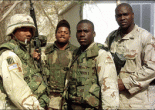
Andrea Mazzarino: The War Zone Is America
A Military Spouse’s Perspective on Racism and Armed Violence in the United States

Paul Christensen: The Reluctant Summer
I could feel the rage building as I saw the nation writhe, then uncoil its wrath and take to the streets. I was demoralized to realize that my whole life had been lived in the twisted emotions of a country poisoned to its soul with racist hatred.

William J. Astore: Warrior Cops When the Wars Come Home
America’s forever wars in distant lands have now come home.

Michael Simms: And Jesus Wept
Our friend Christian, an African-American and one of the best men I know, told my wife that when he saw the video of the murder of George Floyd, he wept for hours.

Michelle Bitting: Walls
Worst I had to deal with, well, I suppose that time my son was shut in a padded room and shit himself at the special needs school. He was 13 and having one helluva wiring crisis. I got called to come get him after he graffitied his feces across white walls.

Barrett Swanson: The Soldier and the Soil
Their prose often stood head and shoulders above the standard freshman drivel, exhibiting a certain rigor of thought and depth of feeling that perhaps comes from having witnessed whole anthologies of trauma—entire villages razed by fire, wide-eyed children draped in gore, wives screaming beside mutilated husbands.

W. D. Ehrhart: Paul Fussell — A Remembrance
While Fussell wrote on a wide variety of subjects over his long life—ranging from Augustan humanism, Samuel Johnson, and Kingsley Amis to the 2nd Amendment, the Indianapolis 500, and travel in between-the-wars Europe—war, the irony of war, the suffering and lunacy and permanent damage of war, the unfairness of war, lay at the heart of his writing and of his being.

Doug Anderson: Burning Man
Burning man comes from an instinct and need for carnival, a masking of the respectable self in order to release the animal/imaginative self, but with ritualized decorum and boundaries.
