
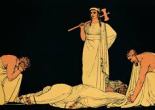
Rachel Hadas: Why Trump’s rage defies historical and literary comparisons
As he has gained fame and power, Trump’s contemptuous rage at his opponents and his appetite for vengeance appear to have sharpened.
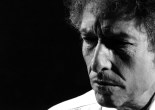
Bob Dylan: Nobel Lecture
When awarded the Nobel Prize for Literature in 2016, Bob Dylan gave no comment for two weeks, ignored the Academy’s calls, didn’t attend the ceremony, and collected the award in a hoodie four months later. But Dylan later sent them a rambling, 27-minute ode to literature.
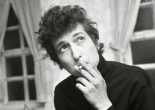
Mike Schneider: Stirring Up the “Great Folk Scare”
There’s nothing easy-going about the folk songs of the Greenwich Village revival, not the ones Dylan sang — a man-killing woman, catastrophic floods, a man driven insane by love — songs that taught him there’s nothing new on Earth.
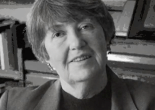
Michael T. Young: The Need to Believe | The Poetry of Lisel Mueller
This is the power we need in a post-truth world, where political forces claim the right to manipulate our perceptions through distortions of language.
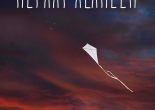
Angele Ellis: The life and legacy of Palestinian writer Refaat Alareer (1979-2023)
Refaat Alareer stands in a field in Gaza, holding a container of freshly picked strawberries. What evokes the earth’s sweetness more fully than a ripe berry? The expression on his face—scholarly, bespectacled—is gentle and tender.
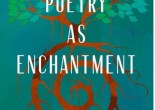
John Zheng: Poetry as Enchantment by Dana Gioia
“If poetry is the most ancient and primal art, if it is a universal human activity, if it uses the rhythmic power of music to speak to us in deep and mysterious ways, if the art is a sort of secular magic that heightens the sense of our own humanity, then why is poetry so unpopular?”
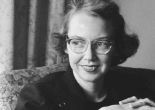
Baron Wormser: Salvation
On Flannery O’Connor, Donald Trump, and American Violence

William D. Hartung: In Stunningly Bright Colors
Enrico Muratore Aprosio’s Cry for Common Sense and Common Humanity,
Christopher B. Daly: The New Yorker turns 100 − how a poker game pipe dream became a publishing powerhouse
A big part of the magazine’s eventual success was Ross’ genius for spotting talent and encouraging them to develop their own voices.
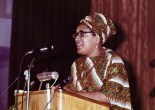
George Yancy: Remember What Audre Lorde Told Us — The Oppressor Doesn’t Determine What’s True
To navigate these terrible times, we need Audre’s Lorde’s audacity: Protect the public sphere. Refuse to be silenced.

Mike Schneider: Incompletely Known | Déjà vu Bob Dylan
The popularity and critical success — a not-easy-to-achieve combo — have to do not only with the singular genius of Dylan, an unknown 19-year-old bohemian who becomes the icon of an era, but also with the historical-cultural milieu in which the movie’s events — real and not — occurred.
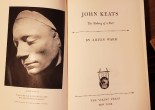
Sydney Lea: Hush
Does it make any sense to say I heard dead silence? No matter. I’ll simply declare that I’ve never known such quiet in the sixty years I’ve roamed these woods and hills.
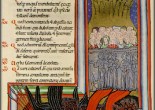
Hildegard von Bingen: Vision 7, The Devil
Then I saw a burning light, as large and as high as a mountain, divided at its summit as if into many tongues.
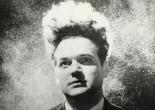
Baron Wormser: David Lynch (1946 – 2025)
In Lynch’s world, human beings are, so to speak, flammable animals whose electrical nature can be set off by a carnal gaze or by sinister forces that roam the ether and can turn one person into another with a mere zap. The zap can seem both hokey and terrifying.
