
Vox Populi
A curated webspace for Poetry, Politics, and Nature with over 6,000,000 visitors since 2014 and over 9,000 archived posts.
Sean Howard: Envisioning a Post-Nuclear, Post-Digital Future
If we appear to seek the unattainable, as it has been said, then let it be known that we do so to avoid the unimaginable. — Students for a Democratic Society (SDS) Port Huron Statement, June 15, 1962
~
Doomsday Dimensions: The Chimney, the Cloud, and the Computer
On January 27, the famed ‘Doomsday Clock’ of the Bulletin of the Atomic Scientists, set symbolically ticking in 1947 at seven minutes to midnight, was moved closer than ever – 85 seconds – to the apocalyptic point of no return to life on Earth. For sixty years, that apocalypse was anticipated to take the mushrooming form of what President John F. Kennedy, shuddering from the close call of the 1962 Cuban Missile Crisis, called “the final failure” of nuclear war. In 2007, the prospect of biosphere collapse from global warming – the opposite apocalypse to nuclear winter – was identified as a co-equal danger, to be joined in 2016 by existential threats of what the Bulletin called “mass disruption” from emerging technologies, some of them (e.g., AI) by then already compounding nuclear dangers and accelerating global warming.
“It is clear,” the Bulletin’s Scientific Advisory Board wrote ten years ago, introducing this latest dimension of doom, that “advances in biotechnology; in artificial intelligence, particularly for use in robotic weapons; and in the cyber realm all have the potential to create global-scale risk.” In the violently volatile time since – featuring the puncture wounds of the pandemic, Russia’s war of disastrous choice in Ukraine, and the corrupt climate denialism of the Trump Administrations – these three dimensions have become fused in evermore tightly-knit ways. The day of increasingly or fully Lethal Autonomous Weapons Systems (LAWS) has dawned, casting a hideous artificial light on conventional conflict while increasing the odds that high-tech war between major powers – under algorithmic direction, command, and ‘control’ – will ‘go nuclear’. Just as nuclear war and global warming are two versions of the same threat, irreversible climate breakdown, so that dual-menace is magnified by the cruel capacities and unnatural appetites of the Technosphere, a ‘sphere’ of seemingly far greater ‘influence’ than the biosphere it is helping to ruin.
In 2019, a Canadian anti-war group I belong to, Peace Quest Cape Breton, launched an initiative to build new coalitions between the peace and climate justice movements. Dubbing our campaign ‘The Chimney and the Cloud’ – the factory chimney and the Mushroom Cloud – to evoke the comparably grave, intimately related dangers of industrialism and nuclearism, we argued that only the combination of two ‘Zeroes’ would add up to survival: economic Carbon Zero and nuclear Global Zero, a green economy and a green peace. But now I believe we should add a third ‘C’, the Computer, to generate an accurately ‘3-D’ image of the interfused violences we face: the doomsday dimensions of industrialism, nuclearism, and digitalism.
Speaking on Democracy Now! on February 4, Dr. Ira Helfand, a nuclear physicist prominent in both the US-based Back from the Brink coalition and the International Campaign to Abolish Nuclear Weapons (ICAN), stated that the “warning we received last week from the Bulletin of the Atomic Scientists really needs to be a wake-up call. We cannot afford to live in denial about this danger any longer. At one point in our history, back in the 1980s, when the danger was also very great, we all got it. You know, millions of people were marching in the streets because everybody understood how dangerous the situation was. Well, it’s even more dangerous today. And the big difference is that people aren’t paying attention to it.”
In 1987, British novelist Martin Amis dubbed nuclear weapons ‘Einstein’s Monsters,’ a weaponization of the E=mc2 relation between matter and energy. So monstrous, larger-than-Life, was the Bomb that it generated what Amis called its “unthinkability”: “I didn’t know why nuclear weapons were in my life or who had put them there. I didn’t know what to do about them. I didn’t want to think about them. They made me sick.” Just a few years later, after the last Soviet leader, Mikhail Gorbachev, decided he did know what to do with them – get rid of them – the Cold War, unthinkably, came to a sudden peaceful end, as, it seemed to most, did the Monsters’ reign of terror. In “the new world authorized by the Gorbachev revolution,” as Sheldon Ungar wrote in The Rise and Fall of Nuclearism (1992) – with the hands of the Doomsday Clock flying back to 17 minutes to midnight – the blissfully relieving working assumption was that the fall of the Berlin Wall effectively equated to the collapse of the nuclear threat (or, at least, the threat of nuclear apocalypse). As Kathryn Bigelow, director of House of Dynamite, told the Guardian in October 2025, “we’d all assumed the bomb was just going to magically disappear,” meaning the “the real bomb for the audience” of her movie, depicting a highly-plausible nuclear escalation, “is realising that this is possible,” that “our world is combustible.”
As the impact of House of Dynamite – riding the shockwave of Christopher Nolan’s Oppenheimer – suggests, the Monsters are resurfacing to the cultural gaze. And as ICAN’s 2017 Nobel Peace Prize proved, the anti-nuclear movement stayed ‘woke’ (I use the term proudly) through a third of a century of sleepwalking. Woke, but not well; alive, but not kicking. In all nine nuclear-armed nations (China, France, India, Israel, North Korea, Pakistan, Russia, UK, US) – and in the three dozen nations in NATO and elsewhere mistaking the Cloud for an ‘umbrella’ – calls for deep nuclear cuts barely register on the hawkish political, public, or media radar; peace education, capable of correcting for nuclear amnesia, is almost nowhere to be seen (or taught); and I can attest from NGO experience that major funders in North America and Europe continue to ‘defund the dove’. One perverse consequence of this sustained inattention is, particularly during nuclear crises and war scares, the reaffirmation in the minds of public and policymakers of the value, as well as prestige, of nuclear weapons, a wager on ‘deterrence’ laid in ignorance of a history replete with atomic imperialism and Bomb-emboldened aggression, ever-dangerous ground littered with technical failures, political miscalculations, close calls and near misses. “Luck is not a strategy,” as UN Secretary General António Guterres likes to say; but how many are listening?
As lamented above, one source of this general ‘denuclearization’ of discourse has been the irrational split between the now-miniscule (though growing) peace movement and the still-sizeable (though shrinking) climate justice movement. But there is, I believe, another crucial factor, almost completely overlooked: the failure of both those movements, and our culture as a tech-dependent whole, to adequately grasp the profoundly computerized nature – or mechanised unnaturalness – of contemporary industrialism and nuclearism. One of the main reasons nuclear weapons “were in” Martin Amis’ life was that digital computers “put them there”, and have kept them there. Without their power – massively boosted in service to the Bomb – thermonuclear weapons would have remained an unachievable because an incalculable violence: we simply wouldn’t “know what to do about them” or “how to think about them” as realizable projects. Computers made the Monsters, if not ‘thinkable’, at least technically viable; and because of the explosive expansion of the digital universe that that produced, our already shrunken world became increasingly computerized – compressed and (just like the ever-smaller warheads!) miniaturized – at increasingly catastrophic human and natural cost. The digital age is necessarily industrial, the atomic doomsday clock necessarily digital: in unholy trinity, the Chimney, the Cloud, and the Computer constitute a single, integrated system, resistance to which will correspondingly necessitate the threefold transformation of decarbonizing the economy, denuclearizing world affairs, and ‘de-digitalising’ – we don’t even have a decent word for it yet! – our societies and our selves.
~
The Maniac Obsession: The Computerized Core of the Nuclear Age
In July 2025, Back from the Brink released ‘A Beginner’s Guide to Nuclear Weapons,’ an attempted corrective to the illiteracy on the topic endemic to the world’s most nuclearized regions. The logic, in this regrettable ‘start from scratch’ context, of providing a “one-stop resource to help you get up to speed on the issue, so you can be informed and get engaged in meaningful ways,” is strong. Dispelling the myths of nuclear deterrence requires registering the reality of what nuclear weapons are; the atrocious, ongoing harm they have already done and (to, mostly, Indigenous people and places); and the apocalyptic damage they may well yet inflict – in the time would take to read the guide! It is, as the group stresses, the “extraordinary devastating force and deadly toxicity” of nuclear weapons that “sets them apart,” über allesfrom “all other weapons.” Yet there is a blind spot, even in this sane vision: the failure to see the Computer at the core of the Bomb. For just as much as fissile material (uranium and plutonium), computing power makes possible, explains, the presence in the world of that unthinkably violent ‘force and toxicity’.
The guide does refer to the “numerous close calls when humans or computer systems mistakenly believed that the United States was facing imminent nuclear attack”. As noted, the latest, increasingly AI-pervaded versions of those early-warning/launch-on-warning systems further compress already contracted decision-making timeframes. But such systems don’t just feature or matter on the fuzzy thresholds between nuclear ‘peace’ and war; the nuclear systems they are programmed to detect only exist courtesy of their computerization, can only exist as weaponized computers.
The atomic age is the digital-nuclear age, a fusion of obscenely potent means of destruction and obscenely potent powers of calculation: a world-shaking technological romance forged in thermonuclear fire. The ‘quantum leap’ from analog to digital computing (a different universe of calculational capacity) paralleled and enabled the leap from fission to fusion weapons (a different universe of destructive capacity). Both leaps, moreover, were radically akin – and thus compatible, marriageable – in their reliance on, and mechanization of, discrete, discontinuous forces and energies.
In the case of the Bomb, these were the (sub)atomic forces and energies binding, underpinning, sustaining the continuous, classical, macroscale, natural realities we know as the rhythms, potentials, and limits of our evolving sentient life. In the case of the digital computer, the parallel move was to reduce what numbers deployed in analog calculations meant as a whole (in their connection to the realities they represented) to discrete bits (digits) capable of both encoding and carrying out instructions – not just storing but doing data. I draw this formulation from George Dyson, son of Manhattan Project physicist and science writer Freeman Dyson, in his 2012 book Turing’s Cathedral: The Origins of the Digital Universe, where he writes that the dawn of the digital was the “break between numbers that mean things and numbers that do things,” a turn from meaning meaning in turn that “our universe would never be the same.”
Digital storage of data – the production of so-called ‘memories,’ bits of actionable ‘intelligence’ – took the standardized unit-form of 40-bit strings of retrievable code including “not only data (numbers that mean things) but also executable instructions (numbers that do things) – including instructions to modify the existing instructions, or transfer control to another location and follow new instructions from there”. Exhibiting such flexible capacity, these ‘digits’ in their performance (instrumental virtuosity) seemed to “come alive,” in the awestruck words of Julian Bigelow in 1951, watching the ‘MANIAC’ – the Los Alamos laboratory’s Mathematical Analyzer Numerical Integrator and Automatic Computer – calculate a thermonuclear explosion, a fission-fusion chain-reaction, by means, as Dyson explains, of a strikingly similar process:
Since a 10-bit order code, combined with 10 bits specifying a memory address, returned a string of 40 bits, the result was a chain reaction analogous to the two-for-one fission of neutrons within the core of an atomic bomb. All hell broke loose as a result. Random-access memory gave the world of machines access to the powers of numbers – and gave the world of numbers access to the powers of machines.
Dyson’s book is a celebration (and agog anticipation) of the wonder-working digital universe, that ‘new world authorized’ by the atomic revolution but now, he maintained, decoupled from the Bomb it helped build: “it was,” he wrote in the safely past tense, “the computers that exploded, not the bombs”. And then he claims strangely: “It is no coincidence that the most destructive and the most constructive of human inventions appeared at exactly the same time. Only the collective intelligence of computers could save us from the destructive powers they had allowed us to invent.”
Just how the advent of ‘numbers that do things’ meant we survived the Cold War is unclear. Psychologically, what Dyson is doing here is conveniently splitting into ‘heavenly’ and ‘hellish’ parts a system in which ‘each’ part, Bomb and Computer, conjured the ‘other’: a ‘whole thing’ weirdly analogous to the hydrogen atom, with the Computer (Dyson’s positive force) bound in orbit to the Bomb like that atom’s single electron to the single proton (his negative force!) in the nucleus. Even a thumbnail sketch of the evolution of this lockstep, strange-love relationship paints the bigger picture we need of the world of troubles our universe is in.
And the current state of that union is as strong as ever, manifested in MANIAC’s latest iteration El Capitan, or El Cap, named after the world-famous granite rockface at Yosemite National Park (a formidable scaling challenge, get it?). Since late 2024, according to the Lawrence Livermore National Laboratory, “the world’s most powerful supercomputer” has been operating at the “exascale” of “at least one quintillion (1,000,000,000,000,000,000+) double precision (64-bit) operations per second (1 exaflop),” though capable of attaining nearly three exaflops per second, to provide “the nation with a competitive edge in complex high-fidelity modeling and simulation as well as artificial intelligence and machine learning codes that can be applied to national security, materials discovery and inertial confinement fusion,” and doubtless other varieties of digital grist to the nuclear mill. For at the core of this ‘super’ – requiring “about 30 megawatts (MW) of energy to run at peak, enough power to run a mid-size city” – is the Super, the H-Bomb, lavishly attended by El Cap’s predecessors since the Clinton Administration’s 1992 decision to end underground nuclear testing and rely on the Science-Based Stockpile Stewardship (SBSS) programmes of the Accelerated Strategic Computing Initiative (ASCI).
World-beating computer power was needed to both design Cold War H-Bombs – those more literal world-beaters! – and analyze the results of their explosive testing in (predominantly) the atmosphere, spectacularly contaminating events that were also the greatest data-generating experiments in human history, thus boosting computer power yet more. Formidable new calculational and modeling challenges emerged – to be met, ‘naturally,’ by enhanced computer potency – when the Mushroom Clouds moved underground after the 1963 Partial Test-Ban Treaty (PTBT). These first four decades of mutually-assured achievement, generating countless commercial and other applications, laid the digital platform for the new virtual-only era. ASCI, Joseph Masco wrote in The Nuclear Borderlands (2006), replaced “the Cold War commitment to speed of nuclear production into a post-Cold War pursuit of computational speed, manifested in the ability to render three-dimensional simulations of nuclear explosions in ever-greater degrees of (temporal and spatial) resolution,” larger-than-lifelike illusions producing a very real result, not “new generations of bombs” but “a new generation of weapons scientists capable of tending to those bombs”.
But those scientists (mostly male) also tended to have fun, with the routine calculational grind of stockpile stewardship sexed up by the graphic conjuring of explosive nuclear climax. Exhibit A, as Masco somewhat squeamishly details, was the “first three-dimensional computer simulation of a thermonuclear detonation in 2001,” not a caretaking task at all but rather a preprogrammed performance “presented in the form of a movie,” shown at Los Alamos’ “state-of-the-art ‘visualization centres’”, running “for 122.5 days” and involving “35 times the total information in the Library of Congress.” And how much more intimate the bond was growing, with the scientists “positioned at the center of an ‘immersive theater,’ and oriented toward a Power Wall, the largest and most detailed projection screen on the planet,” leaving them standing (kneeling?) “physically dwarfed by the microscopic processes that make up a simulated nuclear explosion, which are rendered in full colour and projected on a massive scale,” with pathbreaking “interfaces” allowing manipulation of the evidently stimulating “simulation through use of a virtual reality glove”. All three US nuclear weapons labs (Los Alamos, Livermore, Sandia), Masco adds, were “exploring ways of rendering nuclear simulations in ever-greater temporal and spatial detail, as well as with more interactive possibilities”: possibilities, that is, of seemingly experiencing, in its nuclear-digital essence, the Bomb ‘come alive’.
In sum, without computerized stockpile stewardship to replace computerized analysis of nuclear testing, verifying either the safety and reliability of the American (or any) nuclear arsenal is impossible, opening the path to either a deeply controversial resumption of testing or nuclear abolition. Of course, efforts like ASCI don’t in themselves make a nuclear-weapon-free world unfeasible or undesirable. But in maintaining the viability (e.g., extending the ‘life’) of Einstein’s Monsters, such digital caretaking not only reinvested massive military-industrial interests in perpetuating the nuclearization of world affairs, it kept the door open to explosive tests of new weapons, a prospect which a salivating President Trump is now openly contemplating. And the official premium on feasibility has always been accompanied by, coupled with, a clinically carnal desire to ‘know’ the Bomb inside and out, a manipulative human access only achievable hand-in-glove with the computer.
As we have considered through George Dyson’s Bomb versus Computer Manicheanism, a pernicious paradox of the digital-nuclear age has been the Bomb’s eclipse by the rise of its own technology, especially in app-addled minds dominated by the devices the device has spawned, the endless digital reordering/recoding of existence and experience. The screens screen us from the truth, as Kathryn Bigelow reflected in her Guardian interview: “It is an age of ironies. On our phones, nothing is beyond the pale, and everything makes us furious. And all…while ignoring a nuclear stockpile able to render our online dramas irrelevant. It’s the one thing we never mention, much less question. It isn’t on TikTok, so it doesn’t exist.”
Bigelow isn’t here claiming that the Bomb and Computer are part of the same device, just that the latter veils the former. But is it realistic to think we can just ask people to lower their smartphones and see the Mushroom Cloud? Or do we need also to register the many ways that our digital ‘destiny’ has been shaped by – as well as the many ways the digital universe has shaped – what may yet be the nuclear fate of the Earth? Collectively, culturally, we will be likely to first resist and dismiss such a suggestion. But what it if then fosters a revelation of the Apocalypse, the “final failure” that we still have time, if we resist, to avoid?
~
A Double Peace Movement: Vanquishing the Digital-Nuclear Destroyer
In Scorched Earth: Beyond the Digital Age to a Post-Capitalist World (2022), cultural theorist Jonathan Crary makes a strong case for a clean, complete break with the Technosphere: “the very possibility of a ‘digital age’,” he insists, “requires the expansion of…destructive industrial practices to world-vanquishing extremes,” a “terminal…cannibalization of the planet in the service of prolonging the imploding ‘digital age’”. Thus, “if there is to be a livable and shared future on our planet, it will be a future offline, uncoupled from world-destroying systems and operations of 24/7 capitalism”. For many progressives, nothing so drastic or potentially socially self-harmful is needed, though something assuredly radical is: the decoupling of the Technosphere from 24/7 capitalism, building a democratic, equitable, inclusive, presumably green digital realm committed to connectivity and community.
The beguiling argument develops Dyson’s digital-nuclear dichotomy into a splitting of the digital itself into opposing – incorrigibly destructive, potentially constructive – forces. I reluctantly agree with Crary that such a cleansing, resurrecting, and greening of the digital is far less realistic than his post-digital vision. And I share his aim of preventingin this abolitionist way the Technosphere from destroying the natural world in the process of stunting, de-skilling, and perverting human nature. Crary, though, together with many other acute and eloquent critics of the Technosphere, misses the vital link between nuclearism and digitalism, fails to reject ‘both’ as systematically related aspects of the same waragainst reality. Yes, he is right that the digital universe could implode, collapse exhausted by the costs of exhausting our humanity; but it could also end with a bang not a whimper – with the explosion of the Bomb at its core.
Of course, if it were somehow possible to take the Bomb out of the Computer – achieve nuclear abolition in a pervasively-digitalized world – there would still be compelling reasons to advocate for a post-digital future. And if it weresomehow possible to take the Computer out of the Bomb – miraculously replace the digital Doomsday Clock with an analog one – there would still be compelling reasons to advocate for a denuclearized world. My twofold suggestion in this essay, though, has been 1) that the digital-nuclear system is wholly incompatible with life on Earth, and must thus be wholly rejected, and 2) that adopting this wholistic approach can connect and catalyse multiple struggles to resist the spiralling technological tendencies (implosive and explosive) of our time.
As Crary insists in Scorched Earth, the Tech-House is bleak indeed: “For the majority of the world’s population on whom it has been imposed, the internet complex is the implacable engine of addiction, loneliness, false hopes, cruelty, psychosis, indebtedness, squandered life, the corrosion of memory, and social disintegration. All of its touted benefits are rendered irrelevant or secondary by its injurious and sociocidal impacts.” And as he asks in 24/7: Late Capitalism and the End of Sleep (2014), “how does one remain human in the bleakness of this world when the ties that connect us have been shattered and when malevolent forms of rationality are powerfully at work?” One way, I believe, is to acknowledge that nuclear weapons are the most malevolent form of rationality ever devised (able to deliver not just sociocidal but omnicidalimpacts) due to their technological dependence on the comparably chain-reacting processes of digital computing, the very tendencies and capacities responsible for the insupportable bleaknesses of our half-lives in the Technosphere.
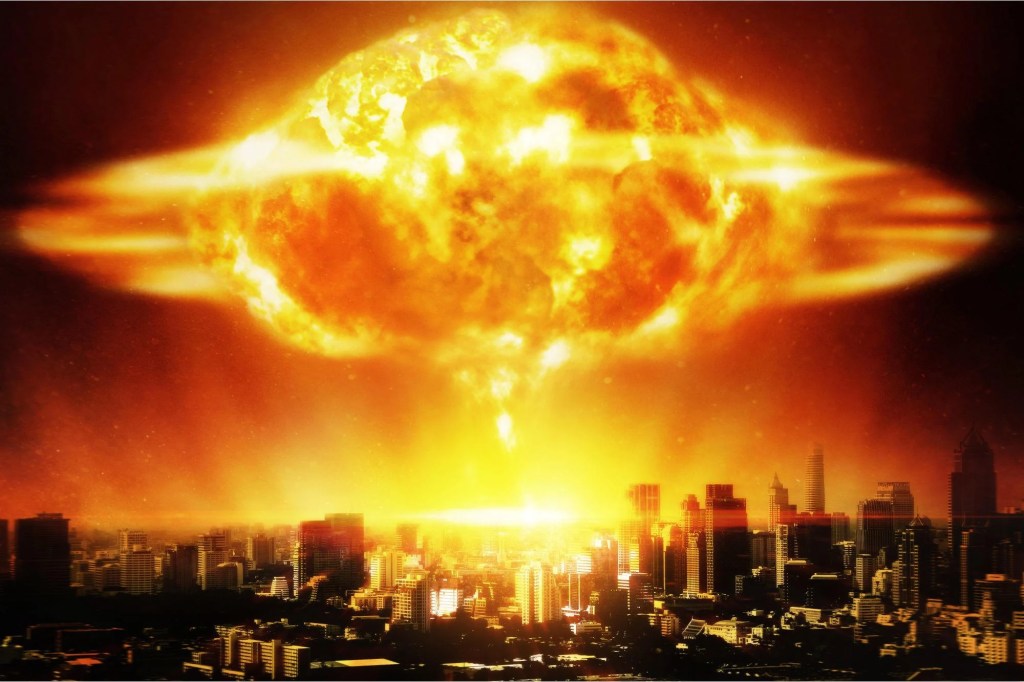
Could this be the dynamite revelation we need? That the Bomb in the Bleak House of Technic is ticking…
Essay copyright 2026 Sean Howard
Sean Howard is a poet, essayist, peace researcher and activist, and adjunct professor of political science at Cape Breton University (CBU) in Nova Scotia. He is the author with Lee-Anne Broadhead of Cultivating Perception, Countering Faust: The Radical Resonance of Goethean and Indigenous Science (Peter Lang, 2025).
Discover more from Vox Populi
Subscribe to get the latest posts sent to your email.

My daughter was born in 1971, still during the Cold War, when in schools they were limply advised to hide under their desks should the alarm go off. She often came into our bed at night, tears streaming down her face, “I don’t want to die from a nuclear bomb!” Ten years old she was. She now has a daughter of her own who’ll be 16 in April, living the digital age. And I, at almost 88, almost dared to forget that the nuclear bomb exists – until an orange madman with dementia was installed as the most powerful man on earth with blood-thirsty Wormtongues whispering into his ear.
“the very possibility of a ‘digital age’,” he insists, “requires the expansion of…destructive industrial practices to world-vanquishing extremes,” a “terminal…cannibalization of the planet in the service of prolonging the imploding ‘digital age’”. Thus, “if there is to be a livable and shared future on our planet, it will be a future offline, uncoupled from world-destroying systems and operations of 24/7 capitalism”.
LikeLiked by 2 people
Thanks, Rose Mary. I fear for the children… What have we done?
LikeLiked by 2 people