
Vox Populi
A curated webspace for Poetry, Politics, and Nature with over 6,000,000 visitors since 2014 and over 9,000 archived posts.
Woody Lewis: ‘A Stranger Comes To Town’, a novel by Lynne Sharon Schwartz
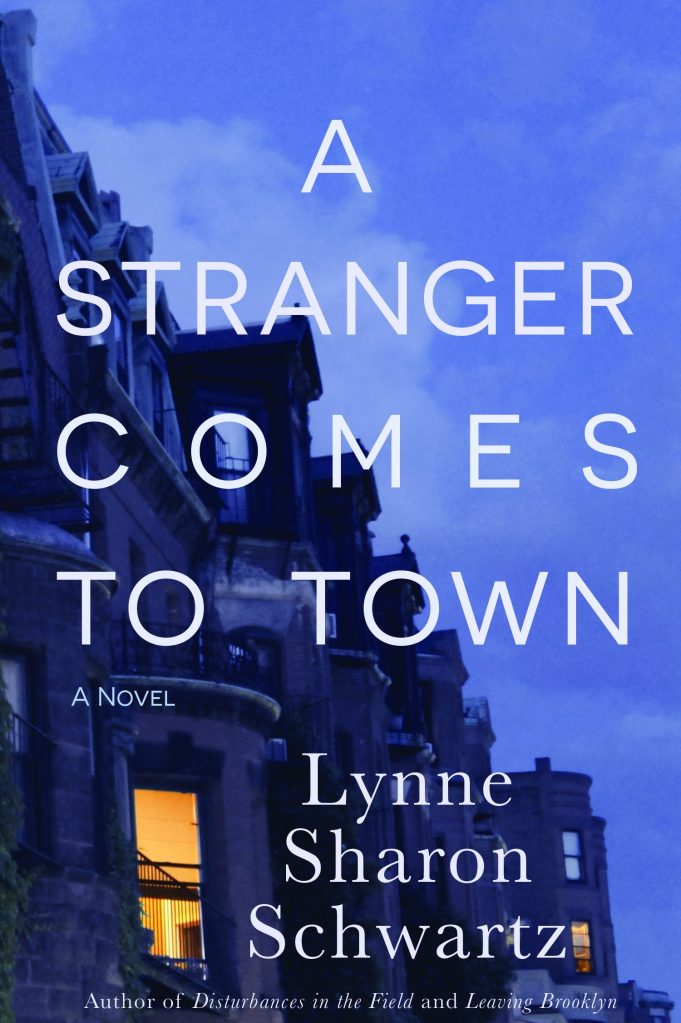
A Stranger Comes to Town by Lynne Sharon Schwartz
Release date: October 28, 2025
Eastover Press: available in paper and ebook editions.
Order here from Bookshop
~
An epigraph often suggests a theme, the writer choosing a quote from another book to establish context for her own. Lynne Sharon Schwartz begins her new novel, A Stranger Comes To Town, with Tolstoy’s maxim about plot: “All great literature is one of two stories: a man goes on a journey or a stranger comes to town.” In this latest work from master storyteller Schwartz, epigraph elevates theme to structure, presenting journey and arrival as parallel narratives.
Her protagonist makes an unreliable entrance: “At the moment I can’t offer a thorough introduction.” We understand that he is a stranger to himself, as well as to us, and we join him on his journey of self-discovery.
His birth, the start of his journey, occurs in the passive tense. “The name Joe Marzino was found in my wallet.” He relates a few facts, as if touching parts of his body after awakening from a deep sleep, and we see his surroundings as backdrop to his predicament.
He knows that he lives in a brownstone in Manhattan, that he was found unconscious on a sidewalk near Central Park. His first impression of a woman leaning over him suggests birth. She tells him that he’s in an ambulance heading to a hospital. With his permission, she opens his wallet and tells him his name. An urban consciousness seeps into his awareness. “I recognized the lilting accent. Jamaica.” “How come I recognize a Jamaican accent when I didn’t recognize my own name?”
Joe remembers that Obama is president, but his wife Norah is a mystery. When she visits him in the hospital, he confesses that he has no memory of their children. “What kind of husband was I? Were we happy together?”
Patches of recollection, physical symptoms of brain and habit, gradually reveal his persona. “Where are my cigarettes?” he asks, only to be told that he stopped smoking a year ago. Like many ex-smokers, Joe feels the craving and remembers how it felt to hold a cigarette between fingers that still smell of tobacco.
Joe is reasonable and intelligent, compassionate to the extent that his faculties have begun to return. As he leaves the hospital with Norah, she tells him that he grew up in that neighborhood, not far away on Riverside Drive. He remembers that his mother said he loved looking out his window at the river and ships. Joe wonders what happened to his mother, and this becomes part of the unfolding story.
We feel two aspects of foreboding: the first regarding what happened, the mystery of Joe’s accident, and the second regarding what might happen, the mystery arising from a conflict that gradually reveals itself.
When Joe learns that he is a TV actor, he understands the irony of his condition. “How could I take on a role when I was having trouble playing myself?” He plays a private detective named Skellings, “whose dealings with the police were ambivalent, like Bogart in his films.”
By now, we’ve grown accustomed to the narrative shifts, to the statements of fact that emerge from his ambiguous rediscovery. Joe admits to confusing himself with Skellings, a character whose fictional life reflects his own. He imagines that the scripted life is really his own: “…the biggest thing we had in common was that we had no past.”
However, Joe does have a past. His mother has been a widow for eight years, his father having been murdered in the Bronx, the body found in an empty lot. Violence runs through the parallel stories of his life and that of Skellings, his doppelgänger.
Joe’s twin sister Susan appears as another marker, her life as a gay breeder of horses on a ranch in Colorado the polar opposite of his. The story of his past solidifies, but not his belief in its accuracy.
A Stranger Comes To Town benefits from Schwartz’s critical work on the narrative aspect of memory. The structure of her novel reflects her study of characters who seek to fill the gaps in their histories. In the introduction to The Emergence of Memory: Conversations with W.G. Sebald, an anthology of essays, she describes the protagonist of Sebald’s novel Austerlitz as “driven to solve the mysteries of his lost past.”
Unlike the intimate recounting of Schwartz’s first person narrator, Sebald’s anonymous third person creates a sense of distance. Jacques Austerlitz, an architectural historian, has memories triggered by travel to foreign locations, while Joe pursues his past without leaving the island of Manhattan. Sebald’s protagonist has repressed his memories, which emerge as he travels and converses with the narrator. Schwartz’s protagonist has temporary amnesia that impairs his recollection of repressed events. In both cases, despite the effort to assemble memories into a cohesive history, some remain unresolved.
Joe’s recovery accelerates as he prepares to return to his acting job. He receives a new script about a suspicious husband. “So have we been faithful?” he asks one night after sex with Norah. “For the most part,” she answers.
The pieces of his life come together, albeit without restored memory. He meets his mother, and then his sister, and discovers more fragments from his past. “My life now is made of the stories people tell me… Together, they are creating a character, not even as well-rounded as Skellings. A character I’m not sure I like…”
Through twists and turns – real, in Joe’s world, and fictive in Skelling’s – we find our way to the denouement, a sequence meant to tie up loose ends. In reality, those loose ends form a knot that separates this story from threads leading to an indeterminate future. As a parting gesture, Joe provides an epilogue:
“I offer these details partly to reassure myself that my life has its narrative and characters who appear and reappear and play their assigned roles as in ordinary lives. The same goes for Skellings… I’m fortunate: he’s an easy role to play, and I hope he continues into the unforeseeable future.”
Copyright 2026 Woody Lewis

Woody Lewis is the author of Three Lost Souls: Stories about race, class and loneliness (Gotham Lane, 2016). He has published work in the Southampton Review, the Los Angeles Review of Books, CONSEQUENCE magazine, AGNI Online and FastCompany.com. He has an M.F.A. from the Bennington Writing Seminars, as well as a B.A. and an M.B.A. from Columbia University.
Discover more from Vox Populi
Subscribe to get the latest posts sent to your email.

I may have to read this for the first time several times. Perhaps in the character, I will discover how to live for each new Groundhog Day, damn stroke.
LikeLike