
Vox Populi
A curated webspace for Poetry, Politics, and Nature with over 6,000,000 visitors since 2014 and over 9,000 archived posts.
William Blake and Catherine Boucher: Four Images from The First Book of Urizen
The First Book of Urizen by William Blake is a mythological creation story, a Gnostic parody of Genesis, where the tyrannical deity Urizen (representing cold, oppressive Reason) separates from divine unity to create a restrictive world of law, matter, and sin, trapping humanity in a “Net of Religion” and physical limitation, with the imaginative artist Los and rebellious energy Orc emerging as forces against this enslavement. The book critiques Enlightenment rationalism and dogma, showing creation as a fall from infinite possibility into a world of suffering, countered only by imagination.
Preludium to the Book of Urizen
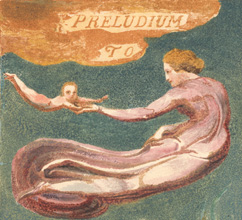
But the wrenching of Urizen heal’d not
Cold, featureless, flesh or clay
Rifted with direful changes
He lay in a dreamless night
Till Los rous’d his fires affrighted
At the formless, unmeasurable Death.
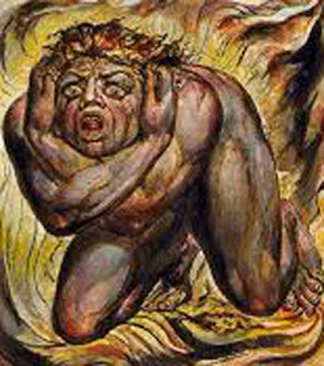
The pangs of hope began,
In heavy pain striving, struggling.
Two Ears in close volutions,
From beneath his orbs of vision
Shot spiring out, and petrified
As they grew. And a fourth Age passed
And a state of dismal woe.
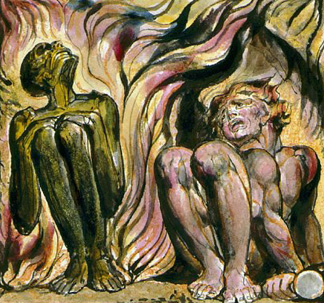
The globe of life-blood trembled
Branching out into roots:
Fib’rous, writhing upon the winds:
Fibres of blood, milk and tears:
In pangs, eternity on eternity.
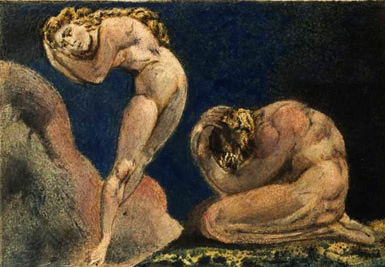
At length in tears & cries imbodied,
A female form trembling and pale
Waves before his deathy face.
All Eternity shudder’d at sight
Of the first Female now separate
Pale as a cloud of snow
Waving before the face of Los.
Text and images from Voetica.
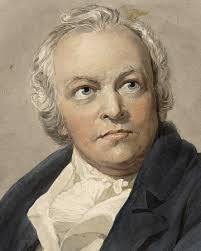
William Blake (1757 – 1827) was an English poet, painter, and printmaker. Largely unrecognized during his life, Blake has become a seminal figure in the history of the poetry and art of the Romantic Age. What he called his “prophetic works” were said by 20th-century critic Northrop Frye to form “what is in proportion to its merits the least read body of poetry in the English language”. He produced a diverse and symbolically rich collection of works, which embraced the imagination as “the body of God“ or “human existence itself”.
Although Blake was considered mad by contemporaries for his idiosyncratic views, he came to be highly regarded by later critics and readers for his expressiveness and creativity, and for the philosophical and mystical undercurrents within his work. A theist who was hostile to almost all forms of organized religion, he was influenced by the ideals and ambitions of the French and American Revolutions. The 19th-century scholar William Michael Rossetti characterized him as a “glorious luminary”, and “a man not forestalled by predecessors, nor to be classed with contemporaries, nor to be replaced by known or readily surmisable successors”.
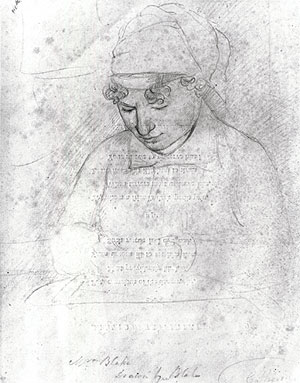
Collaboration with his wife, Catherine Boucher (1762 – 1831) was instrumental in the creation of many of Blake’s books. Boucher worked as a printmaker and colorist for his works. “For almost forty-five years she was the person who lived and worked most closely with Blake, enabling him to realize numerous projects, impossible without her assistance. Catherine was an artist and printer in her own right,” writes literary scholar Angus Whitehead.
[bios adapted from Wiki]
Discover more from Vox Populi
Subscribe to get the latest posts sent to your email.

Jerusalem by William Blake. Unofficial national anthem of England
And did those feet in ancient time,
Walk upon Englands mountains green:
And was the holy Lamb of God,
On Englands pleasant pastures seen!
And did the Countenance Divine,
Shine forth upon our clouded hills?
And was Jerusalem builded here,
Among these dark Satanic Mills?
Bring me my Bow of burning gold:
Bring me my Arrows of desire:
Bring me my Spear: O clouds unfold:
Bring me my Chariot of fire!
I will not cease from Mental Fight,
Nor shall my Sword sleep in my hand:
Till we have built Jerusalem,
In England’s green & pleasant Land.
We are a long way from Blake’s mystic Jerusalem these days. More the dark Satanic Mills.
Google the three words “Blake Jerusalem Proms” to hear a live performance of the musical version by Elgar
LikeLiked by 1 person
Thanks, Jim.
>
LikeLike
Yes. Thank you for bringing this. His figures have such vitality and luminosity. His insights are so brilliant. He is still way ahead of the times. Yes to Heroic Figure.
LikeLike
Thanks, Owen. I agree!
>
LikeLike
He seems to have written for today.
LikeLiked by 2 people
Thanks, Rose Mary. I’ve often thought the same thing. The dedication to unbridled reason has given us institutions like factory farming, AI and trillion dollar military budgets. Art, poetry, music and love of nature have been shoved aside.
>
LikeLiked by 3 people
Blake is one of my heroes, certainly the most original, idiosyncratic and brilliant of the Romantic poets.
LikeLiked by 1 person
He was mine as well — I spent much time in graduate school with Blake and his world! I have written some about this, and may write more!
LikeLike
Great! The cover of my new novel The Hummingbird War has a detail from one of Blake’s prints.
LikeLike