
Vox Populi
A curated webspace for Poetry, Politics, and Nature with over 6,000,000 visitors since 2014 and over 9,000 archived posts.
Philip Levine: The Poem of Chalk
On the way to lower Broadway
this morning I faced a tall man
speaking to a piece of chalk
held in his right hand. The left
was open, and it kept the beat,
for his speech had a rhythm,
was a chant or dance, perhaps
even a poem in French, for he
was from Senegal and spoke French
so slowly and precisely that I
could understand as though
hurled back fifty years to my
high school classroom. A slender man,
elegant in his manner, neatly dressed
in the remnants of two blue suits,
his tie fixed squarely, his white shirt
spotless though unironed. He knew
the whole history of chalk, not only
of this particular piece, but also
the chalk with which I wrote
my name the day they welcomed
me back to school after the death
of my father. He knew feldspar,
he knew calcium, oyster shells, he
knew what creatures had given
their spines to become the dust time
pressed into these perfect cones,
he knew the sadness of classrooms
in December when the light fails
early and the words on the blackboard
abandon their grammar and sense
and then even their shapes so that
each letter points in every direction
at once and means nothing at all.
At first I thought his short beard
was frosted with chalk; as we stood
face to face, no more than a foot
apart, I saw the hairs were white,
for though youthful in his gestures
he was, like me, an aging man, though
far nobler in appearance with his high
carved cheekbones, his broad shoulders,
and clear dark eyes. He had the bearing
of a king of lower Broadway, someone
out of the mind of Shakespeare or
Garcia Lorca, someone for whom loss
had sweetened into charity. We stood
for that one long minute, the two
of us sharing the final poem of chalk
while the great city raged around
us, and then the poem ended, as all
poems do, and his left hand dropped
to his side abruptly and he handed
me the piece of chalk. I bowed,
knowing how large a gift this was
and wrote my thanks on the air
where it might be heard forever
below the sea shell’s stiffening cry.
~~~~
Copyright 2014 Philip Levine. From The Simple Truth (Knopf, 2014).
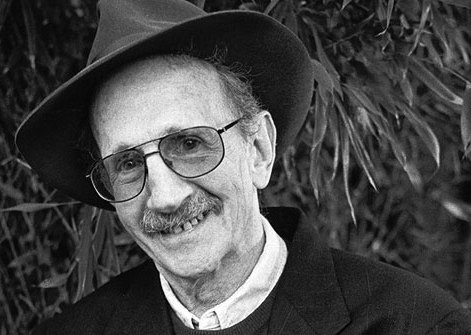
Philip Levine (1928 – 2015) was best known for his poems about working-class Detroit. He taught for more than thirty years in the English department of California State University, Fresno and held teaching positions at other universities as well. He served on the Board of Chancellors of the Academy of American Poets from 2000 to 2006, and was appointed Poet Laureate of the United States for 2011–2012. [adapted from Wiki]
Discover more from Vox Populi
Subscribe to get the latest posts sent to your email.

I love Levine’s poetry. We just read the poem “What Work Is” in my poetry class. I miss that guy. I’m glad we have his poems to keep his world with us.
LikeLike
I love that poem of Phil’s as well.
>
LikeLike
Great to see this poem from one of the greats. Charles ________________________________
LikeLike
Yes, he is!
>
LikeLike
I echo the thanks to Margo for her brilliant comments — I love Phil Levine, was lucky enough to go to at least 20 readings of his when Kurt and I lived in NY. And each time, every single time, I was amazed by his true, absolute authenticity & love & pride for the working class. He also had a wicked sense of humor — and when he and Jerry Stern would share a reading together: oh my, the fireworks!
LikeLike
Thanks, Laure-Anne!
>
LikeLike
Loved listening to the video
LikeLiked by 2 people
me too!
LikeLiked by 1 person
Such a gorgeous poem. Levine is one of my all-time favorites and I know no other poet who reads their own poems so beautifully. His readings often give me the shivers. Thank you for posting.
I did some digging and found a video of him reading this poem. He starts at 2:32.
LikeLiked by 3 people
Thank you, Tony.
>
LikeLiked by 1 person
A favorite poet at the height of his powers.
In his hands, a poem about chalk is not merely an amiable tale, but a blessing to us readers, and to the giver of the chalk. To me, it hints at resilience and enduring pain, while finding meaning in this little culture the two people created through their dialogue. This was true of many others of his poems as well.
Thanks for this poem. Levine did good work, and still matters.
LikeLiked by 3 people
One of our best poets.
LikeLiked by 2 people
Long a favorite of mine.
LikeLiked by 2 people
The mind’s picture so clearly drawn, I almost felt the chalk in my hand. Thank you.
LikeLiked by 3 people
This poems is perfect in its simplicity. I am there, I see the man, regal and elegant, reciting a poem to the chalk. Levine transforms that moment into a magical event. I want to be there.
LikeLiked by 4 people
‘Levine transforms that moment into a magical event.’ Exactly. Thank you, Rose Mary.
>
LikeLiked by 1 person
Sometimes, when I read a poem by Philip Levine, I am so staggered and awed, so dazzled by the brilliant simplicity that I have to read the piece over and over, aloud but to myself, until all the elements of the piece click into place and I am left with nothing but gratitude for the gift. “thanks on the air” indeed.
LikeLiked by 3 people
Thanks, Annie. Well-said. I feel the same way about his poems.
LikeLiked by 3 people
One of my Phil favorites, wonderful to read not long after his birthday.
LikeLiked by 2 people
He was great. Such clarity and passion.
>
LikeLiked by 2 people
Thank you for this one, at this moment.
LikeLiked by 2 people
Thanks, Thomas.
>
LikeLiked by 1 person
How he gets us to his school’s chalkboard opens everything so much wider.
LikeLiked by 4 people
Yes!
>
LikeLiked by 1 person
Oh yes this is so wonderfully complete, has that nuance of a stream flowing at such careful pace through its banks of the soul. He was nothing if not soulful. The poem makes us all complete this morning and able to go on about our day full of the thing we’d otherwise for lack of, be dying.
LikeLiked by 4 people
Poetry gives its gifts in small gatherings of words to feed our starving hearts… a few days ago here… Sean Sexton said of the words for the goats… “Only children and angels would say such a thing.” Today, Philip Levine ends with “my thanks on the air/where it might be heard forever/ below the sea shell’s stiffening cry.”… And as Shakespeare whispered for us…”such things as dreams are made of…”… May the invisible be written in air and in chalk and in chant and in french and other tongues… even in such dark days as ours.
LikeLiked by 6 people
So beautifully said Margo!
LikeLiked by 2 people
Thank you for this wisdom, Margo!
>
LikeLiked by 1 person
Thanks for this, Margo.
LikeLiked by 1 person