
Vox Populi
A curated webspace for Poetry, Politics, and Nature with over 6,000,000 visitors since 2014 and over 9,000 archived posts.
Joanne Durham: The Pulaski Skyway, 1970
I drove that massive maze, high as its trusses,
to make it out of New Jersey to New York’s smoky clubs,
to sit a table away from musicians soon to be stars.
You had to trust your gut to maneuver over that shoulderless
bridge in a banged up blue Ford Falcon
with its sticky clutch I could barely shift into gear,
looping over and under concrete cloverleafs someone
in the 1930s designed with a skewed view of sanity. I should
have guessed they’d name it after a hero who lost
his life in the Revolutionary War – remembering
how we jumped from war to war in US History, no bridge
to understand what flowed between. Outside
of classrooms I learned battles weren’t always won
by the righteous, boys I knew were drafted to fight a war
none of us supported. Never mind I couldn’t pick
a guitar string or hear an A flat from a C, I fantasized
a rock band named The Pulaski Skyway,
loved the rush, the feeling my friends and I thought
was freedom. Fear blasted out rolled down windows
into frosty night air, riding something called
a skyway, close to moon and stars we still believed in.
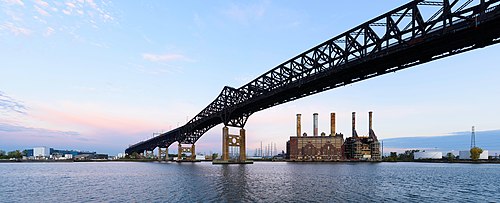
~~~~
First published in Pinesong: Awards 2025, NC Poetry Society, ©Joanne Durham
Joanne Durham is the author of To Drink from a Wider Bowl (Evening Street Press 2022), winner of the Sinclair Poetry Prize, and the chapbook, On Shifting Shoals (Kelsay Books 2023). She lives on the North Carolina coast, with the ocean as her backyard, muse, and source of equanimity in difficult times.
Discover more from Vox Populi
Subscribe to get the latest posts sent to your email.

A fine poem that other commentators have spoken of brilliantly.
An aside. Recent interest in the American Revolution has reminded people of the famous Old North Bridge in Concord, MA, where Emerson later wrote of the shots heard round the world, i.e. the start of U.S. Revolutionary War combat. Much has been written surrounding that bridge. There is still debate about where exactly the bridge stood, etc. After the War, James Russell Lowell, the poet, wrote about the two British soldiers who died there:
James Russell Lowell’s 1849 poem, “Lines, Suggested By the Graves of Two English Soldiers On Concord Battle-Ground:”
They came three thousand miles and died
To keep the past upon its throne:
Unheard, beyond the ocean tide,
Their English Mother made her moan.
Often bridges have different ideologies at their opposite ends. The tales those bridges have to say are thus told differently, and a bridge of peace often has an asterisk beside the word peace*, with a distinct interpretation on either entrance (or is it exit?).
LikeLike
Wow. I don’t know the bridge but I learned “how we jumped from war to war in US History, no bridge
to understand what flowed between.” The era when the guy I had a crush on was in Ñam saying what he would do to those who opposed the war as I was becoming one of them.
LikeLiked by 1 person
Thank you for sharing this painful memory, Barb.
>
LikeLiked by 1 person
An outstanding poem of many layers, masterfully knitted together. A terrific example of show, don’t tell.
LikeLiked by 2 people
Yes!
>
LikeLike
It is marvelous how this poems becomes a meditation on the US war machine, the constant wars that have “no bridge/to understand what flowed between.” And it makes an effort toward redemption, “close to moon and stars we still believed in.” Though it feels like it’s receeding from us, cast, as it is, in the past tense, is, as Sean Sexton put it, an “elegy for old days.” And I have the added personal connection that the Pulaski Skyway is only about 5 minutes from my house; I travel over it regularly. Thank you for this one.
LikeLiked by 4 people
Thanks, Mike. I love your comments — so generous and intelligent.
>
LikeLiked by 3 people
Sean Sexton writes: What a lovely poem/ elegy for old days (my days in part) and the American war dilemma: we’re alternately good and terrible at it! been so from the start! and the secret undercurrent of any civilization: Art—our bridge to true sanity and redemption. What a culture of fools we comprise!
LikeLiked by 4 people