
Vox Populi
A curated webspace for Poetry, Politics, and Nature with over 6,000,000 visitors since 2014 and over 9,000 archived posts.
M. C. Benner Dixon: Will Pull Weeds for Cash
It was a good summer job for a college kid. A quick drive down Old Plains Road, past the AT&T tower, and pull in at one of the innumerable fieldstone farmhouses nestled among the Pennsylvania back roads of the Upper Perkiomen Valley. Elaine would be waiting for me with my tools—a small trowel, a garden rake, a forked dandelion weeder—and a bucket for the weeds.
We would say our good mornings, and soon I would be kneeling in the dewy grass beside whichever bed Elaine had indicated, waiting on my heels while she delivered the day’s lecture. My tutelage in gardening was not officially part of the arrangement, but she was very particular about how I weeded, and so we spent many a morning with her explaining how I should insert the weeder an inch or so away from the base of the dandelion and plunge it halfway to the handle before levering the weed free. For every errant weed, I was to shift the mulch aside, remove the plant along with its roots, shake the dirt off, resettle the soil, and replace the mulch. I was not to place the weeds on the ground but into the bucket. She did not want to see dead weeds strewn around when I was through with the bed. She was very proud of her gardens.
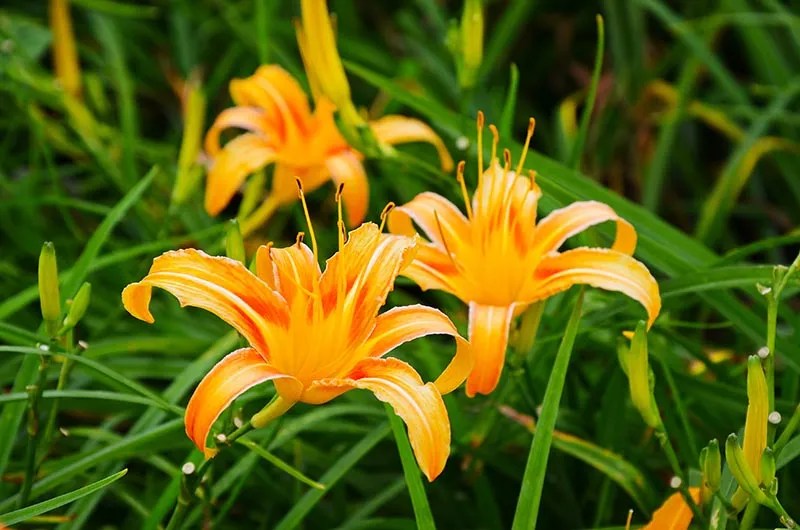
Elaine’s foremost passion was daylilies, and most of the garden beds were given entirely over to their reign. It was not hard to identify the weeds poking up between graceful clusters of elongated leaves. My lessons could have been reduced to one very simple heuristic: Not a daylily? Pull it out.
Now and then, Elaine would sic me on one of the few beds by the house where she permitted a few forget-me-nots, foxgloves, echinaceas and other lesser dignitaries to grow. On those days, her morning lecture would consist of her pointing out every garden plant one by one, sometimes quizzing me on their names, sometimes holding forth on their growing habits and peculiarities. Once properly instructed, I could begin weeding.
The lessons on weed identification weren’t really necessary. In my twenty years on earth, I had spent uncountable hours trailing my mother as she puttered in the yard, helping her weed and plant and haul mushroom soil to dress the beds. My parents had built our house on a windy, shale-rich hilltop. By their efforts, the property had gone through a transformation, and now the house was nestled between beds of mums and hostas and black-eyed Susans. Elaine, who knew my parents, was fully aware of this. She would often, when lecturing me, refer to my mother as if she were standing there beside her, backing her up on whatever point she was making. “Priscilla would tell you the same thing. Take your eye off that mint for a moment, and it will take over.” One day, she sent me home with a division of one of her prized daylilies as a gift for her imagined co-conspirator. Its name was “Priscilla’s Rainbow.”
The point is, I knew my johnny-jump-ups from my wood sorrel, my daisies from my fleabane. I could spot poison ivy at twenty paces and knew the difference between its leaves and Virginia creeper. But Elaine was paying me by the hour, so I figured the time was hers to spend as she wanted. I sat on my heels and listened.
Sometimes, if her back was hurting and she had not already done it by the time I got there, Elaine would have me deadhead the daylilies before I got to weeding. This, too, became a lesson, of course. She walked the beds with me, pointing out tomorrow’s bud and yesterday’s spent flower, warning not to pick the former by accident. The difference between bud and withered bloom was stark, and I had no trouble distinguishing between them. As the name implies, each daylily blossom only lasts one day. The outer petals of the buds remain sealed into a long, tight rod about the length of an index finger. The dead flowers wilt and go soggy, the tips of the petals splaying outward. I was to cut the dead head with my thumbnail, pinching at the stem so that I didn’t crack off unbloomed buds and spoil the next day’s beauty.
Elaine had a policy of deadheading every day. If the plant started setting up fruit, its energy would go into that work instead of producing more flowers. If tended correctly, some of the seventy or so varieties of daylilies around the property could bloom all summer. Elaine explained all this as we walked among the flowers in their purples and pastels, sherbets and scarlets. Some were double blossoms. Some had ruffled petals. Others had throats like receding tunnels that bore a different color from the rest of the flower. She had name plates beside each one. “Cranberry Feast.” “Rare Love.” “Scintillation in Pink.” It reminded me of a museum or a library.
Eventually, Elaine would wrap up the lecture and go inside, and I would get to my work for the day. Chickadees and juncos would be my main source of company from that point on, chatting to each other amiably behind my bent back. Now and then, a truck would pass on the road, and the driver would lift a finger from the steering wheel to greet me. I moved around between the beds of lilies and their lesser neighbors. I filled my bucket, deposited it in the appropriate receptacle, and went back for more.
After that summer, I could not see a daylily—even one so mundane as a Stella D’Oro or a plain orange ditch lily—without thinking of Elaine. She was on my mind quite frequently the summer after my first year of teaching. I had gotten work for the season with a landscaper based in Castle Shannon, three hundred miles due west of Elaine’s stone house.
Like Elaine, my new boss Tom had a habit of beginning the day’s work with a lesson of some kind, though Tom preferred that we lecture him rather than vice versa. He was a stocky Italian American man with a quick laugh and a boisterously co-dependent family who would call him innumerable times throughout the day to tattle on each other, gossip, and fight. Tom was possessed of an innately curious mind, and he had a habit of hiring rather scholarly types to his crew. One of my coworkers was a doctoral candidate researching white supremacy in Western Pennsylvania. I had been accepted into a graduate program in English literature and would start in the fall. He looked to us to provide a mental appetizer at the beginning of his workday. We spent the early mornings in Tom’s living room talking through current events and culture wars before picking up our leaf blowers and rakes and heading to the worksite. He always paid us for our time, no matter how long he kept us there.
Tom took his turn as teacher, too. Though it may be more accurate to call him an un-teacher. More often than not, he was undoing my lessons from Elaine. My first day on the job, he caught me carefully shaking the dirt off the roots of a thistle and stopped me.
“First of all, you don’t want any of those roots to break off and get back in the beds, because it’s just going to regrow. Even a tiny bit of root—” he held his fingers about a quarter inch apart— “can turn into a new plant.” This is true, by the way. I looked it up later. “Second, you’re going to be here all day if you do it that way. Just pull it and move on.”
He had a point. My job was not the same as it had been when I was working for Elaine. Whereas Elaine was tending a sanctuary, Tom was running a business. Tom urged us to mow, blow, weed, and mulch as efficiently as possible so that we could be on to the next house.
It took me a while to adjust, but soon I replaced Elaine’s rules with Tom’s. So this is what it meant to be a tender of gardens. You must establish rules to guide you: how high, how far apart, how varied should the garden plants be? And you must correct anything that strays from that plan. Gardeners and landscapers, I was learning, are people who exert their will over a piece of the earth. This desire is supported with countless hours of labor and an entire industry of garden centers and gardener’s catalogues to feed an interest in making the plants around us look the way we want them to. If we stop, we fail. The garden goes wild, overrun by bindweed, and the homeowner’s association sweeps in with citations.
Given how easily gardens sink into chaos without a guiding hand, I have always wondered why wild places aren’t more unkempt. The wilderness hardly resembles a manicured arboretum, but there is an orderliness to it. If I let my garden go for one season, it is an explosion of pokeweed, garlic mustard, and thistles. It looks nothing like an untamed meadow, with its wildflowers and soughing grasses dipping in the breeze under well-spaced trees. Every week, the gardeners and landscapers of the world spend countless hours beating back the encroachment of garden weeds. Who beats them back from the meadows? Why isn’t the whole world strangled by weeds? How is it that I had to weed every day to defend Elaine’s daylilies from strangulation, but drive down a Pennsylvania road on almost any day in June, and you’ll pass bank after bank of bright orange flowers, thriving without any intervention whatsoever. The same can be said of blazing star, columbine, bluebells, phlox, aster, and wild geranium. Where are the weeds?
I have turned to a new teacher to find the answer: the slow and persistent lectures of nature herself. I have learned that wild spaces have their own system of weed management. Newly disturbed soil invites a very particular kind of plant—including the thistles and pokeweed and bindweed that I have seen in my own garden beds. I, it turns out, am a boon to the plants I so dislike. These weeds grow quickly and easily and produce a great deal of seeds. Their aggressive roots hold loose soil in place, and when their stalks fall or are trampled, they add their borrowed nutrients back to the soil. The typical home gardener creates the perfect environment for these weeds. We disturb the soil. We clear it and dig it and turn it over, keeping it in a perpetual state of starting over. From the perspective of the plants trying to grow in our gardens, we are an ever-collapsing riverbank, an endless landslide, a storm-toppled tree that falls over and over, exposing soil to the sun. And once we stop digging, the weeds come and do their work to halt erosion and replenish the soil following its apparent disaster. But their time is short-lived.
Even nature can only tolerate weeds for so long. The meadow forms, and the component plants establish a give and take that is less hospitable to the pokeweed and the stinging nettle than the bare earth was. Their cycle eventually gives way to more bushy growth. The bushes to pines. The pines to oaks. And we have our forest. When a fire sweeps through after a dry summer, the thistles are ready to spring up from the razed ground and start the process over.
So yes, weeds have their niche in a healthy ecosystem—I pull them out anyway. I am not one of those people who gets defensive of weeds. I don’t feel sentimental about them at all. In fact, for certain weeds (namely, crown vetch, bindweed, and whatever that ridiculously spiky one is that keeps coming up in my back garden no matter how many times I dig it out by the roots), I harbor nothing less than hatred. Understanding their ecological value doesn’t redeem them for me. I know that I garden like a landslide, but I am a landslide with opinions about what should come out and what should be spared. Though I mostly weed on my own account these days, I still accept money, from time to time, to pull unwanted plants from other people’s gardens. I do so without a pang of moral uncertainty. I would willingly profit from the demise of weeds on any day of the week.
But I hold my idea of weeds loosely. The name “weed” is relational—like “brother” or “neighbor.” It doesn’t apply to everyone in the same way. It may not always apply with me and my weeds, just like Elaine and Tom can no longer be called my “boss” because neither of the pays me anymore to follow their rules of gardening. One day, after the world has fallen to disaster, I may see a stand of garlic mustard in what used to be a city park. I will celebrate, knowing that this plant, once topping my list of weeds, is edible and nutritious. But these days, when I am walking in the still-preened park, I yank it out and leave it by the path. When it springs up in my garden, I will pull it out. I am, for the moment, free to call edible things weeds, and so I do, because the garlic mustard is stealing light and nutrients away from my string beans, which I planted from a paper envelope and nurtured from the time they were sprouts.
Tell me the relationship between a human and the earth, and I can tell you what their weeds are. Elaine’s relationship with her garden was one of curation and precision. Her weeds were numerous and encompassed anything that wasn’t a daylily with a pretty name. She would have had me pull a rosebush out, if it had dared to grow in those sacred beds. For Tom’s clients—homeowners in well-to-do neighborhoods and business owners with neat shrubs and edged beds—their little bit of land was part of their reputation; their gardens had to be kept primly within expectations. They wouldn’t have tolerated the lanky goldenrods that I let grow in front of my house, even though they make the autumn bright. A farmer needs their farm to bring in money, so their weeds are any plants that deplete their year-end yield. Some people have no weeds.
As for me, my weeds are many. I come to the garden to learn and unlearn. I come to practice the lessons that have been taught to me by my mother and my other instructors—and to toss them away like last year’s pumpkin vines that turn to soil in the compost heap. I come to find new teachers. I teach myself sometimes. I want a hundred, thousand chances to start over in bare soil. And if I have to fight a purple-headed thistle to get my way, I will.
Copyright 2025 M. C. Benner Dixon

M.C. Benner Dixon is the author of The Height of the Land, winner of the Orison Fiction Award and Millions of Suns: On Writing and Life with Sharon Fagan McDermott (University of Michigan Press, Writers on Writing Series). Dixon lives in Pittsburgh.
Discover more from Vox Populi
Subscribe to get the latest posts sent to your email.

I spent a lot of time converting grass to native plants and labyrinth in back. No longer can spend much time gardening, but it mostly takes care of itself. The pollinators are now the gardeners
LikeLike
Cool
>
LikeLiked by 1 person
I am smiling. Just LOVE it. And share some of the experiences.
LikeLiked by 1 person
Life as seen through lessons about the garden: first by a lovely obsessive, next by a kindly businessman, then by nature itself. And lessons keep being learned and challenged throughout life, and not just about gardens and weeds. This is one of those “feel-good” articles we all need from time to time.
LikeLiked by 1 person
A feel good article that has depth and resonance. I love M.C.’s essays.
>
LikeLiked by 1 person