
Vox Populi
A curated webspace for Poetry, Politics, and Nature with over 6,000,000 visitors since 2014 and over 9,000 archived posts.
Tony Hoagland: Sweet Ruin
Maybe that is what he was after,
my father, when he arranged, ten years ago,
to be discovered in a mobile home
with a woman named Roxanne, an attractive,
recently divorced masseuse.
He sat there, he said later, in the middle
of a red, imitation-leather sofa,
with his shoes off and a whisky in his hand,
filling up with a joyful kind of dread–
like a swamp filling up with night,
—while my mother hammered on the trailer door
with a muddy, pried-up stone,
then smashed the headlights of his car,
drove home,
and locked herself inside.
He paid the piper, was how he put it,
because he wanted to live,
and at the time knew no other way
than to behave like some blind and willful beast,
—to make a huge mistake, like a big leap
into space, as if following
a music that required dissonance
and a plunge into the dark.
that is what he tried to tell me,
the afternoon we talked,
as he reclined in his black chair,
divorced from the people in his story
by ten years a heavy cloud of smoke.
Trying to explain how a man could come
to a place where he has nothing else to gain
unless he loses everything. So he
louses up his work, his love, his own heart.
he hails disaster like a cab. And years later,
when the storm has descended
and rubbed his face in the mud of himself,
he stands again and looks around,
strangely thankful just to be alive,
oddly jubilant—as if he had been granted
the answer to his riddle
or as if the question
had been taken back. Perhaps
a wind is freshening the grass,
and he can see now, as for the first time,
the softness of the air between the blades. The pleasure
built into a single bending leaf.
Maybe then he calls it, in a low voice
and only to himself, Sweet Ruin.
And maybe only because I am his son,
I can hear just what he means. How
even at this moment, even when the world
seems so perfectly arranged, I feel
a force prepared to take it back.
Like a smudge on the horizon. Like a black spot
on the heart. How one day soon,
I might take this nervous paradise,
bone and muscle of this extraordinary life,
and with one deliberate gesture,
like a man stepping on a stick,
break it into halves. But less gracefully
than that. I think there must be something wrong
with me, or wrong with strength, that I would
break my happiness apart
simply for the pleasure of the sound.
The sound the pieces make. What is wrong
with peace? I couldn’t say.
But, sweet ruin, I can hear you.
There is always the desire.
Always the cloud, suddenly present
and willing to oblige.
~~~~
Copyright 1993 Tony Hoagland from Sweet Ruin (University of Wisconsin, 1993).
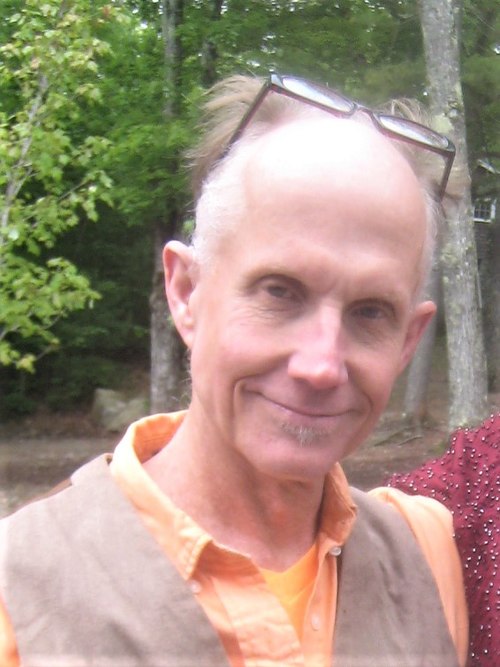
Tony Hoagland, author of eight full-length poetry collections, was born in Fort Bragg, North Carolina in 1953. His father was an Army doctor, so Hoagland grew up on various military bases in Hawaii, Alabama, Ethiopia, and Texas. He had an older sister and a twin brother who died of a drug overdose in high school. He was educated at Williams College, the University of Iowa (B.A.) and the University of Arizona (M.F.A.). According to the novelist Don Lee, Hoagland “attended and dropped out of several colleges, picked apples and cherries in the Northwest, lived in communes, followed the Grateful Dead and became a Buddhist.” He taught in the University of Houston creative writing program. He was also on the faculty of the low-residency Warren Wilson College MFA Program for Writers. Hoagland was married to Kathleen Lee, author of fiction, essays and travel writings. They had no children. He died in Santa Fe, New Mexico on October 23, 2018 from pancreatic cancer at the age of 64. [adapted from Wiki]
Discover more from Vox Populi
Subscribe to get the latest posts sent to your email.

I miss Tony and am so grateful for every one of his books. I’m teaching three of his essays from Real Sofistikashun this semester. I had him sign Donkey Gospel for my son who had just received his black belt in Kung Fu. Tony wrote, “Welcome to manhood, dude” 🙂
LikeLike
Cool.
>
LikeLike
God, I miss Tony. He was the most beautiful cantankerous being. The world so needs poets like him. My undergraduate workshop just read his essay “Are you still writing about your father?” and the poem “Benevolence.” The students loved both. My assistant was his student at Houston, and I taught there at his invitation. We all felt his presence. What a poet.
LikeLiked by 6 people
Thanks, Barbara. There are only a handful of poets writing today who will be read by future generations. I’m betting Tony Hoagland will be one of them.
>
LikeLiked by 2 people
Agreed on missing this man. I also taught “Benevolence” because it’s a gem. He was a gem.
LikeLike
Everyone has said it all . . . One of my favorite teachers and writers. Tony’s heart was huge! (I remember when he banned the mention of rainbows in poems and I’ve never put one in since.) 😂
LikeLiked by 2 people
He would have loved it if you had taken up the gauntlet and only written about rainbows!
LikeLike
Gah! So good. I know Tony had his moments but my gods he wrote great poems & essays. This: “I think there must be something wrong
with me, or wrong with strength, that I would
break my happiness apart
simply for the pleasure of the sound.
The sound the pieces make. What is wrong
with peace? I couldn’t say.
But, sweet ruin, I can hear you.”
LikeLiked by 2 people
Tony had his moments, but he wrote great poems. Yes. His aggravating moments consisted of saying unspeakable truths with wit and imagination.
>
LikeLiked by 5 people
yes, I so agree!
LikeLiked by 2 people
What a wonderful tale to tell, Sean. I so love Tony Hoagland’s work. Came to it late, not steeped in American poetry and poets. This particular poem strikes me as a keen observation of man’s self-destructive instincts, wanting more, and more of the secret, with the instinctive knowledge that there must be something behind the mirror.
“that I would
break my happiness apart
simply for the pleasure of the sound.
The sound the pieces make. What is wrong
with peace?”
LikeLiked by 2 people
The musicality of the poem pours out as true genius. The central idea raises the ante on all sorts of thoughts and wonderings, and debate. I would have given much to dive into a bar or ridden a farm wagon with the man and his poetic cronies. Jocularity and solemnity twinned together. His poem Sweet Ruin is an attitude adjuster for today.
I also enjoy how the central moment of the poem is heightened by being only a four line stanza, while all the rest are five. It had me re-reading that deviation to see why he did that.
The essay written by poet Mike Schneider, and linked to above by Vox Populi, called Rain-Father of Narcissism & the Inner Tyrant is a gem of poetically inspired praise, and a deep dive into Tony Hoagland’s “sofistikated” play with the poetic world and his gropings with masculinity. We need another Hoagland in today’s narcissistic, unsweet ruin of a world.
LikeLiked by 3 people
Agree! Agree! Agree! Thanks, Jim. Tony lifted tragic irony to the level of genius.
>
LikeLiked by 2 people
Thank you & thanks again for mentioing my essay, (two of them actually) which VP linked at the end of this poem. Tony taught at the University of Pittsburgh for a period, a year or so, mid-to-late 90s (I’m too tired & lazy at the moment to check the dates). We were indirectly connected because I’d been at Vermont Studio Ctr & while there Dean Young referred me to Tony, & my spouse Lorraine Higgins taught in Pitt’s English Department. We became pretty close friends for awhile because we lived close to each other & partly, I think, because I was someone to whom he could vent, if he needed to, who wasn’t faculty. Our main bonding glue, as I mention in one of the essays, was quoting Dylan lines back & forth to each other, such as “You Ain’t Goin’ Nowhere,” which sort of fits this poem.
LikeLiked by 2 people
Tony taught at Pitt during the 2001-02 academic year.
LikeLike
Thanks, Mike. Your essays about Tony are important.
>
LikeLiked by 1 person
Love this poem. I hope Tony is never forgotten.
LikeLiked by 3 people
Yes!
>
LikeLiked by 1 person
Me too–me too!
LikeLike
Tony Hoagland’s writing has a beating heart.
LikeLiked by 3 people
Yes, and we can hear it clearly.
>
LikeLiked by 3 people
Tony Hoagland is inimitable.
LikeLiked by 1 person
Indeed. Inimitable and unforgettable.
>
LikeLiked by 3 people
So good to be reminded of Tony first thing in the morning with the slim curve of the moon resting on the hilltop beyond the window. Thank you.
LikeLiked by 3 people
Lovely image, Luray. Thank you.
>
LikeLiked by 2 people
I can’t say enough about this poet and man I came to know in his last years. The Hoagland poem moves so beautifully in its language from place to place within itself as a woman in a lovely evening gown. He came to the ranch on the Sunday morning of our Poetry and Barbeque and we went out to see the cows, all three poets visiting on a little wagon I pulled around the pastures. He wanted to be face to face with them and crouched down by the fence to talk with them. Later, before he read, before the program started at all, he saw fit to roast me in front of the crowd, he said: “If Clint Eastwood and William Stafford were gay and got married at a ceremony in the bureau of Agriculture and could produce a child he would be Sean Sexton.” Things only got crazier from there…
Some people should be allowed to live forever on the basis of our world’s great need.
LikeLiked by 6 people
Lovely anecdote, Sean. Tony would have loved it.
>
LikeLiked by 3 people
I have the “Roast” and all the readings recorded on video, as has been the custom for our “Poetry and Barbeques.” Naomi was here for another program once when gale warnings and Amber alerts chased us all indoors to a old building downtown to hold our event that also turned out to be fabulous.
LikeLiked by 3 people
How wonderful!
>
LikeLiked by 2 people
Tony was a friend of mine since 1993 — a brilliant, funny, tender, furiously loyal, kind and awkward man. But brilliant, brilliant. I know I said this 3 times. He once spent 1O days at my house to finish what would be his last book of poems — we’d spend hours every other evening reading poems to each other (never written by us!) I saw a fat tear fall on one of the pages of W.S. Merwin’s The Moon Before Morning.The other days/evenings we wouldn’t meet or talk — both writing & respecting each other’s privacy. I think of Tony so often with a tender gratitude– hoping the “younger generation” still reads his essays & poems.
LikeLiked by 3 people
Laure-Anne, I’m doing my part. Yesterday my undergraduate workshop read his essay “Are you still writing about your father?” and the poem “Benevolence.” The students loved both.
LikeLiked by 2 people
How great is that, dear Barbara! Thank you!
LikeLiked by 1 person
Sean, I don’t like his jokey characterization of you and your work. It’s condescending, and you are the better poet of the two.
LikeLiked by 1 person
Alfred: My characterization of the incident here was very superficial and in truth, Tony’s roast took in his heartfelt gratitude for my taking him out to be with the cows. He wanted the crowd to know I was a “Wellspring” (his words) of good things for poetry and our community. It was mostly embarrassing because he was so excessive in conveying that. We had a wonderful time with him the whole visit. I Love and miss him!
I regret making him sound trite and patronizing, it was more an attention-getting ploy than anything heartfelt on his part
LikeLiked by 1 person
And Alfred: now you are too kind in your praise as well my dear friend
LikeLiked by 1 person
I dislike his condescending characterization of your work, Sean, as it’s in no way accurate. Of the two poets you are the better one.
LikeLike