
Vox Populi
A curated webspace for Poetry, Politics, and Nature with over 6,000,000 visitors since 2014 and over 9,000 archived posts.
Robinson Jeffers: The Place for No Story
The coast hills at Sovranes Creek;
No trees, but dark scant pasture drawn thin
Over rock shaped like flame;
The old ocean at the land’s foot, the vast
Gray extension beyond the long white violence;
A herd of cows and the bull
Far distant, hardly apparent up the dark slope;
And the gray air haunted with hawks:
This place is the noblest thing I have ever seen. No imaginable
Human presence here could do anything
But dilute the lonely self-watchful passion.
~~~
From The Selected Poetry of Robinson Jeffers © 1932.
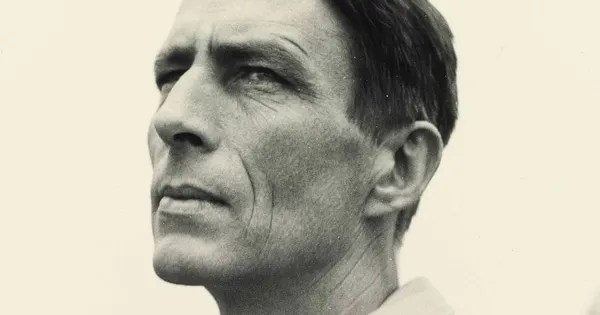
Robinson Jeffers (1887 – 1962) was an American poet known for his work about the central California coast. He is considered an icon of the environmental movement. Influential and controversial, Jeffers believed that transcending conflict required human concerns to be de-emphasized in favor of the boundless whole. This led him to oppose U.S. participation in World War II, a stance that was controversial after the U.S. entered the war.
Discover more from Vox Populi
Subscribe to get the latest posts sent to your email.

Such vivid imagery in those packed 11 lines!
LikeLike
This poem paints a desolate picture, I am thinking of the fens in the northern UK, but ‘desolate’ in a way that restores sanity. And, yes, don’t touch: “No imaginable / Human presence here could do anything / But dilute the lonely self-watchful passion.” The ‘lonely self-watchful passion’ line is pure genius.
LikeLiked by 1 person
Thanks, Rose Mary.
>
LikeLike
Early on in my poetic education I was seduced by nay sayers who only spoke of Jeffers’ misanthropy. So I ignored him, leaving him to his lonely Tor. Now I read Jeffers gratefully, with increasing appreciation for his de-centering of human hubris. “The extraordinary patience of things!” he wrote. “We must uncenter our minds from ourselves;” he told us. (both quotes from his poem Carmel Point). We humans do dilute things, don’t we.
LikeLiked by 2 people
Indeed we do.
LikeLiked by 1 person
Thank you for sharing. I pulled out my first edition of Roan Stallion and re-read the poem to myself in honor of the collection’s centennial. A towering Pacific poet.
LikeLiked by 3 people
‘Towering’ is the right adjective. Thanks, Marc.
LikeLike
There is a place I used to stay in Big Sur on my way to Tassajara ( my room was the petite dejeuner) where we who stayed left thoughts and poems in the room diaries and I would climb to the top of the hill and observe the “ wrinkled sea” (and once a whale passing by) and sometimes I would recite poetry into the breeze and, of course, Jeffers took me back there this morning. So often VP provides a flight of memory. Thank you
LikeLiked by 4 people
Lovely memory, Barb. Thank you.
LikeLiked by 2 people
Just remembered the name . Deetjen’s! I think movie stars stayed there in the 20s. Rumored to have been built by a retired pirate.
LikeLiked by 1 person
How I love this poem! And I can imagine what R. Jeffers saw — there are still a few, very very few– places in CA where such an utterly wild coastline can be seen. I visited his house & tower in Carmel (near Big Sur) a few times, climbed the very steep and, at the top, very awkward steps of the “Hawk Tower” that he built himself, stone by stone — stones he gathered from his walks on the beach. His twin boys loved to play there — and look at the view of the very wild Pacific there, from the top of that tower.
LikeLiked by 4 people
Beautiful, Laure-Anne. Thank you.
LikeLiked by 2 people
I love Robinson Jeffers. He was an ‘environmentalist’ before the word was invented and an antiwar activist during WWII, an unpopular stand that ruined his career. He was a man of vision and principle. And his nature descriptions feel as if they were written by someone who lived in nature fully and authentically.
LikeLiked by 4 people