
Vox Populi
A curated webspace for Poetry, Politics, and Nature with over 6,000,000 visitors since 2014 and over 9,000 archived posts.
Watson Institute, Brown University: US military aid to Israel
The estimates on the graph below are conservative; while they include approved security assistance funding since October 7, 2023, supplemental funding for regional operations, and an estimated additional cost of operations, they do not include other economic costs.
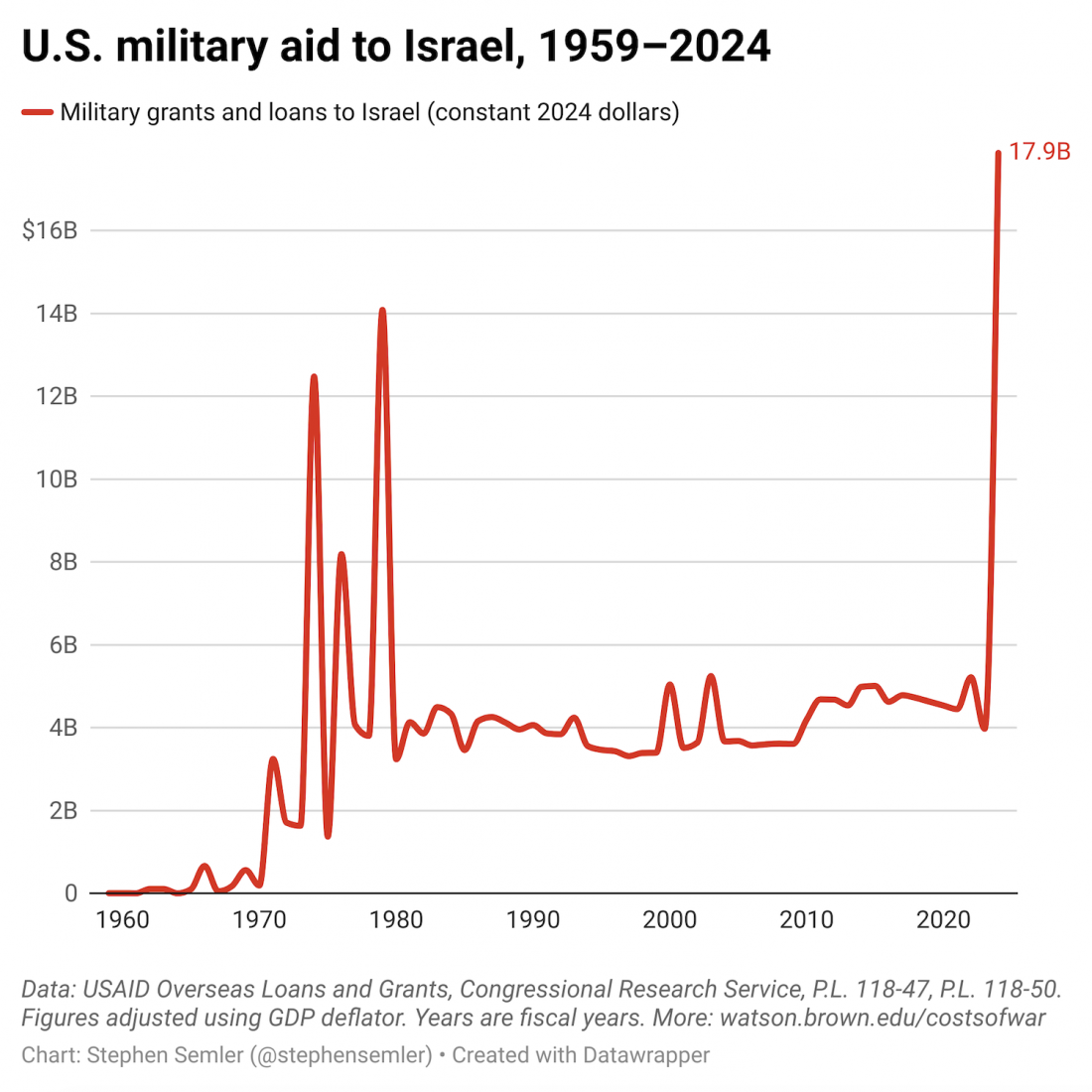
Related U.S. military operations in the broader region since October 7 are part of the fuller picture and not included in the graph. In particular, the U.S. Navy has significantly scaled up its defensive and offensive operations against Houthi militants in Yemen, which the Houthis claim is related to Israel’s war in Gaza. Hostilities have escalated to become the most sustained military campaign by U.S. forces since the 2016-2019 air war against ISIS in Iraq and Syria. U.S. operations in the region, including in Yemen, have already cost the U.S. government $4.86 billion.
This Houthi-related conflict has also cost the maritime trade an additional $2.1 billion, because shippers have been forced to divert vessels or pay exorbitant insurance fees. U.S. consumers may experience paying higher prices for goods as a result.
This report touches on the relationship between U.S. weapons manufacturers and the Israeli government, which have maintained longstanding commercial relations. The U.S. government has cited these commercial ties as one of the reasons why the U.S. should continue to supply foreign militaries, including the Israeli military, with weapons and equipment.
From Costs of War Project,The Watson Institute for International & Public Affairs, Brown University.
The Costs of War project conducts and publishes research about the ongoing consequences of the United States post-9/11 wars in Afghanistan, Iraq and elsewhere; the costs of global U.S. military operations; and the domestic effects of U.S. military spending. Created in 2010 and housed at Brown University’s Watson Institute for International and Public Affairs, the Costs of War project builds on the work of over 70 scholars, experts, human rights advocates, and physicians from around the world.
The project aims to raise awareness and foster public debate by providing the fullest possible account of the human, economic, political, and environmental costs of U.S. militarism, laying the foundation for better informed U.S. foreign and domestic policies.
Research Goals:
- To account for wars’ costs in human lives and the consequences for public health and wellbeing, both in the U.S. and in the war zones;
- To assess wars’ budgetary costs, including the financial legacy, as well as the opportunity costs of the U.S. military budget;
- To describe the scope of U.S. global military operations and their human, economic, political and social impacts in the U.S. and around the world;
- To examine the environmental and ecological impact of the U.S. global military presence, including military carbon emissions;
- To evaluate alternatives that provide for meaningful, just, and inclusive human safety and security.
Discover more from Vox Populi
Subscribe to get the latest posts sent to your email.
