
Vox Populi
A curated webspace for Poetry, Politics, and Nature with over 6,000,000 visitors since 2014 and over 9,000 archived posts.
Jessie Redmon Fauset: Nostalgia
Lonely log cabin
On the road to Notasulga,
Sighing and sagging and quaking;
Let me breathe to the heart of your walls
A secret—
To keep it from breaking.
Once in a Harlem cellar,
A brown girl,
Wiggling and strutting
In a stranger’s arms,
Dreaming of you
For a God-given moment—
Forgot to proffer her charms.
~~~~
From Black Opals 1, No. 2 (Christmas 1927). This poem is in the public domain.
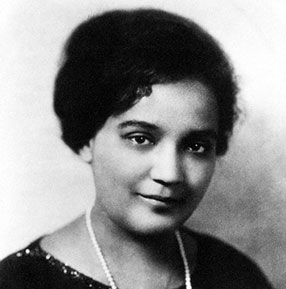
Jessie Redmon Fauset was born on April 27, 1882, in Camden County, New Jersey. She grew up in Philadelphia and attended the Philadelphia High School for Girls. She received a scholarship to study at Cornell University, where she was likely the first Black female student, and she graduated with a BA in classical languages in 1905. After college, she worked as a teacher in Baltimore and Washington, D.C.
In 1912, Fauset began to write for the NAACP’s official magazine, The Crisis, which was cofounded and edited by W. E. B. Du Bois. After several years contributing poems, essays, and reviews to The Crisis, Fauset became the journal’s literary editor in 1919, moving to New York City for the position.
In her role as literary editor, Fauset introduced then-unknown writers, including Countee Cullen, Langston Hughes, Claude McKay, and Anne Spencer, to a national audience. In his memoir The Big Sea, Hughes writes, “Jessie Fauset at The Crisis, Charles Johnson at Opportunity, and Alain Locke in Washington were the three people who midwifed the so-called New Negro literature into being. Kind and critical—but not too critical for the young—they nursed us along until our books were born.”
Along with her poetry and short fiction in The Crisis, Fauset published several novels known for their portrayal of middle-class African American life, including There Is Confusion (Boni and Liveright, 1924) and Plum Bun (Matthews & Marrot, 1928). She also edited The Brownies’ Book, a periodical for African American children, from 1920 to 1921.
Fauset left The Crisis in 1926 to teach French at a high school in the Bronx. She married Herbert Harris, a businessman, in 1929, and they lived together in New Jersey until his death in 1958. Fauset then returned to Philadelphia, where she lived until her death on April 30, 1961. [from Academy of American Poets)
Discover more from Vox Populi
Subscribe to get the latest posts sent to your email.

Thanks, Michael, for including Jessie Fauset’s piece in the poetry collection. I read her works in the 1980s. Back in the 1920’s, some prose styles seemed bent on proving black excellence, even within a white rule book/by white standards. I should read Jessie Fauset and peer Nella Larsen again. (Larsen’s “Passing” contained a scene describing a buffet with “funeral meats.” I thought I’d die laughing on the one hand, but was almost in tears that she felt moved to OVER-prove herselfon the other.)
In this same time frame of reading these Harlem Renaissance authors, I worked at Cornell. Toni Morrison had just won the Pulitzer for “Beloved” in 1987, and was coming to Cornell to read and speak, hosted by “Skip” Gates. Skip had me do the poster in a heartbeat and hang them all around campus and Ithaca. My “educated” colleagues didn’t know who Toni Morrison was–was she the black hairdresser in town? I was in my 30s and very angry that I was expected to be competent culturally and historically across two-to-three very different cultures while white folks could “feel educated” while only knowing one.
Sorry for venting. Again, thanks, Michael, for including Jessie Fauset and, for earlier including Langston Hughes’s poem. I met Langston Hughes in Chicago on the set filming “A Raisin in the Sun” in 1960. According to my mom, I was able to hold up my end of the exchange with this cultural giant and didn’t embarrass the fam!
LikeLiked by 1 person
Always exciting to learn of a pioneer/poet who I’ve missed. Thanks for remembering her, and others, Vox has resurrected into view again.
LikeLiked by 2 people
Thanks, Jim. One of the pleasures of this job is finding excellent poets who’ve been largely forgotten.
>
LikeLiked by 2 people
Thank you for introducing me to a new poet. Sometimes a poem leaves you wanting more which is a good way to be left.
LikeLiked by 2 people
The Harlem Renaissance produced a number of great writers and poets. An historical moment I keep returning to.
>
LikeLiked by 3 people