
Vox Populi
A curated webspace for Poetry, Politics, and Nature with over 6,000,000 visitors since 2014 and over 9,000 archived posts.
Baron Wormser: Thought Nothing
Over the years, I have read a number of books about King Philip’s War. I’ve done this out of a sense of duty as an American, returning, as it were, to the scene of the crime, the aboriginal American war in a couple senses of that term. The nation was not a nation back in the seventeenth century but the forces that drive the nation have not changed. Why would they? The nation grew from seeds—violence and religion to name two—that are very much alive and scarily well. Donald Trump telling the world that his escape from two assassination attempts was directed by God fits well with the notions of providence that the so-called settlers of New England called upon at the drop of a circumstantial hat. It’s a much more exciting story than someone’s aim being off. Trump was puffed up already but now he has some divine helium in there and the terrible certainty that goes with that. Politics, based as it is on assertion after assertion, abolishes doubt in most cases anyway, which is one more trouble with politics.
The violence on both sides up to and including King Philip’s War was harrowing. The Natives employed tortures that were remarkable in their viciousness. The settlers had no compunction about setting fire to a stockade filled with hundreds of Native women and children. The Natives, who comprised various tribes, also murdered women and children. It was war without mercy and in that regard similar to what the Israelites did to the Canaanites, a war that was divinely ordained. The Separatists, as the religious settlers of New England were denominated, saw themselves as people similar to the Israelites in the Bible, people who were in a covenant with the Lord and who faced an enemy who stood in the way of occupying destined land. To say that this story is not over would be to say the obvious. A book that is thousands of years old is not only relevant. It is, as the expression goes, gospel.
The Separatists were in direct communication with the Lord in the sense that they took the events that marked their coming to and residing in New England as proof or disproof of the Lord’s favor. Thus at times when they were attacked by the Natives, they observed days of penitence, of fasting and prayer, humbling themselves before the Lord and beseeching the Lord’s help. They were true believers who read each earthly sign carefully as they sought to confirm the faith that drove them to the foreign shores where, as they put it, “Devils” lived. The demonizing of the Natives made it relatively easy to murder them in that the Natives were both less than human and evil, to boot. Although the Natives, time and again, tried to get along, the hunger for their land on the part of the Separatists was insatiable. That hunger was only part of the story since the settlers brought alcohol, devastating epidemics, and contempt for Native ways as part of their British baggage. There was no satisfying those men and women clutching their Bibles.
Given the mindset that went with the conquest of New England, it is not surprising that the conquerors, for that is what they were, much as, according to the Bible, the Israelites conquered Canaan, thought nothing of the violence they practiced. Murdering the Other was part of the quest. I keep returning to that phrase “thought nothing” because it seems a contradiction in terms. How can one “think nothing”? Doesn’t thought imply some substance? If one thinks nothing then one is not thinking but doing something else. That, to me, seems the rub because for all the theological reasons the Puritan ministers advanced about why the occupation of New England should happen, their thinking was based on the emotional bedrock of belief. Belief, as has been observed more than once, begins where thinking ends. Yet as Alexis de Tocqueville, that smartest of all observers of the American scene, affirmed, belief was crucial to the whole human endeavor, as in “men cannot do without dogmatic beliefs.” To think beyond such a place was, to Tocqueville, an uphill climb to put it mildly: “Only minds truly emancipated from life’s ordinary preoccupations, deeply penetrating, extraordinarily agile, and highly practiced, can break through to such necessary truths, and then only with a great investment in time and care.” So much for thinking anything through in this palsied, perfervid world.
Tocqueville was sanguine about the place of belief, probably because he was one of those extraordinary thinkers who could float above the commonplaces of “dogmatic beliefs” hence, to my mind, he shortchanged the degree to which belief had humankind by the throat and how one belief was bound to challenge another and lead to friction, to say nothing of war. Patriotism, honor, religious conviction, ideology of one stripe or another—civilized people were shot through with beliefs. And who could imagine otherwise since the Lord was the linchpin of all beliefs for both the worldly Tocqueville and the not-so-worldly Separatists of New England. The Lord, as the present moment indicates, still is the linchpin but, as ever, what the Lord wants from people, especially in a heterogeneous democracy in which a certain amount of the population is not especially theistic, is debatable. Yet to the believer there is no debate: you agree or you don’t, saved or damned—to evoke an old but still thriving nomenclature.
What strikes me when I read about the era of King Philip’s War is how much anxiety the settlers lived with, not just the uncertainty of how to deal with the Natives and who the Natives were and whether a violent death was only a tomahawk blow away (and many skulls were accordingly cracked) but also the anxiety about their own spirituality and their intimate connection with the Lord, a connection that was not supervised by any intermediary priest. Separatist Protestantism was a raw religion, a protest against a protest. It didn’t have many legs to stand on but it insisted it did: the Lord was nearby. Their faith was steadfast and the more their faith was tested the more steadfast it became. Since there is no arguing with belief, such steadfastness makes a sort of sense as does the belief in providence, the active hand of the Lord in diurnal affairs, as if eternity could peer into the turmoil of human days and bestow some meaning that otherwise never would have been there. In its unencumbered way that touch was thrilling and the United States, for many, in its numerous secular incarnations has been thrilling in that way, too. Hundreds of years later, Jack Kerouac was out on the American road testifying.
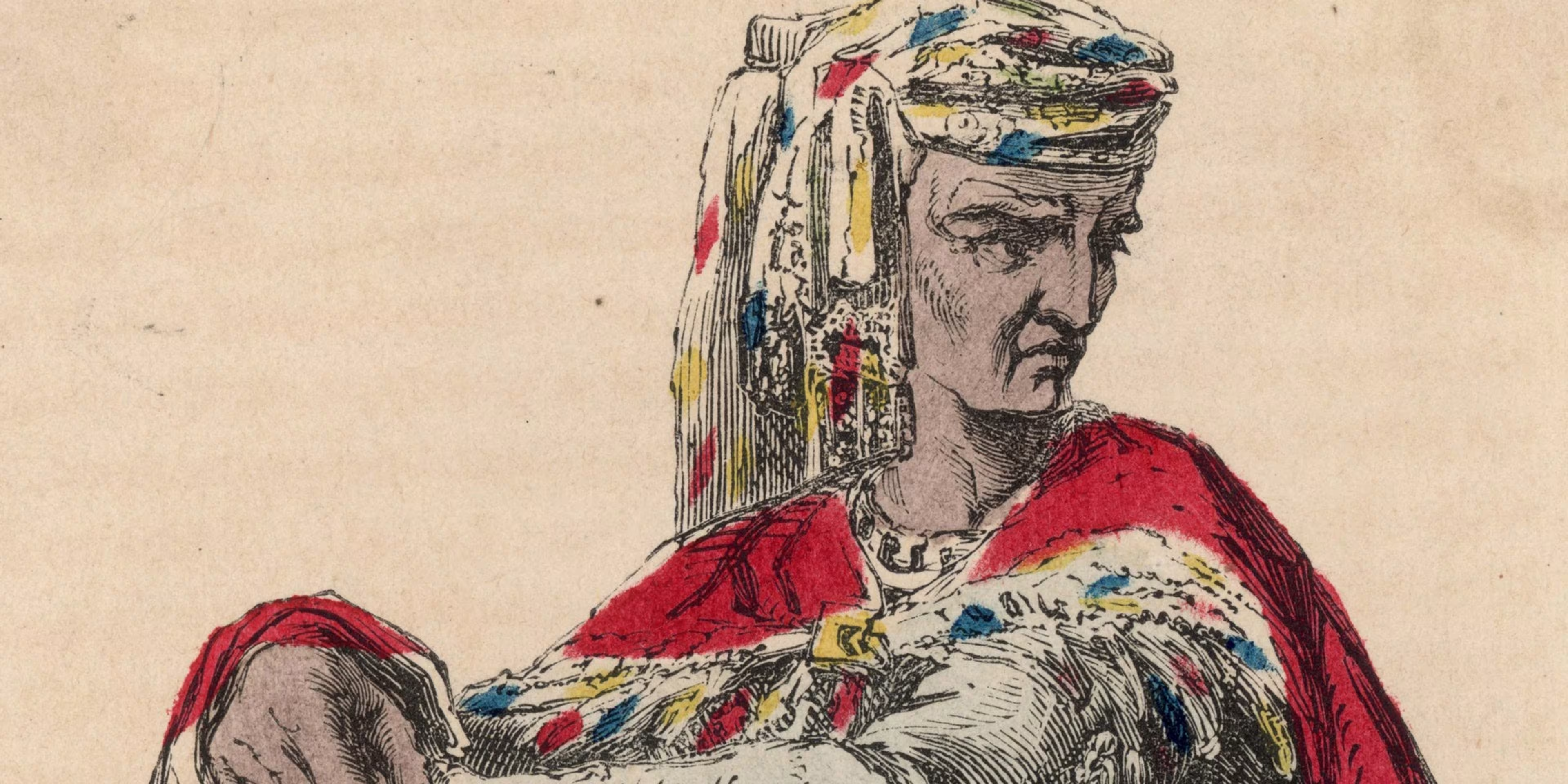
Eventually the Natives lost the war which, given the superior numbers, capital, and firepower of the British, was not surprising. The Natives raised a lot of hell (an apt word given the milieu), however, and the settlers at times sorely wondered about the outcome. For the Natives’ part, they were beset by tribal feuds, which didn’t help them. Indeed, several tribes fought on the side of the British. Philip, a brave, charismatic, determined man could only take his war so far. He knew that, I suspect, from the beginning but he also knew that a life without dignity was worthless. In that regard, he was what many in our world would call “un-American” and, indeed, he was. He wanted no part of what the Separatists were offering. Their cattle, their Bibles, their houses, their Lord, their holy cant, all disgusted him. They didn’t know how to live yet they insisted they knew everything. What was one to make of such people? How could one get along with such people? After the war, many Natives were sold into slavery and wound up in the Caribbean where I assume they were worked to death on sugar plantations. They had lost everything and were told they deserved their fate. The bluff, hectoring assurance that greets us each day from the White House speaks to an old American story, though one abetted by wealth and technology and a conceit that the Separatists tried to keep an eye on. That eye is gone. King Philip could swear to it.
Copyright 2025 Baron Wormser
Baron Wormser’s many books include the novel Some Months in 1968 (Woodhall, 2023). He founded the Frost Place Conference on Poetry and Teaching and also the Frost Place Seminar.
Discover more from Vox Populi
Subscribe to get the latest posts sent to your email.

“Trump was puffed up already but now he has some divine helium in there and the terrible certainty that goes with that.” Good one.
LikeLike
Ha!
>
LikeLike
As Rose Mary says, I always look forward to a Baron Wormser post. And I can’t do better than Bob in his praise of Baron’s reappraisal! Bravo.
LikeLike
Yes, Baron’s work is our flagship leading us over the open sea.
>
LikeLike
Baron’s first sentence–that “duty” as an American–makes him who he is and his writing what it is: a call to self-examination. Reading him I am always reminded of Robert Lowell’s great poem, “West Street and Lepke” where Lowell writes “no agonizing reappraisal jarred his (the lobotomized Lepke) concentration.” That phrase, “agonizing reappraisal” (which Lowell borrowed from Secretary of State Dulles) is what Baron is always calling for. This piece is no history lesson. It is an agonizing reappraisal of our “lost connections” to both a past and a present each of us is called on to make.
LikeLike
Beautifully said, Bob. Thank you!
>
LikeLike
“Since there is no arguing with belief […] ” A devastating essay, as always lucid and cutting to the bone. My father, after the War, became a believing, Evangelical Christian, and when I was 16 I still hoped to be able to argue with him (and, perhaps, win a point or two). What never made sense to me was that the Christ-loving Christians would go and defend (or aggressively assert) their belief ‘with a sword in hand’ and that all those people who obviously hadn’t heard of ‘Our Lord, Jesus Christ’ would go to hell (and were, quite obviously less than human). I couldn’t deal with that lack of critical thinking and bigotedness and left the Church (in Germany we are either or and the respective denomination gets part of the taxes I pay. When I leave officially I don’t pay the church tax anymore. Then I increased my reading about all the ways we have murdered each other in the name of religion. I so look forward to every Baron Wormser post!
LikeLike
Thanks, Rose Mary. I grew up in an evangelical community in Texas, so my experiences overlap with yours somewhat.
LikeLike