
Vox Populi
A curated webspace for Poetry, Politics, and Nature with over 6,000,000 visitors since 2014 and over 9,000 archived posts.
George Yancy: Pete Hegseth Has Banned 3 of My Books From the US Naval Academy
~~
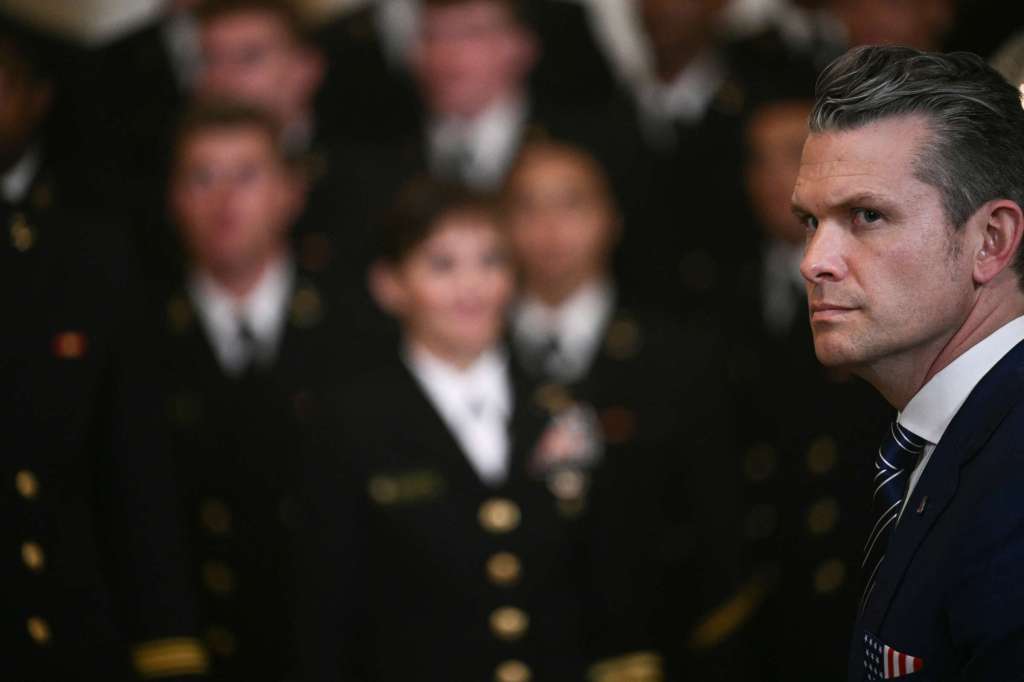
Not one, not two, but three of my books have been removed and banned from the United States Naval Academy’s Nimitz Library by the order of President Donald Trump’s appointed defense secretary and former Fox News host Pete Hegseth. The New York Timesreports that 378 others were also removed.
Naval students and sailors must feel insulted by Hegseth’s lack of confidence in their intellectual ability to read challenging material that encourages self-examination and renders visible the subtle ways in which racism manifests itself. My books lay a foundation for the capacity to think critically and compassionately about those suffering under the toxicity of racism. Navy sailors need to be able to think for themselves and not be immobilized by fear of speaking out against forms of social injustice.
Some have suggested I should feel honored by the removal. There’s a sense that one has done something right to garner such negative attention. That’s one way of positively framing an alarming situation, but, for me, that sense of honor gave way quickly to frustration, outrage and righteous indignation. I take it that these books were banned because of their capacity to disturb those who’d rather erase certain truths from memory. After all, memory can function as a weapon and threat to those who prefer we forget the horrible history of unfettered power.
The removal of my books is also an attack on my free speech: It is a violation of my First Amendment rights against the government to intervene and engage in censorship. The move is likewise an affront to my civic responsibilities, an injury to my democratic freedom, an assault on the integrity of my written work — a form of silencing that violates my democratic agency to share knowledge, to critique structures of power, and to intervene in processes of racial injustice. Indeed, this censorship isn’t just an act of cowardice but a direct refusal of the mirror I hold up to this country’s racist past and present.
It says, in no uncertain terms, that my work, my academic scholarship, my philosophical calling, will not be tolerated by those who’d rather live in ignorance and wield a false narrative of the U.S. as “a shining city on a hill.” If the U.S. is on a hill, then it was partly built upon the backs of enslaved Black people and the genocide of Indigenous peoples. Those harsh and brutal realities are inextricably linked to U.S. history. To remain steadfast in one’s effort to seek the truth about this history, one is confronted by a “shining city” steeped in political and moral rot. It’s my constitutional right to point that out, and no government, no policy and no would-be authoritarian should be allowed to silence me.
As a philosopher, my vocation is to engage in critical thought, to exercise a robust imagination, and to seek beauty, virtue and justice. It is to refuse wanton ignorance, especially the kind that solidifies into mindless lockstep. This censorship represents the kind of shameful and dangerous ignorance found in the dystopic pages of George Orwell’s 1984, where ignorance and anti-intellectualism are glorified in the name of intolerance and authoritarian rule. What we’re witnessing is an attack on freedom of thought itself, which is linked to a deep fear and hatred directed at those who stand ready to engage in truth-telling practices.
Banning books (or even, eventually burning them) is an anathema to a society predicated upon the free exchange of ideas, the value of political dissent, and the critique of authoritarian political actors and policies. This is why history is so important. As philosopher Jason Stanley reminds us, “The Nazis infamously maintained strict control over the publication and dissemination of books. The Nazi propaganda minister, Joseph Goebbels, kept lists of books to be censored on the grounds that they were ‘alien’ or ‘decadent.’” The emphasis upon “alien” and “decadent” speak powerfully to Trump’s broad deployment of the phrase, “the enemy from within.” I assume I too am now such an “enemy” — what Trump calls “some sick people, radical left lunatics.”
The aim of Trump’s discourse is to conjure those seen as “traitorous” and committing acts of “sedition.” “Us versus them” is par for the course when it comes to fascist indoctrination. We are in the throes of a dangerous form of 21st-century McCarthyism. In our contemporary moment, however, it’s not fear of communism manifesting alarm and paranoia: What’s under attack is anything that resembles critical thought that refuses to be policed by fear and hegemonic governmental machinations.
The disappearance of these books is the result of unconstitutional control, and their dissemination and availability are restricted on the grounds that they are “un-American,” and support diversity, equity and inclusion efforts which are now deemed something “alien” and “decadent,” even though those efforts were precisely designed to correct historical injustices. What was once understood as progressive is now being attacked and reframed as something divisive and oppressive.
As Orwell wrote in 1984: “Every record has been destroyed or falsified, every book rewritten, every picture has been repainted, every statue and street building has been renamed, every date has been altered. And the process is continuing day by day and minute by minute. History has stopped. Nothing exists except an endless present in which the Party is always right.” You get the point. Trump is always right.
After all, Trump believes that he “was saved by God to make America great again.” Here we have a case where God is deployed to underwrite his actions, including banning books. Not only, then, am I the “enemy from within,” but I’m also apparently “an enemy of God.” Needless to say, I reject that implication, and I consider Trump’s theology a form of white Chistian nationalism — one that is idolatrous and based on xenophobia, hatred, and the refusal and denigration of the “stranger.” In referring to undocumented immigrants, Trump has said “in some cases, they’re not people.” For Trump’s God, the concept that we are made in the image of God only applies to some. That is a racist conception of God.
Because I am a Black philosopher, it is not lost on me that it is my Blackness that is also deemed as “alien” and “decadent.” After all, an attack on my books is also an attack on what it means for me to be Black within a white supremacist society. Why? My published work is an expression of my knowledge, and the latter is an expression of my racially embodied existence as Black. Within this context, I am reminded of James Baldwin’s line that, “This color [this Blackness] seems to operate as a most disagreeable mirror.” I take the removal of my books from the Nimitz Library as more than merely an academic affair. Their removal is an existential threat: If my books are being erased, then I, too, can be erased, as history has shown time and again.
Trump, after all, has a predilection for all things white (white nativism, white Christianity, white renters, white insurrectionists, white extremism, white pilots, white people from Norway, white South Africans). All three of my now-banned books speak critically about what it means to be white in the U.S. and what that means in terms of white privilege, white complicity and the false claim of white innocence.
This is also the conceptual terrain that I cover within the context of my classes and seminars. It’s not about indoctrination but inviting students, especially white students, to begin to think beyond white racism as the expression of intentional hatred toward “racialized others.” I encourage them, through the critical examination of texts, and through robust dialogue, and deep vulnerability, to think in terms of the historical systemic processes of whiteness that they inherit and thereby knowingly or unknowingly perpetuate. By the end of my courses, white students often share with me that they now begin to see how whiteness operates in quotidian ways, though by no means any less consequential for those who are not privileged by whiteness.
If the U.S. is committed to the maintenance of the existence of whiteness as a structure of power and violence, then what I teach is “un-American.” But I am not a national security threat; I’m a philosopher-citizen who desires to make sure that human creative capacities aren’t imprisoned, that the imaginative capacities of my students aren’t stifled, that they’re unafraid to speak with courage and identify injustices where they exist, and that they’ll never be seduced by vacuous political slogans designed to suppress their ethical integrity. Speaking of the purpose of education, Baldwin writes that, “What societies really, ideally, want is a citizenry which will simply obey the rules of society.” He then warns, “If a society succeeds in this, that society is about to perish.”
Socrates, whom Martin Luther King Jr. saw as a fellow gadfly, was not the kind of citizen the Athenian society really wanted around. This is why he was condemned to drink hemlock. King was also seen as a nuisance, a threat to the social order of U.S. racism, militarism and capitalism, what he described as the three evils of U.S. society. King, as we know, was assassinated for his efforts to hold the U.S. to its word. Both Socrates and King held their fellow citizens accountable. Both practiced courageous speech in the face of danger.
I care for my students. I encourage students to never make peace with mediocrity, injustice or authoritarian rule. I teach them to question their teachers and academic institutions, and to refuse to accept what I say as “sacrosanct.” A critical educational experience doesn’t involve worshipping ideas. In my classroom, I encourage open expression of moral emotions vis-à-vis social injustice and forms of political and physical violence used against those who have been marginalized and dehumanized based on identities deemed “alien” and “decadent.”
In my philosophy courses, we learn how to suffer together, how to name forms of injustice that others would like to invisibilize, and how to never be silenced in the face of social misery and systemic injustice. That, and so much more, is what I teach. In Trump’s U.S., that form of pedagogy is a threat to conformism. Philosopher and educational reformer John Dewey writes, “Education is not an affair of ‘telling’ and being told, but an active and constructive process.” Philosopher and educator Paulo Freire, meanwhile, reminds us that “to glorify democracy and to silence the people is a farce.” Banning books is not just about silencing people — it is about silencing critical thinking and introspection.
Socrates was defiant until the very end: “As long as I draw breath and am able, I will not cease to practice philosophy,” he said. This meant refusing the peddling of lies and deceptions, and making sure Athenians engaged in honest and relentless self-examination. The refusal to be silenced is what is necessary at this moment, especially as universities are caving in and other governmental structures are being dismantled through fiat. I too will continue to embolden students who so desperately need our courage at this moment, to resist authoritarian rule, and the captivity of their imaginations. That is what love sounds like pedagogically. As Freire writes, “Dialogue cannot exist … in the absence of a profound love for the world and for people. The naming of the world, which is an act of creation and re-creation, is not possible if it is not infused with love.”
In the spirit democratic practice, a steadfast dedication to the value of the free exchange of ideas, and the refusal to perpetuate the silencing of different perspectives, I would challenge the U.S. Naval Academy to invite me to engage in an exchange with Navy sailors regarding how race and racism continue to function in U.S. society.
There is an aphorism that states, “There are no atheists in foxholes.” Perhaps, but I assure you that race exists in foxholes, at universities, in classrooms and in all our daily encounters. Navy sailors, like my students, are racialized before they become college students. They have already internalized and been exposed to the racist stereotypes, assumptions and biases that are part of U.S. DNA.
First published in Truthout. This article is licensed under Creative Commons (CC BY-NC-ND 4.0), and you are free to share and republish under the terms of the license.
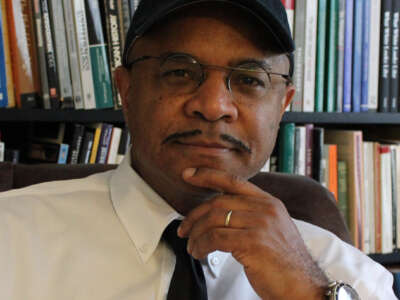
GEORGE YANCY is the Samuel Candler Dobbs professor of philosophy at Emory University and a Montgomery fellow at Dartmouth College. He is also the University of Pennsylvania’s inaugural fellow in the Provost’s Distinguished Faculty Fellowship Program (2019-2020 academic year). He is the author, editor and co-editor of over 25 books, including Black Bodies, White Gazes; Look, A White; Backlash: What Happens When We Talk Honestly about Racism in America; and Across Black Spaces: Essays and Interviews from an American Philosopher published by Rowman & Littlefield in 2020. His most recent books include a collection of critical interviews entitled, Until Our Lungs Give Out: Conversations on Race, Justice, and the Future (Rowman & Littlefield, 2023), and a coedited book (with philosopher Bill Bywater) entitled, In Sheep’s Clothing: The Idolatry of White Christian Nationalism (Roman & Littlefield, 2024).
Discover more from Vox Populi
Subscribe to get the latest posts sent to your email.

Knowing Professor Yancy is in the world gives me hope. But that doesn’t mean I’m not outraged by what’s happened to his work and what’s happening every day in this country.
LikeLiked by 1 person
George is one of the pioneers of current thinking about race. He has been attacked, threatened and censored, and yet he continues to write and publish. He is one of my heroes.
>
LikeLiked by 1 person
Amen, Michael. African American philosophers are a rare breed indeed. Right on, Professor Yancy! Onward!
I met then-Professor of Philosophy Adrian Piper at Wellesley College around 1990-1991 (CUNY cum laude 74, Harvard MPhil 77 and PhD 81). She said there were only 6 African Americans with a PhD in PHILOSOPHY. [Piper is now listed as a conceptual artist in Wikipedia first, and as a Kant philosopher 2nd. She is the first female African American to receive academic tenure in the US. Wikipedia also indicates she lost tenure at Wellesley when on unpaid sabbatical in Berlin in 2008, when she was listed by TSA as a “suspicious traveler” and didn’t return to the States.]
After reading Professor Yancy’s wonderful piece, I did some digging (Journal of Blacks in Higher Education; NSF; and Daily Nous). In 2022, 8 PhDs were awarded to Blacks/Africans out of the 399 people who were awarded one in Philosophy. That’s a whopping 2%.
All I can say: Loved your piece, Yancy. DO take the banned books as a badge of honor! The white power elite wouldn’t care if your words mean nothing. You threaten the status quo, and WE ALL NEED TO RESIST during this fraught, evil season. “Keep on keepin’ on,” as my favorite professor and friend, Dr. J. Herman Blake (now 91), says.
LikeLike
And it’s going to get worse.
LikeLiked by 2 people
Oh yes, we are at the beginning of a very big ugly.
>
LikeLiked by 1 person
Within this brilliant article, one sentence of Prof. Yancy particularly gobsmacks me. He writes: I take the removal of my books from the Nimitz Library as more than merely an academic affair. Their removal is an existential threat: If my books are being erased, then I, too, can be erased, as history has shown time and again…
LikeLiked by 1 person
Yes, the erasure of everyone who opposes fascism is the point Trump and his cronies are making.
>
LikeLiked by 1 person
When I read today’s poem, my stroke addled mind flicked to a book, the Hobbit (?), where a darkness covered the land, except in Lothlorian (?) where evil couldn’t penetrate, and how much I longed to be there. Then I read this and once more felt that thick, evil shadow, the suffocating pressing down. How do we provide these books to young people anywhere, perhaps future leaders who carry our hope to dispel the despair?
LikeLiked by 1 person
Thank you, Barbara.
>
LikeLike
That is one of the huge questions, isn’t it? Witty repartee, or compassion don’t produce much impact with those humorless demagogues in power, as they suffocate critical thinking skills.
Being taught to follow commands, no matter what immorality they possess, has led many in various military situations over time to obey criminal orders. And will again. Also, lots of erasure around race going on in the alt-right these days, too. Old dead ends are travelled again.
LikeLiked by 1 person
I’d emphasize that the removal of Yancy’s books is an injury to the students. It deprives them of a full education. Decades ago one of my son’s best friends got an appointment to West Point. A copy of the New York Times was delivered to every cadet every morning, and they could be quizzed on the contents. We need for the service academies to educate students on ethics, history, and when to refuse a command.
LikeLiked by 2 people
Yes. Encouraging ignorance among cadets is a tool of tyranny.
>
LikeLiked by 1 person
George Yancy is one of the leading philosophers exploring the intersection of race and society, an area that is of utmost importance in understanding how organizations manage their personnel. For the US Navy to censor discussion on this topic demonstrates an alarming reaction against the progress toward inclusion of recent decades.
LikeLiked by 3 people