
Vox Populi
A curated webspace for Poetry, Politics, and Nature with over 6,000,000 visitors since 2014 and over 9,000 archived posts.
Bertolt Brecht: In Praise of Doubt
Translated by Rose Mary Boehm
Do not honor what is lacking
as much as what has been achieved.
Just as you doubt progress,
also doubt the truth.
Doubt has a lot on its conscience:
What is true today,
has not been spared by doubt.
What one thought to be certain,
wavered. But wherever
the wavering wavered,
even the wavering did not waver enough.
Ah, the great self-evident
Will not be self-evident
Without doubt.
Look at the skillful,
the makers of opinions!
They give you their truths
And you should believe them.
They give you their truths
And with them you can prove everything.
He who loves his truth,
Can he not doubt it?
What kind of truth is this,
The one that flees from scrutiny?
Look at the happy ones!
They agree
with what is.
Look at the unhappy ones!
They disagree
with what is.
Look at the righteous!
They disagree
with the unrighteous.
Look at the unrighteous!
They agree
with the unrighteous.
Doubting the custom
has changed the world.
What never was,
Doubt dared to do.
For he who doubts,
asks not only how it is,
but also how it could be.
~~~
Lob des Zweifels
Verehrt nicht das Fehlende ebenso
ie das Erreichte.
So wie ihr den Fortschritt
Bezweifelt, so zweifelt auch die Wahrheit.
Der Zweifel hat einiges auf dem Gewissen:
Was heutzutage gilt,
Blieb nicht von ihm verschont.
Was man für sicher hielt,
Wankte. Aber wo immer
Das Wankende wankte,
Wankte auch das Wankende nicht genug.
Ach, das Große Selbstverständliche
Wird nicht selbstverständlich
Ohne den Zweifel.
Seht die Geschickten an,
Die Verfertiger von Meinungen!
Sie geben Euch ihre Wahrheiten
Und ihr sollt dran glauben.
Sie geben Euch ihre Wahrheiten
Und damit kann man alles beweisen.
Wer seine Wahrheit liebt,
Kann er sie nicht anzweifeln?
Was ist das für eine Wahrheit,
Die von der Untersuchung flieht?
Seht die Glücklichen an!
Sie sind einverstanden
Mit dem, was ist.
Seht die Unglücklichen an!
Sie stimmen nicht überein
Mit dem, was ist.
Seht die Gerechten an!
Sie stimmen nicht überein
Mit dem Ungerechten.
Seht die Ungerechten an!
Sie stimmen überein
Mit dem Ungerechten.
Der Zweifel an der Gewohnheit
Hat die Welt verändert.
Was nie gewesen ist,
Das wagte der Zweifel.
Denn wer zweifelt,
Fragt nicht nur, wie’s ist,
Sondern auch, wie’s sein könnte.
~~~
Brecht’s poem is in the public domain.
Translation copyright 2025 Rose Mary Boehm
A German-born UK national, Rose Mary Boehm lives and works in Lima, Peru. Author of two novels and eight poetry collections, her work has been widely published in US poetry journals.
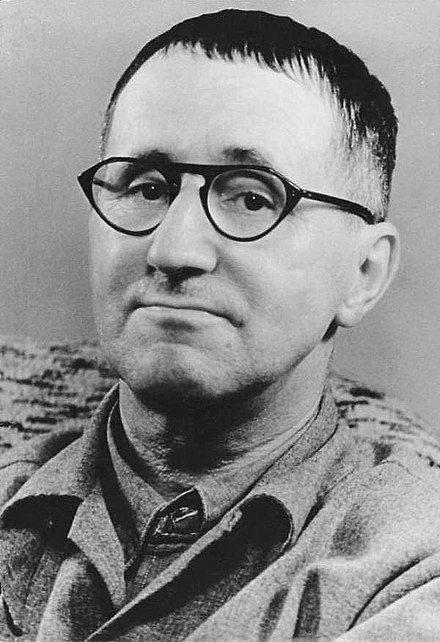
Bertholt Brecht (1898 – 1956) was a German playwright and poet. He had his first successes as a playwright in Munich and moved to Berlin in 1924, where he wrote The Threepenny Opera with Elisabeth Hauptmann and Kurt Weill and began a life-long collaboration with the composer Hanns Eisler. Immersed in Marxist thought during this period, Brecht wrote and became a leading theoretician of dialectical theatre. When the Nazis came to power in Germany in 1933, Brecht fled his home country. During World War II he moved to Southern California where he established himself as a screenwriter, and meanwhile was being surveilled by the FBI. In 1947, he was part of the first group of Hollywood film artists to be subpoenaed by the House Un-American Activities Committee for alleged Communist Party affiliations. The day after testifying, he returned to Europe, eventually settling in East Berlin where he co-founded the theatre company Berliner Ensemble with his wife and long-time collaborator, actress Helene Weigel.
Discover more from Vox Populi
Subscribe to get the latest posts sent to your email.

Lob des Zweifels seems to be an entirely different poem, published in 1938. Where and when was the one cited and translated here published?
LikeLike