
Vox Populi
A curated webspace for Poetry, Politics, and Nature with over 6,000,000 visitors since 2014 and over 9,000 archived posts.
William Trowbridge: Gun Crazy, 1955
My friends and I were crazy about guns, partly due to the proximity of World War II in which America outgunned the Axis. My father, despite the possibility of a court martial, plus a ban against shipping firearms from overseas, managed to get his service pistol and an assortment of souvenir German firearms shipped to our home in his Army foot locker. So when my friends and I “played guns,” we sometimes used real ones, unloaded of course. We studied The Shooter’s Bible, a comprehensive gun catalog, as if it were the King James. Our favorite entry was for the double-barreled Rigby .600 Nitro Express, a rifle for hunting large game, including elephants— considered sporting in those days. We admired its muscular appearance and what was called its “stopping power.” It was the biggest and the baddest: its recoil could break collar bones of the unwary. We associated guns with manhood, victory over oppression, independence, and just plain fun. We enjoyed the look, feel, and sound of them. No one discouraged us, though my father insisted on proper safety measures, even with imitation guns. I recall his anger when I aimed my new water pistol at him. “ In boot camp, l saw a fool kill a buddy, fucking around like that,” he said. “Little hole in the forehead and the rest on the barracks wall.”
Gun control was not an issue in the ‘50s. The ongoing threat of mass shootings wouldn’t start till 1966, with Charles Whitman, the “Texas Tower Sniper.” School or church shootings were unheard of. The NRA was a benign organization for hunters, known mainly for its gun safety programs. Automatic weapons were hard for civilians to obtain, and there was little interest in owning one. Most criminals, other than Mafiosi, had to rely on flimsy, small-caliber “Saturday night specials.” The heaviest-armed youth gangs carried primitive “zip guns.” Firing .22 cartridges, they were usually made at home or in shop class, sometimes out of car arial tubes mounted on wooden stocks. Due to the flimsy barrels, shooters could be in as much danger as their victims.
Playing guns had rules, starting with the time-honored “no shooting through bushes.” The sounds of gunfire were oral, as in ” “Blam,” “Ka-pow,” “Pa-ting,”(for ricochets). “A A AAA,” (for machine guns). No fair punching or wrestling. Most casualties had to be fatal, since mere wounds were invisible and hard to keep track of. Actually, getting killed was desirable, since we could act it out dramatically, like we saw John Wayne and Robert Mitchum do in the movies. You can’t really act out being alive. Disagreements about kills were determined by majority vote. The dead could not be reborn before the battle was declared over. The battling was over when we got tired or when somebody got hurt enough to cry.
When we weren’t playing guns, my friend Barry and I liked to go through the foot locker my father ferreted home after the war. Stored in our basement, it contained, among other souvenirs, Nazi pistols, including a Luger, a Walther PPK, and a Mauser. But our main focus was on my father’s service .45 automatic. While fighting in Germany, he had a friend make grips for it out of the plexiglass canopy from a downed Messerschmitt 109 fighter plane. He then put a photograph of me under one grip and of my sister under the other. He told me that, during training, he had to learn how to disassemble and reassemble the gun blindfolded. After Barry and I taught ourselves to do that, we felt even closer to the gun. It was soldier-hood, it was history, it was family.
Though Barry’s father wasn’t in the war, he kept a small .25 caliber pistol in a bedroom drawer “for protection.“ One day after his parents had gone to dinner, Barry got it out. After admiring it for a while, he took it to the back yard to practice the fast draw that he and I had often seen on the old oaters our TV station was showing to fill afternoon air time (TV was just getting started then). Lacking a holster, he put the gun in his pocket, assuming it was on safety. But when he tried a fast draw, the gun stuck in his pocket and went off, leaving a bullet lodged in his right thigh. His main concern was not about the wound but about what he’d face from his parents for getting his hands on the gun. Using 14-year-old logic, he went into the kitchen and got out a steak knife. He then proceeded to the bathroom and, holding his leg over the tub, dug out the bullet, biting down on a stick like we’d seen oater stars do when pulling arrows out of their legs or shoulders. Then, with the help of his mother’s sewing kit, he stitched up the wound. The operation was a success and, amazingly, his parents never discovered the transgression or the wound. Years later, then a doctor, he told me he still had no feeling in that part of his thigh.
But Barry’s mishap didn’t sap our attraction to guns. The time finally came when we acquired our own rifles. I got a Mossberg bolt-action .22 for my 15th birthday. My friends had also acquired .22s by then. Using real bullets, we needed to shoot at something other than each other, so the war games ended. They seemed so juvenile after all. Our targets were located in a ravine near Happy Hollow Country Club, located just outside town. Someone had been dumping large amounts of junk there, which provided a wealth of targets: cans, bottles, sinks, and dishes were our favorites. We never shot squirrels, rabbits, birds, or anything else alive. I got my allergy to that one day out alone. I shot a squirrel, and the thump of the bullet hitting it made me nauseous and guilt ridden. My friends shared that allergy. So we banged away into the trash, sometimes having contests of who could hit the smallest item first. We sometimes used up 100 or more .22 rounds each—happily trigger-happy.
Once, we did slip back into shooting at each other. There were six of us that time, and for a reason I can’t recall, we separated into two groups of three. I was shooting away at a beer can when I heard something zip by about a foot over my head. After another zip or two, I realized I was hearing bullets. The other group had wandered off in the distance, and I guessed they didn’t notice their bullets were coming close to us. There comes a time, maybe several, in one’s youth when he or she idiotically survives doing something crazy enough to be fatal. This was one of them. My group decided we’d zip a couple of rounds over the others’ heads in return, just to show them how it felt. Soon after, the two groups started exchanging zips, intending for the bullets to go over, not into, each other. I don’t remember how long this went on, but we finally realized the need to cease fire. From then on, we kept together on our shooting ventures.
When I went off to college I left my rifle at home. But in 1963, after I got married I decided it would be a good idea to keep my father’s service .45 at hand for, yes, protection. He’d given it to me as a keepsake after I left home. My wife and I were living in an apartment in Jefferson City, a couple of blocks away from the Missouri State Prison. Convicts were escaping monthly, especially trustees, who were permitted to work outside the walls. I bought a box of shells, then took my wife out in the woods and taught her how to load and fire. She learned quickly, and we decided to keep the gun in our bedroom dresser. I was commuting to graduate classes at MU in Columbia on Tuesdays and Thursdays. One Tuesday evening I arrived to find that class had been canceled, so I drove back home. When my wife heard what sounded like someone trying to get in the front door, she got out the gun, cocked it, and leveled it mid-door. Luckily, she hesitated long enough to see it was me. After that, we switched the pistol’s purpose back to keepsake. Removing the bullets, we stored it in a box on the bedroom shelf, under my high school letter sweater. So ended my attachment to guns—three years before Charles Whitman and the new kind of gun crazy.
~~~~
Copyright 2025 William Trowbridge
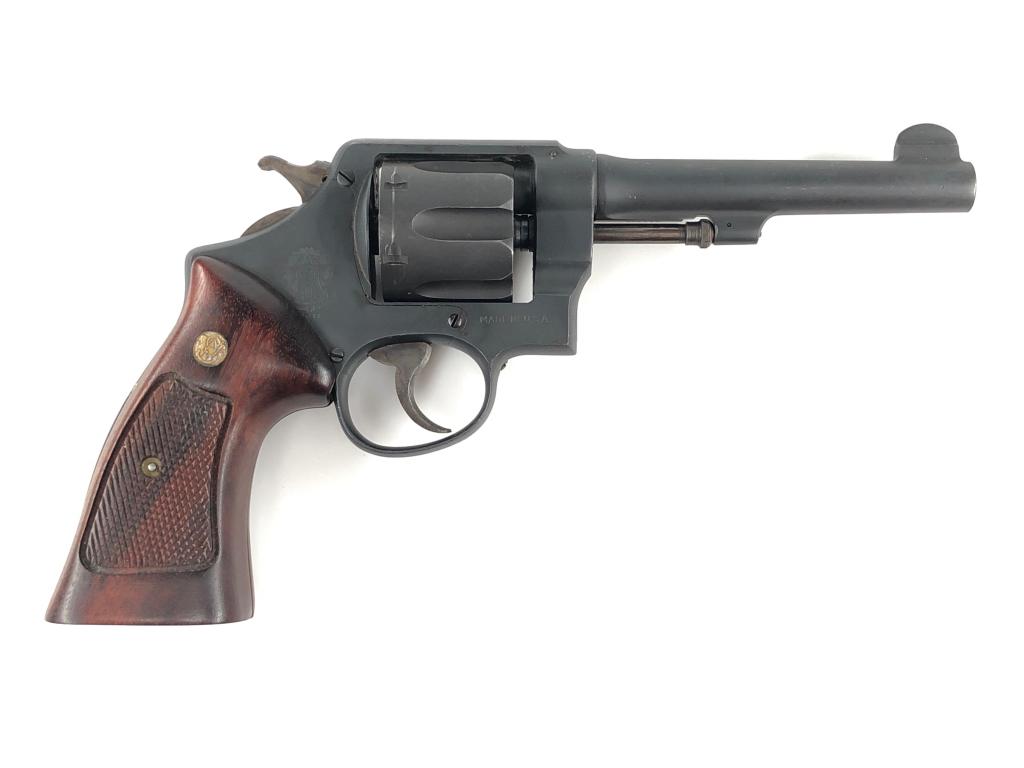
Image: Smith and Wesson M1917 Revolver. This firearm was one of the service pistols used by the US Army in World War I and II. (Source: National Museum of American History)
William Trowbridge served as Poet Laureate of the State of Missouri from 2012-2016. His poetry collections include Call Me Fool, [Red Hen Press, 2022] and Oldguy: Superhero—The Complete Collection, [Red Hen Press, 2019].
Discover more from Vox Populi
Subscribe to get the latest posts sent to your email.

I’m about William Trowbridge’s age, and I remember the zip gun phenomenon well. As he says in his delightful and profound essay, they were used chiefly by the roughest teen gangs, real pistols being hard for most post-war teenagers to acquire in those days. Because zip guns were flimsy and difficult to use, they caused far fewer deaths (even the self-inflicted and accidental kind) than genuine guns would have. It’s a crushing commentary on the situation now—sixty or seventy years later—that today’s teens can, without much effort, acquire enough firepower to put a WWI G I to shame. And too often they do. And they use it.
LikeLike
Thanks, Charlie. Gun control is one of the many large issues that have been set aside in the public consciousness in the Trump era. Pity.
>
LikeLike
My father was born in Europe in 1910. During the war (I didn’t think to ask what war), soldiers were quartered in his family’s house. He liked one Siberian soldier, who took him out back and taught him to shoot his pistol.
LikeLiked by 1 person
Many decades ago, I started keeping a 12ga double barrel shotgun with as short a stock as possible by my bed. At the time, I was deeply involved in building a rank and file movement in the then very corrupt and often violent Teamsters Union. Phoned in death threats were not uncommon, altho it was clear that most were just drunks who could still operate a payphone in the bar. My general attitude, shared by my then partner, was that the ones who really intend to do you harm don’t give warning, they just do it when you’re not looking. Nonetheless, the shotgun was there, loaded and ready, and my partner understood that if it sounded like someone had entered our home while I was working night shift on a freight dock, she would simply point the shotgun over the second floor stair railing and warn anyone below that any attempt come up would result in a staircase full of lead. One night, I got sick at work and headed home. I tried to be silent in my entry as to not wake her but before I got to the staircase, I heard her voice yelling that there was a shotgun pointed down the stairs ready to fire. Fortunately, I was able, in my fear, to shout “…….it’s me!” and the gun was never fired. I learned a lesson that night and realized that if owned a gun, it might be used and like most guns at home, usually at the wrong targets. I’m not arguing that one should never have guns for hunting or even protection, but how the hell one keeps a gun safely locked up with ammo locked elsewhere yet is still able to get that gun out to protect oneself or family is beyond me. So, as we know, many people, usually relatively untrained, keep them in bags while shopping, or in a glove compartment, or in the bedside dresser and usually fully loaded and that’s where kids and others find them and shoot each other or themselves. Or, as we have seen too many times in moments of rage, people turn to the biggest weapon they have to express their outrage and if the gun is there, they use it. Sad state of affairs in every way.
LikeLiked by 1 person
Thanks, Mel. Rarely are guns used for self-protection. Instead, they are used to shoot family members, sometimes on accident.
>
LikeLiked by 1 person
An alien planet to me.
LikeLiked by 2 people
In rural Texas where I grew up, learning how to handle a gun was part of a boy becoming a man. My first firearm was a .22 rifle which was given to me on my 13th birthday. I got pretty good at target practice, but couldn’t bring myself to kill anything. This reluctance frustrated my grandfather who stopped taking me deer hunting, a pity since I enjoyed those long weekends in the woods with him. Possession of a gun is a very important part of many men’s identities, and they are an essential tool for ranchers defending their herds; however, there is no purpose other than mass slaughter in owning an automatic weapon. Shootings in schools, churches and synagogues would be much more difficult if guns were restricted to people who have a legitimate use for them. Automatic weapons should be outlawed altogether.
LikeLiked by 2 people
Same, or similar, upbringing. I got my first gun at 6 years old. It was a single-shot .410 with six inches cut off the stock to fit me. I totally agree about the need to ban automatic weapons.
LikeLiked by 2 people
Thanks, Kim.
>
LikeLike