
Vox Populi
A curated webspace for Poetry, Politics, and Nature with over 6,000,000 visitors since 2014 and over 9,000 archived posts.
Erica Frantz, et al: Firing civil servants and dismantling government departments is how aspiring strongmen consolidate personal power – lessons from around the globe
With the recent confirmations of Tulsi Gabbard and Robert F. Kennedy Jr. – two of the most controversial of President Donald Trump’s high-level administration nominees – the president’s attempt to remake government as a home for political loyalists continues.
Soon after coming to office for a second term, Trump aggressively sought to overhaul Washington and bring the federal government in line with his political agenda. He is spearheading an effort to purge the government’s ranks of people he perceived as his opponents and slash the size of long-standing bureaucratic agencies – in some instances dismantling them entirely.
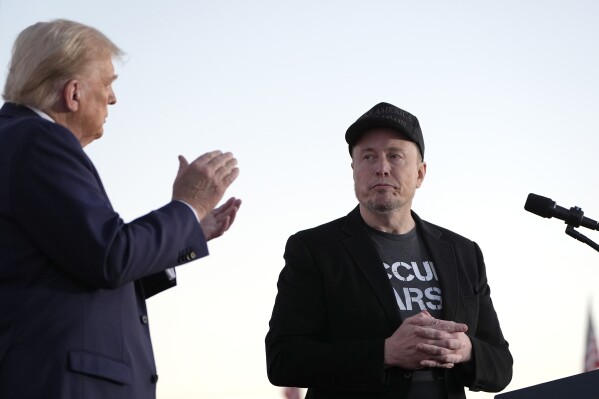
At the helm of much of this is businessman Elon Musk, who is not only the world’s richest man but also the largest donor of the 2024 election and the owner of multiple businesses that benefit from lucrative government contracts.
Musk – and a small cohort of young engineers loyal to him but with little experience in government – descended on Washington, announced their control over multiple government agencies, fired career civil servants, and even strong-armed access to government payment systems at the Treasury Department, where the inspector general had just been sacked.
This unprecedented sequence of events in the U.S. has left many observers in a daze, struggling to make sense of the dramatic reshaping of the bureaucracy under way.
Yet, as researchers on authoritarian politics, it is no surprise to us that a leader bent on expanding his own power, such as Trump, would see the bureaucracy as a key target.
Dismantle democracy from within
A well-functioning bureaucracy is an organization of highly qualified civil servants who follow established rules to prevent abuses of power. Bureaucracies, in this way, are an important part of democracy that constrain executive behavior.
For this reason, aspiring strongmen are especially likely to go after them. Whether by shuffling the personnel of agencies, creating new ones, or limiting their capacity for oversight, a common tactic among power-hungry leaders is establishing control over the government’s bureaucracy. Following a failed coup attempt in 2016, for example, Turkish President Reccep Tayyip Erdoğan fired or detained as many as 100,000 government workers.
In the short term, greater executive control over the bureaucracy gives these leaders a valuable tool for rewarding their elite supporters, especially as diminished government oversight increases opportunities for corruption and the dispersion of rewards to such insiders. Erdoğan, for example, by 2017 had worked to fill lower-level bureaucratic positions with loyalists of his party, the AKP, to ensure the party’s influence over corruption investigations.
In the long term, this hollowing out and reshaping of the bureaucracy is part of a broader plan in which aspiring autocrats usurp control over all institutions that can constrain them, such as the legislature and the courts. As we document in our book, “The Origins of Elected Strongmen,” attacks on the bureaucracy constitute a significant step in a larger process in which elected leaders dismantle democracy from within.
Take control of bureaucracy
The seemingly bizarre series of events that have transpired in Washington since Trump came to power are highly consistent with other countries where democracy has been dismantled.
Take Benin, for example. Its leader, Patrice Talon – one of the wealthiest people in Africa – came to power in democratic elections in 2016.
Soon after taking control, Talon created new agencies housed in the executive office and defunded existing ones, as a means of skirting bureaucratic constraints to his rule. The central affairs of the state were in the hands of an informal cabinet, initially led by Olivier Boko, a wealthy businessman considered to be Talon’s right-hand man despite not having any official position in government.
Talon and his inner circle used this control over the state to enrich themselves, turning the country into what one journalistreferred to as “a company in the hands of Talon and his very close clique.”
Consolidating control over the bureaucracy was just one step in a larger process of turning Benin into an autocratic state. Talon eventually amassed greater power and influence over key state institutions, such as the judiciary, and intervened in the electoral process to ensure his continued rule. By 2021, Benin could no longer be considered a democracy.
Purge civil service
A similar dynamic occurred in Hungary. After governing relatively conventionally for one term, Prime Minister Viktor Orban was defeated in elections in 2002. He blamed that outcome on unfriendly media and never accepted the results as legitimate.
Orban returned to office in 2010, bent on retribution.
Orban ordered mass firings of civil servants and put allies of his party, Fidesz, in crucial roles. He also used the dismantling of bureaucratic constraints to pad the pockets of the elites whose support he needed to maintain power.
As a Hungarian former politician wrote in 2016, “While the mafia state derails the bureaucratic administration, it organizes, monopolizes the channels of corruption and keeps them in order.”
Likewise in Venezuela, President Hugo Chavez had his cronies draw up a blacklist of civil servants to be purged for signing a petition in support of a referendum to determine whether Chávez should be recalled from office in 2004; government employees who signed were subsequently fired from their jobs.
More than a decade later, Nicolas Maduro, Venezuela’s current leader, would conduct his own purge of civil servants after they signed a petition to hold another recall referendum. After multiple rounds of government and military purges, Maduro was able to overturn an election he lost and jail his opponents, knowing full well the judges and generals would follow his orders.

Foster culture of secrecy and suspicion
Orban and Chavez, like Talon, were democratically elected but went on to undermine democracy.
In environments where loyalty to the leader is prioritized over all else, and purges can happen at a moment’s notice, few people are willing to speak up about abuses of power or stand in the way of a power grab.
Fostering a culture of secrecy and mutual suspicion among government officials is intentional and serves the leader’s interests.
As a World Bank report highlighted in 1983, in President Mobutu Sese Seko’s Zaire, now Democratic Republic of Congo, the bureaucracy had been “privatized by the ruling clique,” creating a climate in which “fear and repression … prevented any serious threat from dissenting groups.”
When leaders gain full power over the bureaucracy, they use it to reward and punish ordinary citizens as well. This was a tried-and-true tactic under the PRI’s rule in Mexico for much of the 20th century, where citizens who supported the PRI were more likely to receive government benefits.
In short, when aspiring autocrats come to power, career bureaucrats are a common target, often replaced by unqualified loyalists who would never be hired for the position based on merit. Recent events in the U.S., as unprecedented as they may seem, are precisely what we would expect with the return of Trump, a would-be autocrat, to power.
Authors of this article:
Erica Frantz is Associate Professor of Political Science, Michigan State University.
Andrea Kendall-Taylor is Distinguished Practitioner in Grand Strategy, Jackson School of Public Affairs, Yale University.
Joe Wright is Professor of Political Science, Penn State.
~
First published in The Conversation. Included in Vox Populi with permission.
Discover more from Vox Populi
Subscribe to get the latest posts sent to your email.

Joseph Goebbels said, “We enter the Reichstag to arm ourselves with democracy’s weapons. If democracy is foolish enough to give us free railway passes and salaries, that is its problem. It doesn’t concern us. Any way of bringing about the revolution is fine for us.”
(Sited in a Bret Stephens column in NYTimes)
LikeLike
Exactly. We have armed the MAGA terrorists and now act surprised that they are using the arms against us.
>
LikeLike
Yes, it’s all from Hitler’s and Göbbels’ playbook. The guys who are doing this (Trump is too ignorant, he just signes where the point to) know exactly what they’re doing. Project 25. It’s all happening, and sound of silence from the ‘resistance’ is overwhelming.
LikeLiked by 2 people
They are following Victor Orban’s contemporary strategy for systematically dismantling democratic institutions and turning the country into an autocracy.
LikeLiked by 1 person
Exactly.
>
LikeLiked by 2 people
I continue to read of the destruction but I know we can’t give up.
LikeLiked by 1 person
Agreed. I am waiting for the free spirit of the American people to wake up.
LikeLiked by 1 person
I hope that spirit still exists.
>
LikeLiked by 2 people
So scary and so true. The dictators’ playbook for systematically dismantling democratic institutions. We are in a watershed and the rapids and then the falls are just ahead.
LikeLiked by 1 person
Exactly. Most Americans seem to be sleeping at the bottom of the boat, oblivious to what’s ahead.
>
LikeLiked by 1 person