
Vox Populi
A curated webspace for Poetry, Politics, and Nature with over 6,000,000 visitors since 2014 and over 9,000 archived posts.
Edna St. Vincent Millay: “And you as well must die” (Sonnet 19)
And you as well must die, beloved dust,
And all your beauty stand you in no stead;
This flawless, vital hand, this perfect head,
This body of flame and steel, before the gust
Of Death, or under his autumnal frost,
Shall be as any leaf, be no less dead
Than the first leaf that fell,–this wonder fled.
Altered, estranged, disintegrated, lost.
Nor shall my love avail you in your hour.
In spite of all my love, you will arise
Upon that day and wander down the air
Obscurely as the unattended flower,
It mattering not how beautiful you were,
Or how beloved above all else that dies.
~~
Public Domain
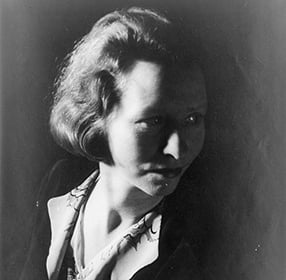
Edna St. Vincent Millay (1892 – 1950) was a renowned social figure and noted feminist in New York City during the Roaring Twenties and beyond. She won the 1923 Pulitzer Prize for Poetry and was awarded the Frost Medal for her lifetime contribution to American poetry. Millay was highly regarded during much of her lifetime, with the prominent literary critic Edmund Wilson calling her “one of the only poets writing in English in our time who have attained to anything like the stature of great literary figures.” However, by the 1930s, her critical reputation began to decline as modernist critics dismissed her work for its use of traditional poetic forms and subject matter, in contrast to modernism’s exhortation to “make it new.” However, the rise of feminist literary criticism in the 1960s and 1970s revived an interest in Millay’s works.
Discover more from Vox Populi
Subscribe to get the latest posts sent to your email.

I love how she so beautifully wrestles with death in a number of her poems. Sigh.
LikeLike
Here’s another sonnet of hers:
I shall go back again to that bleak shore And build a little shanty on the sand, In such a way that the extremist band Of brittle seaweed will escape my door But by a yard or two; and nevermore Shall I return to take you by the hand; I shall be gone to what I understand, And happier than I ever was before. The love that stood a moment in your eyes, the words that lay a moment on your tongue, Are one with all that in a moment dies, A little under-said and over-sung. But I shall find the sullen rocks and skies Unchanged from what they were when I was young.
(from The Harp-Weaver, 1923, public domain)
LikeLike
Love this poem. Thank you!
>
LikeLiked by 1 person
What a moving poem. Years ago, Judy gave me a volume of her poetry. I love her work. Thanks for posting it.
Charlie
LikeLiked by 1 person
Thanks, Charlie.
>
LikeLiked by 1 person
I’m just meeting her for the first time, along with Lorine Niedecker. Which one would you begin with?
LikeLiked by 1 person
To my mind, Millay is a truly great poet, one of the best that America has produced. In comparison, Niedecker is a minor poet. Worth reading, but not on the same level as Millay.
>
LikeLiked by 1 person
Thanks for the advice. I may read a couple of Niedecker but focus on Millay. She was friends with a several of the nuns at my workplace, St. Kates, and there are letters of hers in the archives. It was a strange relationship, but the sisters at St. Catherine were feisty, and Millay, apparently, loved feisty.
LikeLiked by 1 person
I discovered her late, but when I did I was awed.
LikeLiked by 2 people
When I was a young poet, I was in love with the modernists — Pound, Eliot, Stevens, Williams, etc. Then later I discovered the Beats. Vincent was considered old-fashioned, not with it. More recently, I’ve begun to admire her formal discipline and her wild imagination. She’s now one of my favorite poets….
>
LikeLiked by 3 people
Like for you, Michael, I NEED a poem by Millay from time to time. More often than that. And each time I’ll want to read it aloud. Such reassurance: yes, yes, poetry so alive!
LikeLiked by 1 person
I’m so glad that Vincent is back in fashion. I love her poems so much.
>
LikeLiked by 1 person
Ditto, ditto!
LikeLiked by 1 person