
Vox Populi
A curated webspace for Poetry, Politics, and Nature with over 6,000,000 visitors since 2014 and over 9,000 archived posts.
Ramzy Baroud: ‘We Lost Everything, But We Are Still Standing’ | Letters from Gaza
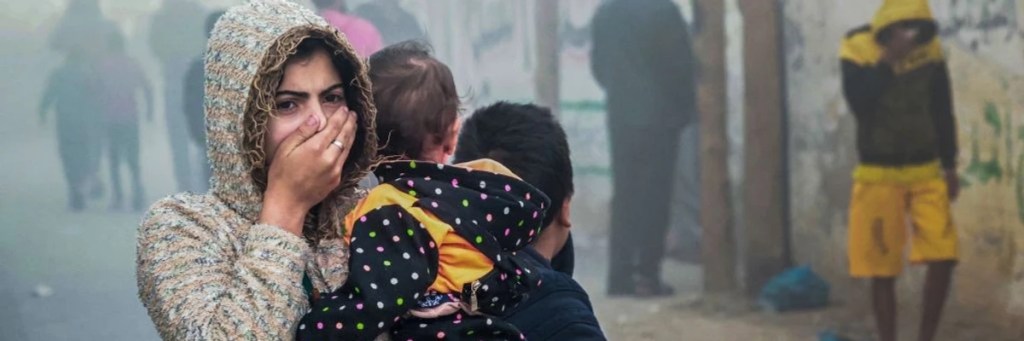
None of those who communicated with me throughout the war have ever questioned their faith, and have often, if not always, begun their messages by checking on me, and my children.
Over the past 14 months, I have received hundreds of messages from family members throughout the Gaza Strip. The nature of the messages often conveyed a sense of urgency and panic but, at times, contentment in God’s will.
Some of those who wrote these notes have been killed in Israeli strikes, like my sister, Dr. Soma Baroud; others lost children, siblings, cousins, neighbors, and friends. It may seem strange that none of those who communicated with me throughout the war have ever questioned their faith, and have often, if not always, begun their messages by checking on me, and my children.
The samples of the messages below have been edited for length and clarity.
Ibrahim:
“How are you? We are all fine. We had to leave Shati [refugee camp]. The Israelis arrived at the camp yesterday. Our whole neighborhood has been destroyed. Our home, too, was destroyed. Alhamdulillah—praise be to God.”
Soma:
“How are you? And how are the kids? Times like these make me realize that no material wealth matters. Only the love of one’s family and community matters most. We had to flee Qarara [east of Khan Younis, in southern Gaza]; the boys fled further south, and I am in Deir Al-Balah with my daughter and grandson. I don’t know what happened to H [her husband]. The army bulldozers began destroying the neighborhood while we were still inside. We ran away in the middle of the night.”
I wanted to help, but I could do nothing. I kept walking from one body to the next, holding hands and looking into dying eyes.
A’esha:
“E [her husband] was killed on the first day of the invasion. A [her son] disappeared after he learned that his father was killed. He said he wanted to avenge his father. I am worried. I don’t know what to do.”
Salwa:
“Cousin, A’esha’s son, A, was killed [he was 19]. He was fighting in Jabaliya. She is somewhere in Rafah with her surviving kids. Her newborn has a congenital heart defect. Do you know of any charity that can help her? She lives in a tent without food or water.”
Ibrahim:
“We escaped to al-Shifa [hospital in Gaza City]. Then, the Israelis invaded. They took all the men outside and had us stand in line. They spared me. I don’t know why. All the men were executed. Nasser’s son [his nephew] was killed in front of me. We are still trapped at al-Shifa.”
Soma:
“My husband was killed, brother. That poor soul had no chance. His illness had prevented him from running away on time. Someone says he saw his body after he was shot by a drone. He was hit in the head. But when we went back to the place, we couldn’t find him. There was a massive heap of rubble and garbage. We dug and dug day and night, to no avail. I just want to give him a proper burial.”
A’esha:
“Did Salwa message you about the charity? My baby is dying. I named her Wafa’ after her auntie [26, who was killed in the first few weeks of the war along with her son Zaid, five, and husband, Mohammed, in Gaza City]. She can barely breathe. Some people are allowed to leave Gaza through Rafah. They say the UAE accepts some of the wounded and sick. Please help me.”
Walid:
“Have you heard anything about the cease-fire? We ran away back to the center of Gaza, after we were forced to flee south. They [the Israeli army] said ‘Go to the safe zones.’ Then, they killed the displaced inside their tents. I saw my neighbors burning alive. I am too old [he is 75]. Please tell me that the war is about to end.”
Ibrahim:
“How are you, cousin? I just wanted to tell you that Nasser [his brother] was killed. He was standing in line waiting for a loaf of bread in Zeitoun. After the martyrdom of his sons, he became responsible for the grandchildren as well. They [the Israelis] bombed the crowd as they waited for the aid trucks. The explosion severed his arm. He bled to death.”
Soma:
“I was in Nuseirat when the massacre happened [278 people were killed and over 800 wounded on June 8]. I walked through the area not knowing the extent of the bloodbath. I was on my way back to Qarara to check on the kids. Bodies were strewn everywhere. They were mostly mutilated, though some were still groaning, desperately grasping onto life. I wanted to help, but I could do nothing. I kept walking from one body to the next, holding hands and looking into dying eyes. I worked in the emergency room for many years. But at that moment I felt helpless. I felt that I, too, had died on that day.”
[Dr. Soma was killed in an Israeli strike targeting her car on October 9. She had just left the hospital, where she worked, to check on her sons.]
Ibrahim:
“My condolences, cousin, for the martyrdom of your sister. She will always remain the pride of our family.”
A’esha:
“Wafa’ died this morning in our tent in Al-Musawi. There was no medicine. No food. No milk. My only solace is that she is now an angel in Paradise.”
Walid:
“How are you, cousin? We are okay. We lost everything, but we are still standing. Alhamdulillah. Do you know when the war will be over? Maybe another week, or two? I am just too old, and so, so tired.”
Ramzy Baroud is a journalist and the Editor of the Palestine Chronicle. He is the author of five books including: “These Chains Will Be Broken: Palestinian Stories of Struggle and Defiance in Israeli Prisons” (2019), “My Father Was a Freedom Fighter: Gaza’s Untold Story” (2010) and “The Second Palestinian Intifada: A Chronicle of a People’s Struggle” (2006). Dr. Baroud is a Non-resident Senior Research Fellow at the Center for Islam and Global Affairs (CIGA), Istanbul Zaim University (IZU).
First published in Common Dreams. Licensed under Creative Commons (CC BY-NC-ND 3.0). Feel free to republish and share widely.
Discover more from Vox Populi
Subscribe to get the latest posts sent to your email.

Thank you for publishing this
LikeLike
Thank you, Barbara.
>
LikeLiked by 2 people
Very sad story and, at least, the word is getting out about their plight. What about the kidnapped hostages (including young children)? Where’s the concern about those abducted on October 7, 2023 and the war Hamas started? No word is getting out about them. Imagine you had an abducted hostage in Gaza, and the concerns you’d have. The global community isn’t addressing this issue and it seems clear that once the hostages are released, the war ends, despite Hamas’s mandate to destroy Israel. Bring them home and end the war.
LikeLike
Just a thought: the US just declared that in Somalia genocide is being comitted. And Gaza?
LikeLiked by 2 people
Interesting dialogue on PBS between Amna Navaz and a US State Department spokesperson in which Amna asked the same question. The spokesperson did a very clumsy dance trying to distinguish between the two situations. It seems that the US is opposed to genocide unless Israel is doing it.
LikeLiked by 1 person
I can’t…
LikeLiked by 1 person
Israel’s Watchdog: IDF Intimidating Officers Who Meet With Staff Probing October 7 Failures- Haaretz.com
https://www.haaretz.com/israel-news/2025-01-07/ty-article/.premium/israels-watchdog-idf-intimidating-officers-who-meet-with-staff-probing-oct-7-failures/00000194-3fcb-d18c-a7bd-bfdbd8b90000
This is one article I’ve just received
LikeLiked by 1 person
Thanks, Noelle.
>
LikeLiked by 1 person
My heart aches to read these terrible stories, and yet, I cannot look away. Thank you for keeping these people alive through their stories.
LikeLiked by 3 people
Unfortunately, the major news channels do not cover Gaza at all. The NYTimes, THE NEW YORKER, Washington Post, NBC, ABC, Fox, MSNBC, NPR barely mention the issue except from the Israeli perspective. Only PBS does a credible job… so it’s necessary that alternative sources keep the story alive. But it’s getting more difficult to get the truth out there. Vox Populi has been shut out of FB and Instagram entirely, and LinkedIN has been censoring our coverage as well.
>
LikeLiked by 4 people
Thank you Michael for continuing to do this work and we can all continue to share it.
LikeLiked by 3 people
Michael have you tried to get Ha’aretz online? I go between this and the Guardian and certain things on Facebook where I feel sure they’re reported honestly.
LikeLiked by 2 people
I read The Guardian which gives honest coverage. I used to enjoy and admire Haaretz online, but now the only thing I get from them is trashy coverage of travel: the best escort service in London is the lead story today. Perhaps I need to subscribe to get real news service.
>
LikeLiked by 2 people
That is seriously weird. I don’t see any of that. They have really good and probing articles.
LikeLiked by 2 people
Yes, I have noticed this also; the networks ranting and raving about Trump and Associates’ dumbassery but ignoring the murdering glee of others.
LikeLiked by 2 people
No words suffice. My gratitude to Michael for publishing this haunting piece. Will share with some folks who need to wake up.
LikeLiked by 3 people
No words suffice. My gratitude to Michael for publishing this haunting piece. Will share with some folks who need to wake up.
LikeLiked by 2 people
Thank, Desne.
>
LikeLiked by 2 people
Genocide. The evidence mounts higher and higher amidst rubble and conflagration.
These stories are necessary as part of a shared response, speaking, as they do, to the survival of the human spirit amidst horror, grief, and the wanton execution of ongoing genocide.
LikeLiked by 2 people
Thank you for publishing Ramzy Baroud’s “messages”. Everybody in Israel needs to read them. Even those who choose to know and make sure they know. I will share them on Facebook.
LikeLiked by 3 people
Thanks, Noelle.
>
LikeLiked by 2 people