
Vox Populi
A curated webspace for Poetry, Politics, and Nature with over 6,000,000 visitors since 2014 and over 9,000 archived posts.
Video: Crying Glacier (2024)
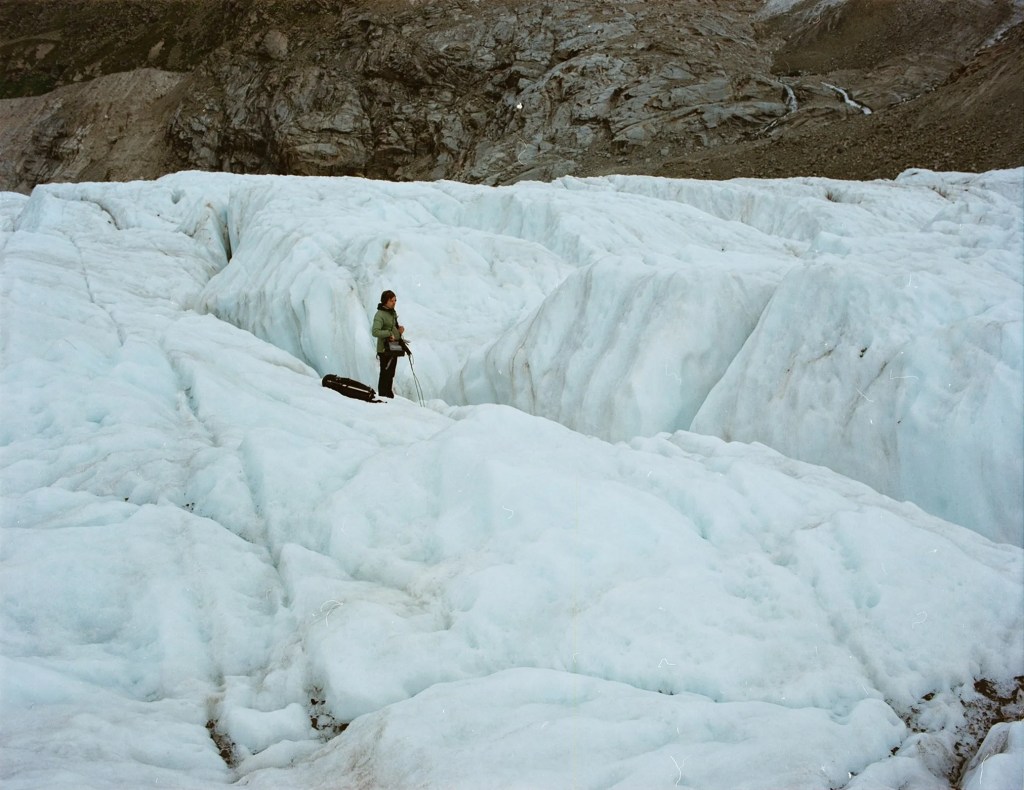
A sound artist tries to conserve the sounds of a melting glacier in the Swiss Alps before it might disappear forever.
The louder the glacier, the stronger the melt. The creaking, cracking and rippling is the voice of impermanence. Sound artist Ludwig Berger shows how important it is to listen to the world that surrounds us. The film follows him on one of his numerous visits to Morteratsch glacier in the Swiss Alps, where he collects fascinating sounds that might disappear forever. Berger says, “Climate change has always been visible to me, but had something abstract and not directly tangible. With the idea of recording the inner sounds of the glacier I got a much more direct reference.“
Running time: 14 minutes
~~~~
Ludwig Berger, is a sound artist and composer from Zurich and Milan. In his installations and performances he playfully deals with superhuman worlds such as beehives, glaciers, water infrastructure and trees. He has released various albums of field recordings, improvisations and electroacoustic music.
Artist and Sound Design – Ludwig Berger
Director – Lutz Stautner
Director of Photography – Philipp Becker
Best Shortfilm @ Mendi Filmfest Bilbao 2023
Best Environmental Film @ Discover Film Festival London 2024
Official Selection @ FIPADOC Biarritz 2023
Finalist @ Banff Mountain Film Festival 2023
Shot in July 2023.
Discover more from Vox Populi
Subscribe to get the latest posts sent to your email.

Dear Michael, this is such a beautiful film, how sensitive. Ludwig Berger’s words sound like a poem.
” Each time I come back,
I feel I’m coming back to someone
and not just to something, It’s like seeing an old friend.
Many things that are in our world, that are in our reality, we cannot hear them directly, we cannot even notice them because they are kind of out of our human scale. With Hydrophone and with contact microphone…(you can hear the Glacier melting)” Melting is natural for Glaciers, but ( in this case) you know that nothing new is coming back…the Glacier is actually dying.
James Lovelock, English scientist, environmentalist and originator of Gaia theory says that the earth is a living being, and that we are just part of its system of life, as cells or capillaries are part of our bodies. All natural forms of the earth, including humans, are all connected.
What can we do as we watch our long-time faithful friend, the Glacier, die? Too many good people who care about climate change say, “look what we are doing” or they blame it on a race.
But the majority of people on earth of all skin shades are not causing our Glacier-friend and other living things to die. It’s the super-rich 1%, the good old corporations.
Just wanted to mention, that I have noticed that, that whole thing of blaming “us” or “we” or a “race” or a people, for causing climate change, or other disasters on earth caused by humans, is ,I think, a trick, a propaganda promoted by the real criminals, the 1%, in order to shift the blame off of themselves and unto a majority of people. It seems like it must be that, because in the early part of the twentieth century when the Labor Movement (or revolution) was in full force, people did not blame themselves for disasters created by economic elites. They called it out for what it was. They were very clear that the culprits, the criminals were the super-rich. But today these criminals are ruling our language and they have us blaming ourselves.
LikeLike
I agree, Luz. The film is a poem.
>
LikeLike
Thank you, Michael.
LikeLike
Exquisite, terribly tragic, educational, prophetic
LikeLike
Yes. The film reminds us that Gaia is not an inanimate object but a living being.
>
LikeLike
Extraordinary. Everyone should listen to this. Shared.
LikeLiked by 1 person
Yes
>
LikeLiked by 1 person
The vanishing objects of the world move through us with their beauty and our loss. The interpenetration of the melting ice sounds with a deep grief at the melting. We must make sure not to aestheticize loss without remembering the objects disappearing. This video does well at showing us the moving boundary of wonder and tragedy.
LikeLiked by 1 person
Yes, the plaintive cry of nature dying…
>
LikeLiked by 1 person
Like the video so much! It IS the cry of glaciers. Thanks for sharing!
LikeLiked by 1 person
Yes, I love this film.
>
LikeLiked by 1 person
What a superb video — sometimes the ice sounds like birds, sometimes like a tree trunk falling. And that clicking of an air-bubble!!
LikeLiked by 2 people
I live in North Carolina, and wonder, having watched this film, what our own vanishing natural landscapes are. We know of vanished species at we won’t hear again, the birds, animals, but there are also dammed rivers, logged forests, built-over grasslands, ditched and drained wetlands.
LikeLiked by 2 people
Exactly, there are entire ecosystems disappearing every day.
>
LikeLiked by 1 person