
Vox Populi
A curated webspace for Poetry, Politics, and Nature with over 6,000,000 visitors since 2014 and over 9,000 archived posts.
William Trowbridge: Packinghouseland, 1957
In the summer of my junior year in high school, I got a job in the hog-cut department at Cudahy Packing Company. I was a checker, which involved recording the number and weights of pork loins before they were packed for shipping. Yes, dreary sounding, but it paid more than mowing lawns. I lived among other privileged kids in suburban west Omaha, and the job was in South Omaha’s packing house district, which composed most of that underprivileged part of town. As a partial result of the migration of workers from the Chicago packing plants after WWII (Chicago’s Polish population was then second only to Warsaw’s) and displaced persons from the war, the population was mostly Slavic, though Slavs had been coming there for work since the 1860s. Going to that part of town was like visiting eastern Europe. Business signs contained lots of consonants. Prominent were Sokol Hall, The Polish Home, The Bohemian Cafe, St. Stanislaus Church—and, of course, the four major packing houses and their surrounding stockyards. The biggest events, the merriest anyway, were Polish weddings, which featured bright colors, a block-long line of food-laden picnic tables, a sea of Schnapps, Slivovitz, and Pilsner, and a parade of painted and paper-mached cars, horns and yawps blaring non-stop through the neighborhoods—as far a cry as possible from the daily grind.
Since my father managed Wilson & Co., another South Omaha packing house, I had been through that area of the city many times. In fact, he got me the job at Cudahy, of course making sure I wouldn’t have to join the union. But my first experience at his plant left me a little on edge about the new job. When I was seven, he decided to take me for a tour of it. The sights, sounds, and smells of the killing floors left me traumatized. Years later, I wrote a poem about the experience:
LESSON
Idling for my Quarter-pounder
at the drive-thru, I drift back
to my 7th year, when my father
took me through the slaughter part
of the packing house he managed—
Daisy the Cow sledge-stunned
and hoisted by a hind leg to be bled,
blood caked two inches thick
in places on the killing floor; Porky Pig
with his pale gray guts exposed
after a scald and a flailing by canvas
paddles to strip off his hair; Mary’s
little lamb and family taking the knife
in dim-brained silence, the stench
and din everywhere. I suppose he only
meant to ready me for the underside
of things, offer a glance of what he’d
learned from growing up. Or maybe
he only meant to spread the pain around,
like families do so well.
When I was sickened, I couldn’t help feeling that I’d faltered in his attempt to provide a step toward manhood. Worse, that experience was repeated the next year when I invited my Cub Scout pack to tour my father’s plant. I felt I was ready and that my fellow scouts would be impressed with my sangfroid. However, I was the only one among them to get sick mid-tour. My father kidded me about it afterwards, but I didn’t see the humor. Maybe he didn’t either.
But I needed a job, and the one at Cudahy wasn’t in the killing areas.
My early morning drive to Cudahy’s seemed to run slightly downhill. As I approached that part of town, it seemed as if I might be descending into some kind of film noir netherworld. It was still slightly dark, so most streets were shadowy, with aging single-story shops and houses. And if film noir had SmellOrama, the packing house odor — stench, outlanders would say—could fill the bill. As you got near the packing houses, it became what you had to breathe. Siren wails were common. The Ace Tavern, on 13th and N., was another landmark. Occasionally, even at that time of day, there’d be someone gantried out under a bloody sheet from an early morning beating, knifing, and/or gunshot/s. When I pulled up to the Cudahy front gate, I’d see the line of hard cases assembled at the office where daily work was doled out. Most were standing, some sat. Occasionally, one would walk over to the gutter and take a leak. A lucky few were given a day’s work, but most were sent slumping off to try again the next day—if they didn’t get knifed at the Ace. Once I saw a newborn lamb standing there, pink and shivering. It must have been born on the killing floor. The scene seemed like something out of a Fellini movie. I didn’t know how the lamb got there, but I was pretty sure where it would end up.
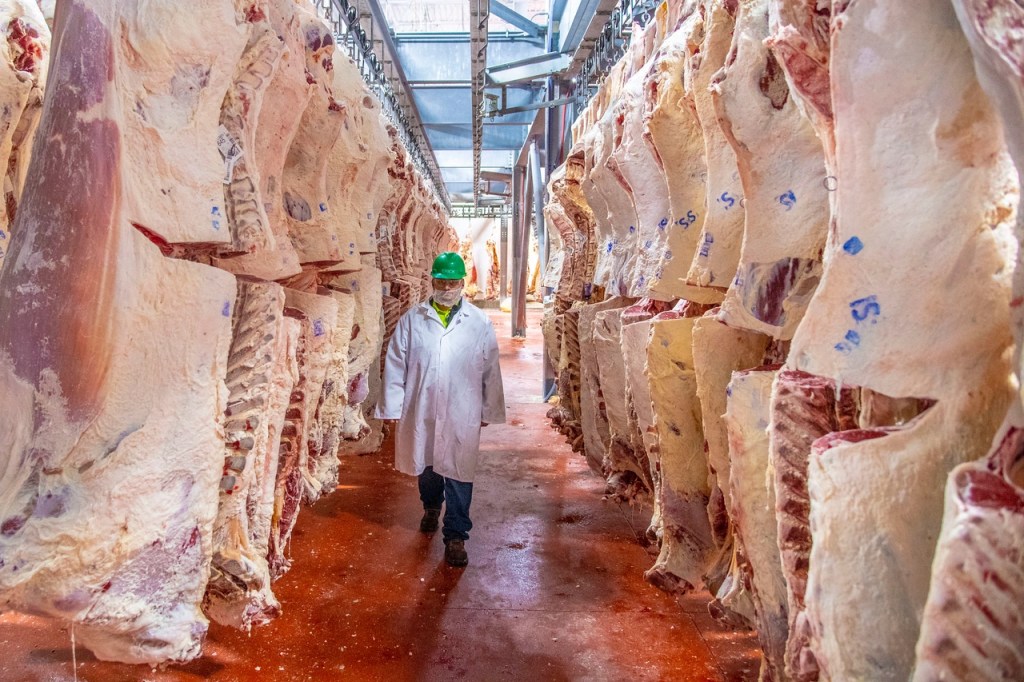
During my first few weeks on the job, I felt like a stranger in a strange place. All I could do was show up and see what happened. The floor where I worked was refrigerated down to about 40 degrees. My feet always felt cold. For a sanitary look, workers had to wear white lab-style coats or jackets, though they didn’t stay white for long. Since the non-office part of the plant was built around 1900, the floor was unsanitarily wooden and perpetually damp. Unlike the killing floors, it was comparatively quiet, save for assorted chatter and clatter. On the production line, two rows of trimmers sliced off the fat from the backs of the loins and pulled out the tenderloins for separate packing. The three people in my group stood at the end of the line, weighing, packing and counting. After a couple of hours on the job, you didn’t notice the ubiquitous smell anymore. They guy next to me was Joe Jelinek. He weighed and then stamped the weights on the boxes of loins and kept the rollers oiled on our end of the line. Joe was in his 50s, which seemed elderly to me, and had been working in packing houses for 35 years, starting in pre-war Czechoslovakia. He looked like he’d been through a lot. He was a quiet guy, but willing to help orient me in the new surroundings, unlike the rest of the crew.
Being non-union and a summer replacement high school kid made me suspect in the eyes of my other co-workers and the butt of some packing house humor. In my second week, they brought by a guy nicknamed “D.P. Richard.” The term “D.P., ”which stood for “displaced person,” was, for some reason, among the most demeaning in packing house lingo. He was tall and puffy, with red hair under his greasy butcher’s cap, and with several front teeth missing. His coat had turned a pale gray-brown, with rust-colored stains around the arm pits. His skin had the grayish tinge of those who never bathe. His specialty, I’d observed, was pushing an empty wheelbarrow round and round our floor and bumming change for the cigarette machine. I couldn’t tell whether he was retarded or crazy or lazy or a combination of all. Union membership kept him from being fired. Hoping to watch the look on my face, some of my crew brought him by to tell me how to, well, fuck a horse. That seemed to be his other specialty. Everyone except the deeply-engaged Richard must have enjoyed the look on my face, though all I remember from his tutelage is something about how to safely employ the ladder.
A guy named Adam focused a lot of his nastiness on me. He was a stocky guy with a crooked nose and beady eyes. He wore Big Smith coveralls and sported a union button on his cap. His mouth was shaped in a perpetual sneer. Leering, he’d ask almost daily, with gestures, things like how my “little girlie” “liked it “doggie style.” For laughs, he’d throw hog fat and spray oil on the floor of my work station when I was on break, hoping for a pratfall when I returned. Others, except Joe, seemed mildly amused. I was too intimidated to do anything about it for a week or so, but one afternoon I’d had it. Despite the possibility of provoking a fight, one I’d probably lose, I took his oil can and doused his station while he was on break. To my surprise, those around me pitched in, tossing fat and spraying more oil. Apparently, they too thought Adam was an asshole. When he retuned, he cleaned up the mess and went back to work amid the chuckles, looking at no one directly. I guessed I’d passed some kind of packing house initiation.
One benefit of my initiation was being offered lunch by my co-workers. The tenderloins that trimmers stripped out were in a nearby bin, to be taken away for separate packing. They were also a source of hot lunches for our crew, who’d stripped off a two-foot section of the insulation on the overhead steam pipes that fed the knife sterilizers. Someone would wrap a tenderloin in foil filched from the ham department and, after adding seasoning, place it on the pipes. Thirty minutes later, voila: tenderloin sandwiches. The company foreman, busy in his office cooking his own tenderloin, never intervened. I was able to wiggle out of eating two other items on the menu. One was known as “prairie oysters” or in the jargon, “hog nuts.” I was allowed a free pass on that and another entry, known as a “pig snoot”sandwich. I assumed that the snoot would be ground up—till I was offered one. There, from the bottom slice of Wonder Bread, a hog’s nose stared back at me, a reminder of the hog kill.
“My father worked in profanity the way other artists might work in oils or clay,” said Ralphie in The Christmas Story. The same and more went for the linguistic artists in the packing house. I marveled at how, using just the 7-words you can’t say on television, most of my co-workers could say what they had to say. “Fuck,” of course, was the traditional favorite. It could function as noun, verb, adjective, or adverb; in the imperative, declarative, or interrogative moods; and in the active or passive voice. One might hear, “Fuck it, this fuckin’ fuck fucker is fucked.” The language was Fuck, which wasn’t taught at Westside High. And I had to learn to speak it without an accent. Don’t get me started.
The unforgivable sin in the packing house was turning stoolie. Bubble Ass was ours. He worked in the nearby sausage department, stuffing the nasty looking stuff into casings.
He got his name from his peculiar shape, which resembled that of the Schmoos in L’il Abner. He’d ratted on a workmate who’d smuggled a flask into work, which got the guy fired. Afterwards, Bubble Ass let it be known that he kept a pistol in his car in case somebody thought of jumping him after work. But the punishment for stoolies was harsher. He was declared an empty space, a ghost nobody believed in, something you might walk through on your way to use the john.
Though I’d adapted to my work environment, I finally couldn’t resist visiting the killing floors on several work breaks. I wanted to try and face the fear, revulsion, nausea, and humiliation of my first exposures there. I felt I needed to toughen up. I had my father’s disappointment in the back of my mind, though not very far back.
The hog kill was still startling. Its giant wooden “Hereford Wheel,” held four shrieking hogs, each dangling from one of the chains spaced around its rim. It rotated them onto a rail that led to the sticker, who wielded a small hooked-blade knife. He was a native American with a profile much like you see on the buffalo nickel, and an expression just as stolid. He never flinched. When he severed their carotid arteries, blood spewed out a foot or so. Three or four hogs would hang there screaming and flailing blood before they died and the next group was moved up. The screams were unrelenting—and sounded almost human. The dead hogs were then moved on the rail and into a “dehairing” machine, which ripped off the hair with a rapidly spinning set of canvas straps. It all seemed like something out of H.P. Lovecraft. I succeeded in keeping down my lunch, but the spectacle still shook me—while the killers might as well have been harvesting wheat.
The beef kill was almost as bad. The steers were driven up a ramp, above which stood the “knocker” with an eight-pound sledge hammer. He was a black guy, young, athletic-looking, maybe 18 or 20. Someone told me he’d batted over .400 on South High’s baseball team, though the irony seemed a little too neat. After he’d knocked a steer unconscious, it would then be dropped through a ramp onto the concrete floor. There it was shackled by its hind legs and hauled up on a hook to be stuck and bled out. The floor was thick with caking blood and other bodily discharges. One time when I was watching, a steer had jerked its head sideways right before the hammer hit. The crazed animal was then ramped out onto the floor about ten feet in front of me and, with one eyeball dangling, it staggered in my direction. Before I could react, the knocker swung down from his post and stepped between me and the steer. When it reached him, he downed it with one blow of his hammer. But it kept getting up till he brained it several more times. I tried to thank him, but he climbed back to his post, never looking back.
Again, I felt like that quivering, helpless seven-year-old.
The Kosher kill was on Thursday mornings. I’d never seen that. It required an all-Jewish crew, headed by a butcher who was usually also a rabbi—though they looked more like football players than acolytes. For the meat to be Kosher, the steer had to be conscious when killed. The terrified animal would bellow and flail as it dangled from the hook. One man would hold its head still from behind by hooking his thumbs over the ears and his index fingers into the eye sockets. The rabbi would then take something that looked like a stainless steel machete and slice the head nearly off, leaving a strip of skin to keep it attached. He then would run a fingernail across the blade to check if it had been nicked. If it had, the meat would be labeled “tref,” not Kosher. Gimme that old time religion, I guess. But this new horror took me by surprise. I was lucky I skipped lunch before witnessing it.
The sheep kill was the weirdest. They just hung there limp, letting out a subdued “baa” now and then till they bled out. Those slaughtered on Kosher day couldn’t have been bedded down on sand, which might nick the Rabbi’s blade.
So my attempts to exorcise the childhood trauma were only partly effective. I never could accommodate myself to it the way my father and the lifers on the killing floors had. There was no word for “humane” in packing house lingo of the time. But I began to recognize that hardening myself to the slaughtering was not a requirement for manhood, even if my father may have thought so. It was just for those who had to do it, whom I think had to stifle some of their humanity. That Hog sticker came to mind. And then my father.
On my last day of work, when I said goodbye to my fellow workers, one told me they were going to bake me cake but they ran out of hog nuts. I was actually a little touched. Then it was out the door and back to west Omaha, which then began to seem a little strange, a little too genteel and sheltered. Occasionally, my language shocked classmates.
A few years after, Omaha, like Chicago before it, had to say goodbye to its title of “hog butcher for the world.” A guy who worked for my father figured out that decentralizing the industry would be much more efficient. All the big packing houses had been located in one city, first Chicago and then, when transportation got too expensive there, Omaha. But that meant shipping cattle from where they were raised to a central location, processing them, and then shipping the meat back out to cities and towns throughout the country. That guy asked why not slaughter them in a number of smaller plants near where they were raised, then ship the meat to closer destinations. So, goodbye Wilson, Armor, Swift, and Cudahy, hello non-centralized Iowa Beef.
The methods of slaughtering livestock have also changed significantly since my time at Cudahy. Various methods with varying degrees of success have been employed attempting to make the processes more humane—or seem so. Pigs are now stunned before slaughter. Stunning of all livestock is done with either a pressurized air gun that replaces the sledge hammer, or electronic shock to the brain, or use of CO2 gas. None, however, is foolproof. The old method of the Kosher kill was banned in 2000 by the Committee on Jewish Law and Standards. The animals are now driven into “comfortable” restraining pens that hold their necks in place for the blade, though they still must be conscious when killed. Also, Temple Grandin has written a number of influential articles and books on how to transport livestock using special pens and restrainers to lessen the intense psychological stress produced by older methods. Some of her ideas have been adopted by modern-day packing houses. Nevertheless, the slaughtering goes on, sometimes brutally.
It’s been a long time since my last morning drive to Cudahy’s. I wound up a university professor: by design or happenstance, about as far away from meat packing as one can get. On my last visit to Omaha, some years after my father died, I learned that the old packing plants, including my father’s, had been demolished to make room for other businesses. And South Omaha is now mostly Hispanic and Asian. So it goes. But every once in a while, I have a dream of that oncoming steer—or rather, a number of them, one eyeball dangling, their mad bray jolting me awake.
William Trowbridge served as Poet Laureate of the State of Missouri from 2012-2016. His poetry collections include Call Me Fool, [Red Hen Press, 2022] and Oldguy: Superhero—The Complete Collection, [Red Hen Press, 2019].
Copyright 2024 William Trowbridge
Discover more from Vox Populi
Subscribe to get the latest posts sent to your email.

What an incredible article, so sensitively written and so descriptive.
LikeLike
I read it, but skipped through at a fast clip. I’m vegetarian. My health reasons became concern for critters. I am still evolving.
LikeLike
I forced myself to read this article; being a vegan for a number of years, I knew what it was going to say. I wish we could force others to read it, but that is not who we are. I have, not by choice, been inside a chicken processing plant years ago and can still see the victims, hundreds, hanging by a single foot, decapitated, dripping blood, moving overhead toward our smacking lips.
It is good to know that now animals are no longer killed or slaughtered for our benefit but Harvested; that makes it ok. Doesn’t it? Harvest was actually the title of the last poem I posted on my blog months ago. My muse has been asleep at the wheel.
LikeLiked by 2 people
Thanks, Leo. Like you, I have been a vegan for a long time: at first for my health, and later for ethical and environmental reasons. The way we treat animals in factory farms and slaughter houses is truly horrible, a crime against nature.
>
LikeLiked by 2 people