
Vox Populi
A curated webspace for Poetry, Politics, and Nature with over 6,000,000 visitors since 2014 and over 9,000 archived posts.
Charles Davidson: Donald Trump and an Insider’s View of Nazi Germany
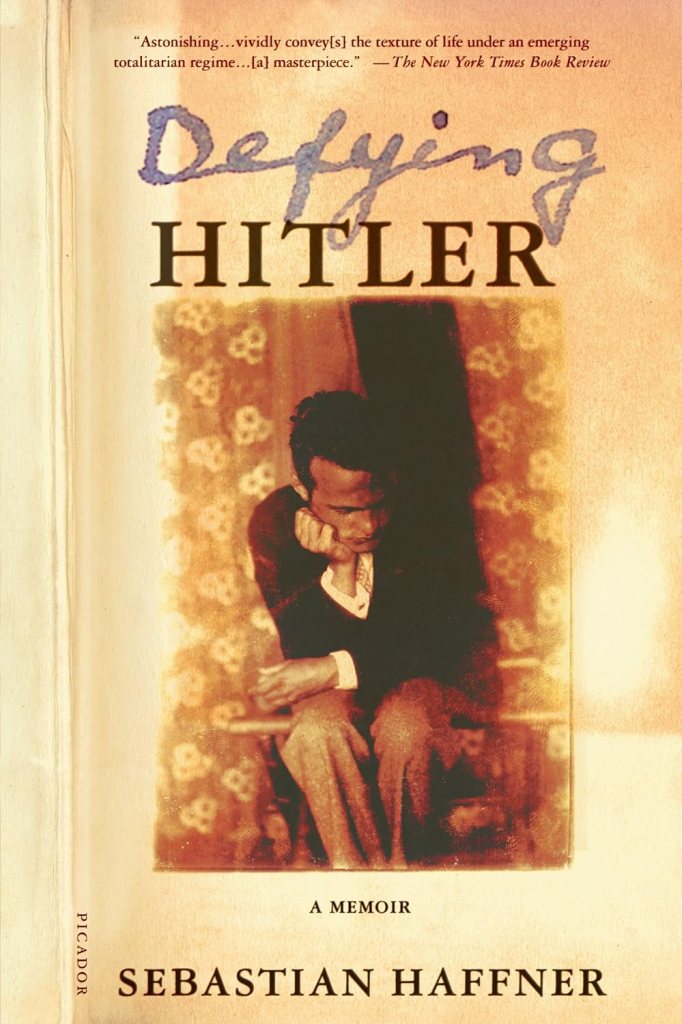
Sebastian Haffner Addresses an American Audience
IT WAS THE LATE 1930s IN GERMANY. Adolf Hitler had ascended to the chancellorship of the Third Reich in 1933. The following year he had assumed for himself the title of Führer.
The German journalist and historian Sebastian Haffner (1907–1999), in his early thirties by the end of the decade, and an apprentice to judges of the court in the civil service, began composing a memoir of his youth during World War One and the subsequent revolution in German politics that had culminated in the entrenchment of the Nazi regime.
Attempting to make sense of the swelling cataclysm, Haffner posed for his readers a bevy of profoundly important questions that reverberate even now within the anxiety-ridden political climate of 21st century America on the cusp of the 2024 national election.
Haffner had noted the “unsolved riddle in the history of the creation of the Third Reich” that involved “psychological developments, reactions, and changes that took place simultaneously in the mass of the German population, which made Hitler’s Third Reich possible and . . . form[ed] its unseen basis.”1 That riddle was far more interesting to Haffner than the matter of who set fire to the Reichstag on February 27, 1933.2 He began his query with a soul-searching question.
“What became of the Germans?”
“Most of my [non-German] readers,” wrote Haffner, “will have looked on their German acquaintances as normal, friendly, civilized people like anyone else. . . . When they hear the speeches coming from Germany today (and become aware of the foulness of the deeds emanating from there), most of these people will think of their acquaintances and be aghast. They will ask, ‘What’s wrong with them? Don’t they see what’s happening to them—and what is happening in their name? Do they approve of it? What kind of people are they? What are we to think of them?’”3
Today, in September 2024, with the possibility of a second Trump regime looming at the political horizon to take control of the federal government of these United States, we Americans would be exceedingly smart to heed those very questions since, two or three years from now, non-Americans could very well be asking them of us.
What became of the Americans? What’s wrong with them? Don’t they see what’s happening to them—and what is happening in their name? Do they approve of it? What kind of people are they? What are we to think of them?
For Sebastian Haffner, situated in the midst of the great storm that had besieged Germany, such questions were not hypothetical. They were existential.
“You cannot come to grips with them if you do not track them down to the place where they happen: the private lives, emotions, and thoughts of individual Germans. They happen there all the more since, having cleared the sphere of politics of all opposition, the conquering, ravenous state has moved into formerly private spaces in order to clear these, too, of any resistance or recalcitrance and to subjugate the individual. There, in private, the fight is taking place in Germany. . . . Today the political struggle is expressed by the choice of what a person eats and drinks, whom he loves, what he does in his spare time, whose company he seeks, whether he smiles or frowns, what he reads, what pictures he hangs on his walls. It is here that the battles of the next world war are being decided in advance. That may sound grotesque, but it is the truth.”4
In hindsight, looking upon Hitler’s rise to power, Haffner had said of himself, regarding the Nazis, that at first “I was inclined not to take them very seriously—a common attitude among their inexperienced opponents, which helped them [the Nazis] a lot.”5
As for those opponents of Hitler, Haffner had observed their repeated capitulation, as to how they had “suffered from a compulsive urge to offer [Hitler] everything he wanted, indefatigably and at an ever cheaper price, indeed to press it upon him. . . . [The] only hope was Hitler’s own unreasonableness. Would it not sooner or later exhaust the patience of his opponents? Then as now, it became apparent that their patience knew no bounds.”6
Are such compulsive capitulations not familiar to Americans also, who have paid even the slightest bit of attention to the machinations of the salacious Mr. Trump and his Republican sycophants?
Have those so-called Republicans—who might have been, and should have been, the primary source of opposition to their own homegrown authoritarian—have they not thoroughly indulged “the compulsive urge to offer” Trump “everything he wanted”? The GOP’s elephantine “patience” with its demagogue clearly knows “no bounds.”

Moreover, as for those monied interests who deposit their plutocratic “cryptocurrency” into Trump’s piggy bank, is Trump not exactly the kind of useful instrument they desire? Because soon enough they will dispose of him when he finally loses his last marble and they can replace him with another strongman who coldly and rapaciously enforces the dystopian measures set forth in Project 2025.
It’s but an old story, isn’t it?—with a new name given to the Constitutionally-insubordinate headline: American Democracy Elects a Felon as Its Fascist Dictator.
Sebastian Haffner, with his eyes opened ever wider, witnessed the Nazi takeover of government offices, court houses, public spaces, and universities. His vocation in the legal profession never materialized because he had to make a life-or-death-defining decision. Either embrace Hitler in order to survive the reign of terror, or take the narrow escape hatch that he did take in order to avoid the jaws of Hitler’s henchmen, and thereby live to tell what too few Germans wanted to admit they had altogether stupidly gotten themselves into.
Of the Nazi judicial system, Haffner said: “Judges could now be removed, quite legally and according to law. The judges, who could be ousted at a moment’s notice, were told that their power had been immeasurably increased. They had become ‘people’s judges,’ ‘sovereign judges.’ They need no longer anxiously follow the letter of the law. Indeed, it was better if they did not. Understood?”7
Haffner revealed his own emotional state as he glanced about the judicial spaces that only temporarily had offered him collegial meaning, safety, and belonging.
“It depressed me to see the dismal, inglorious collapse and destruction of a world in which I had lived, not without some feeling of being at home, of participation, even of pride. It dissolved before my eyes, disintegrated and decayed, and I could do nothing about it. My only option was to shrug my shoulders and to admit the certainty that I had no future here.”8
“You had to choose your words with care and conceal your thoughts to avoid going to the concentration camp instead of the Ministry of Justice.”9
Deportations were already well underway. A Jew was a persona non grata. Haffner had married a Jew, which was tantamount to serving up his own death sentence and hers, since Nazi law forbade the marriage. Many were the roads that led to hell. But few of the German populace had the slightest perspicacity early on to foresee the catastrophe that lay before them.
So . . . if we Americans were to ask Sebastian Haffner—were he still alive—whether a human catastrophe of incalculable magnitude could ever occur in “the land of the free and the home of the brave,” what do you think Haffner would say?
What he did say at the time of Germany’s unfurling cataclysm was this:
“What saved me . . . my nose. I have a fairly well developed figurative sense of smell, or to put it differently, a sense of the worth (or worthlessness!) of human, moral, political views and attitudes. Most Germans unfortunately lack this sense almost completely. The cleverest of them are capable of discussing themselves stupid with their abstractions and deductions, when just using their noses would tell them that something stinks. . . . As for the Nazis, my nose left me with no doubts. How it stank! . . . There are few things as comic as the calm, superior indifference with which I and those like me watched the beginnings of the Nazi revolutionin Germany, as if from a box at the theater. It was, after all, a movement with the declared intention of doing away with us. Perhaps the only comparably comic thing is the way that now, years later, Europe is permitting itself exactly the same indifferent attitude, as though it were a superior, amused onlooker, while the Nazis are already setting it alight at all four corners.”10
In her September 7th edition of “Letters from an American,” Heather Cox Richardson focused our attention squarely upon the depraved voice and rabid threats of the current Republican aspirant to the White House—he who craves the personal exercise of unhinged presidential power.
Of Trump at his recent Mosinee, Wisconsin, rally, Richardson wrote: “He assured attendees that ‘If you think you have a nice house, have a migrant enjoy your house, because a migrant will take it over. A migrant will take it over. It will be Venezuela on steroids.’ He reiterated his plan to get rid of migrants. ‘And you know,’ he said, ‘getting them out will be a bloody story.’
“He went on to try to rev up supporters in words very similar to those he used on January 6th, 2021, but focused on this election. ‘Every citizen who’s sick and tired of the parasitic political class in Washington that sucks our country of its blood and treasure, November fifth will be your liberation day. November fifth, this year, will be the most important day in the history of our country because we’re not going to have a country anymore if we don’t win.’
“He promised: ‘I will prevent World War III, and I am the only one that can do it. I will prevent World War III. And if I don’t win this election, . . . Israel is doomed . . . Israel will be gone. . . . I’d better win.’
“’I better win or you’re gonna have problems like we’ve never had. We may have no country left. This may be our last election. You want to know the truth? People have said that. This may be our last election…. It’ll all be over, and you gotta remember…. Trump is always right. I hate to be right. I’m always right.’
“Then . . . Trump posted on his social media site a rant asserting that he will win the 2024 election but that he expects Democrats to cheat, and ‘WHEN I WIN, those people that CHEATED will be prosecuted to the fullest extent of the Law, which will include long term prison sentences so that this Depravity of Justice does not happen again. We cannot let our Country further devolve into a Third World Nation, AND WE WON’T! Please beware that this legal exposure extends to Lawyers, Political Operatives, Donors, Illegal Voters, & Corrupt Election Officials. Those involved in unscrupulous behavior will be sought out, caught, and prosecuted at levels, unfortunately, never seen before in our Country.’”11
Sebastian Haffner was all too familiar with the collective naïveté that greeted the reality of those sorts of demagogic threats and intimidations that had come from Hitler.
“Our [Germanic] thinking is usually constrained by a certain civilization in our outlook, in which the basics are unquestioned—and so implicit that they are almost forgotten. When we argued about certain opposites—freedom and slavery, for example, or nationalism and humanism, or individualism and socialism—the discussion always respected certain Christian, humanistic, civilized principles as axiomatic. Even some of those who became Nazis at this time did not fully realize what they were doing. . . . Most of them would have been deeply shocked if one had suggested that what they really stood for were torture chambers and officially decreed pogroms (to name but two of the most obvious things, and these are certainly not yet the final horrific culmination). Even today there are Nazis who are shocked and alarmed if this is pointed out to them.”12
So—what about us in America, especially the unctuous and submissive Republicans? Will we as a democracy on Tuesday, November 5, have voted ourselves into the dungeons of an American Gulag?
After all, Trump, a prince of lies, in his lawless grandiosity has two chief fathers-in-crime—Vladimir Putin and Adolf Hitler. They are his twin idols of greatness.
Let us make no mistake about it.
The God of Moses and Jesus declared: “You shall have no other gods before me” (Exodus 20:3).
That includes Donald Trump.

~~~~
1 Sebastian Haffner, Defying Hitler: A Memoir, trans. Oliver Pretzel (New York: Farrar, Straus and Giroux, 2000), 184. The incomplete memoir, written in the late 1930s, was published posthumously by Haffner’s son, Oliver Pretzel. Sebastian Haffner was the pen name for Raimund Pretzel.
2 The Reichstag was the German parliament building in Berlin.
3 Haffner, 184–85.
4 Haffner, 185.
5 Haffner, 104.
6 Haffner, 106.
7 Haffner, 188.
8 Haffner, 191.
9 Haffner, 192.
10 Haffner, 103–104.
11 Heather Cox Richardson, Letters from an American, Substack, September 7, 2024.
12 Haffner, 102–103.
Originally published in Charles Davidson’s “Letters from a Confessing Christian” on Substack, September 14, 2024
~~~~
Charles Davidson, a retired Presbyterian pastor, psychotherapist, and professor of pastoral theology, is the author of Foster’s Pie Pan: Stories of Grace Abounding in a Fallen World (Parson’s Porch Books) and Bone Dead, and Rising: Vincent van Gogh and the Self Before God (Cascade Books).
Copyright 2024 Charles Davidson — All Rights Reserved. Republished here with the author’s permission.
Discover more from Vox Populi
Subscribe to get the latest posts sent to your email.

https://www.nytimes.com/2024/09/15/us/justice-roberts-trump-supreme-court.html
LikeLike
Thanks, Richard. There’s a paywall for the NYT, so some of us can’t open the link. Why is the article important to you?
>
LikeLike
Sorry. I didn’t realize it was behind a paywall; of course it is. I posted it to accompany posts about Haffner’s memoir, which recounts how Hitler relied on judges who would do his bidding. The article demonstrates that even the Chief Justice is now aiding Trump’s coup.
LikeLike
Yes, this is the ‘song’ I have been singing for a few years now. Sadly my reach is only my FB page, but still, I have often been told I shouldn’t exaggerate. And the German intellectuals thought Hitler was a joke. Germany also always had an excellent ‘Kabarett’. You went regularly to the political cabaret and thought you’d done your stuff. ‘Wehret den Anfängen’ (Ovid originally) (Fight the beginnings). It sometimes seems too late already.
LikeLiked by 2 people
Yes, America has gone a long way down the road to Fascism, but I have to believe it is not too late.
>
LikeLiked by 2 people
I wonder how many MAGA voters are home-schooled.
LikeLiked by 1 person
Rose, thanks for all you do and write
the solutions will be intricate and daunting, and people must stay energized and start paying better attention. Singing and playing music, art, jokes and laughter, or other activities necessary for energy and mental health, but also witnessing, organizing, and convincing. And a more energized younger group of people too. A great challenge, that?
LikeLiked by 1 person
Since Harris entered the picture I am so much more optimistic.
LikeLiked by 2 people
one of the most important essays of our times. and rhoff1949 sums up so much of the US MAGA side of this parallel, and of the imperative to not let things get to where they did with the Nazis. Ten years ago I spent a sabbatical researching, reading, and writing about Etty Hillesum, a Jewish woman from the Netherlands with a law degree, who kept a journal after the Nazi invasion, and later was able to get letters out of the Westerbork Transit Camp in Holland, before she was put on the cattle car for Auschwitz. By the time of the journal’s beginning in 1941 till her last letter, the scapegoating and destruction of the Jews of Holland went on with increasing brutality. After one massive resistance in Amsterdam to the deportation of Jews, its brutal suppression led to the most common form of resistance, the hiding of Jews by non-Jews. I suppose we too must ponder that consequence of Trump’s plans. In the Westerbork Camp, Etty summed up an important part of human nature in the face of brutality with these words, writtten as she watched a cattle car being loaded: “The sky is full of birds, the purple lupins stand up so regally and peacefully, two little old women have sat down on a box for a chat, the sun is shining on my face–and right before our eyes, mass murder. The whole thing is simply beyond comprehension”
Comprehend before we reach the situation again. Etty was my friend who died six years before I was born. I don’t want to see someone like her have the same fate in our own place and times.
LikeLiked by 1 person
Thanks, Jim. I completely agree. Trump is a fascist and a danger to our country.
>
LikeLike
Chrales Davidson responds: “Thank you for your comment about Etty Hillesum. She remains a profound witness to the human beauty and goodness that can remain steadfast in the presence of evil. Your friendship with her beyond death is a poignant manifestation of transcendent love that not even death can defeat. Her story and poetry bring us face to face with the decision we must all make, which begins by refusing to see (or accept) the world as Hitler saw it and Trump views it. My prayer is that enough people will comprehend the consequences of a second Trump administration before they enter the voting booth. It remains a mystery as to why some see clearly what is at stake while others remain the blind led by the blind. “
LikeLike
Thanks for the comments on Etty and transcendent love, also your work to help us face the consequences of current situations in an unravelling world. Your words here bring me to tears, but also extend hope that we can see past the propaganda and chaos of authoritarian wannabees.
LikeLike
Thanks, Jim. Yes, we are in this together for the greater good.
LikeLiked by 1 person
Thank you to Charles Davidson for writing this and pointing out the terrifying parallels.
LikeLiked by 2 people
The parallels are shocking, aren’t they?
>
LikeLike
The parallels to 1930s Germany are terrifying.
>
LikeLiked by 1 person
I can’t thank you enough for this. I taught this book in my graduate seminar in the memoir during the Trump administration. Students found it chilling in its parallels, particularly the remaking of the federal judiciary. In Germany, the inexorable march to tyranny was paved with judicial replacements in key jurisdictions. We wondered how Anthony Kennedy was “convinced” to retire from the Supreme Court, and noted that most Americans, ourselves included, do not understand how the federal courts work, who is appointed to them, and how certain key positions ensure a clear path to SCOTUS where the fix is in. I remember one sentence from that book that stopped me dead in my tracks: “By then, organized resistance was impossible, and individual resistance was suicide.”
Let us do everything we can while we still can!
LikeLiked by 2 people
YES!!!!!!
>
LikeLiked by 1 person
Thank you for your comments. I think you have raised the serious issue of a behind-the-scenes coup staged within the federal judiciary, coinciding with the Association of Republican State Attorneys General’s agenda as well as widespread legislative gerrymandering, all part of the larger Republican scheme to upstage majoritarian democracy by establishing permanent minority rule.
LikeLiked by 1 person