
Vox Populi
A curated webspace for Poetry, Politics, and Nature with over 6,000,000 visitors since 2014 and over 9,000 archived posts.
Angele Ellis: Love in a Time of Genocide | In Palestine Wail, Yahia Lababidi seeks the redemption of the human soul
Palestine Wail: Poems by Yahia Lababidi. Daraja Press, 2024.
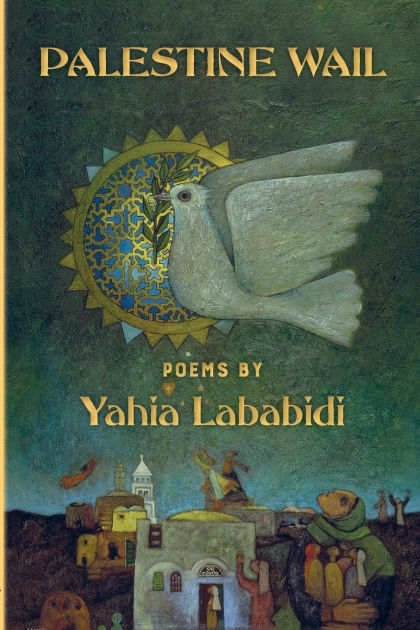
Yahia Lababidi’s eleventh book draws on the spiritual and aphoristic traditions of Middle Eastern and Arab American poetry—from Rumi to Kahlil Gibran—as well as on its vein of political and social critique. This makes Lababidi’s brief free verse poems at once meditations on peace and bulletins from the battlefield.
In his introduction to this collection, Lababidi references not only the Sufi mystic Rumi and the Christian allegorist Gibran, but a range of notable writers and rebels of the past century, including Martin Luther King, Scott Peck, Leonard Cohen, and Elie Wiesel.
In a passionate afterword, Lababidi evokes the spirits of Palestinian poets Ghassan Kanafani (1936-1972) and Refaat Alareer (1979-2023)—separated by a generation, yet both killed by Israeli bombs, along with members of their families. He advocates for an end to the “daily horrors” which since this past October, have deprived 2.3 million Palestinians of their homes. According to the latest figures provided by the Gaza Health Ministry, more than 40,000 Palestinians have been killed in Israeli attacks, and thousands more are buried under rubble and threatened by illness.
Palestine Wail gets to the thorny heart of the matter in poems such as “Open Letter to Israel.” If Gaza is the world’s largest open air prison, then the artist may question the terrible effects of this situation on the jailer as well as on the jailed. The poem begins:
Tell me, what steel entered your heart,
what fear made you rabid,
what hate drove out pity?
How could you forget
that how we fight a battle
determines who we become?
When did you grow reckless
with the state of your soul?
“I view all this narrow-hearted mess that we’re in as a spiritual disease. If we acknowledge that we belong to one another, we recognize that we suffer when we make each other suffer,” Lababidi said in an August 2024 interview with Kori Davis <https://pen.org/yahia-lababidi-the-pen-ten-interview/>. “There is no Other. No lasting peace can be founded upon profound injustice. The jailer is never free. These are spiritual laws.”
If the moral hypothesis and conclusion of Lababidi’s poem “Q&A” are correct:
…If each of us houses the Divine,
then to take another’s life
is to murder a piece of G_d
then we must mourn the recent murders of Israeli hostages in Gaza, including Hersh Goldberg-Polin, a 23-year-old Israeli American. (Please note that some in Israel are blaming these murders on the hardline policies of the Netanyahu government.) But if each human life is precious, then we also must acknowledge the equality of every human life that has been destroyed. As Lababidi asserts in “Middle East Advice”:
To begin a conversation
about Palestine & Israel
First, you must say:
I am your brother
& you are my sister
[…]
Then, you can speak of history
and compare your losses
And in the face of nearly six decades of occupation—how glibly the phrase “The Occupied Territories” flows from the tongue and the pen. Try saying it slowly: “The. Occupied. Territories”—there are barriers at which love may quail. In “The Limits of Love,” Lababidi warns:
…you may find yourself, abruptly
at the outskirts of compassion
by the fence, where barbed wire begins
Palestine Wail is dedicated to Lababidi’s late grandmother, Rabiha Dajani, who fled Palestine “at gunpoint” in 1948 during the devastating dispossession that Palestinians refer to the Nakba (the Catastrophe), and then went on to be a teacher, social worker, and activist. This reviewer thought of Rabiha Dajani when reading her grandson’s poem “Wounded Healers”:
Lately, when I see
a beautiful person,
I want to ask them:
who or what hurt you?
Because I recognize
they had to work hard
in dark caves to carve
space for such a Light.
It is enormously difficult to hold on to the Light in this dark time, as Lababidi acknowledges. He juxtaposes the beauty of a potted plant’s unexpected blooming in the poem “Peace, Lily”
…For years, it withheld its flowers,
but sensing a great need
it could not bear it any longer
& granted us radiant relief
with “Waking Nightmares,” which features spoiled watermelons (freshly sliced watermelon having become a globally recognized symbol of Palestinian solidarity and art):
…The watermelons are rotten
– cut open and bone dry –
from bleeding in the streets
Watered tears, I shudder to imagine
the future of these sad seeds,
what terrible fruit will grow…
This necessary book almost did not come to be. As Lababidi recounts in his PEN interview: “In a two hour Zoom meeting, the [American] publisher let me know that they were uneasy with my use of words like Genocide, even murder — as they felt that it was ‘prejudging a legal matter’ — and they went so far as to suggest that if they were to publish my book, it would result in scandal for them and some of their authors would walk out.” Finally, Daraja Press, a Canadian press run by Kenyan-born activist Firoze Manji, stepped in to publish Palestine Wail.
Reader, some pertinent and impertinent questions: Should we hold poetry presses to higher standards of journalistic freedom than we do newspapers such as The New York Times? Should we continue to accept censorship—especially in the pages of The Times and other mainstream media—censorship that has been standard for the past seventy years, and longer? Does our compliance come at the risk of our own souls?
Full disclosure: This reviewer’s heart has been broken over Gaza. I am an Arab American, the granddaughter of Lebanese immigrants, and the daughter of a father with strong pro-Palestinian sympathies who brought a number of Arab and Arab American artists, academics, and activists into our orbit and our home when I was growing up. Since the mid 1980s, my work in the peace and justice movement has resulted in friendships not only with Arab Americans, but with American Jews who have questioned Israeli policy and advocated for the rights of Palestinians—only to be excoriated and threatened by some in their own communities.
Since the early 2000s, my work as a poet has connected me with other Arab American poets, as well as with Jewish American poets. The phrase “People of the Book” has a special and poignant meaning for me. (“People of the Book” is an Islamic term for the followers of other religions whose scriptures have contributed to Islamic thought and teaching: this includes Jews, Christians, Zoroastrians, Buddhists, Hindus, and Jains.)
I will close this review with an excerpt from Palestine Wail’s “Say Something,” a plea with the urgency of a prayer:
If you’re uncomfortable saying Genocide,
[…]
At least say, not in my name
I’m waiting to hear from you
At least, say something.
~~~~
Angele Ellis is a Pittsburgh-based writer and editor and the author of four books, including Arab on Radar (Six Gallery), whose poems about her Arab American heritage earned a fellowship from the Pennsylvania Council on the Arts.
Copyright 2024 by Angele Ellis
Discover more from Vox Populi
Subscribe to get the latest posts sent to your email.

Didn’t accept my comment:
Heartbreaking.
To begin a conversationabout Palestine & IsraelFirst, you must say:I am your brother& you are my sister
–Rosmarie Epaminondas (Rose Mary Boehm)
http://rosemaryboehm.weebly.com/https://www.rose-mary-boehm-poet.com/ https://www.rose-mary-boehm-poet.com/* https://www.youtube.com/channel/UCR9fygcz_kL4LGuYcvmC8lQ https://www.youtube.com/channel/UCR9fygcz_kL4LGuYcvmC8lQ
LikeLiked by 1 person