
Vox Populi
A curated webspace for Poetry, Politics, and Nature with over 6,000,000 visitors since 2014 and over 9,000 archived posts.
Matthew J. Parker: Tree Huggers’ Last Stand
The song you heard singing in the leaf when you
were a child
is singing still.
~ Mary Oliver
.
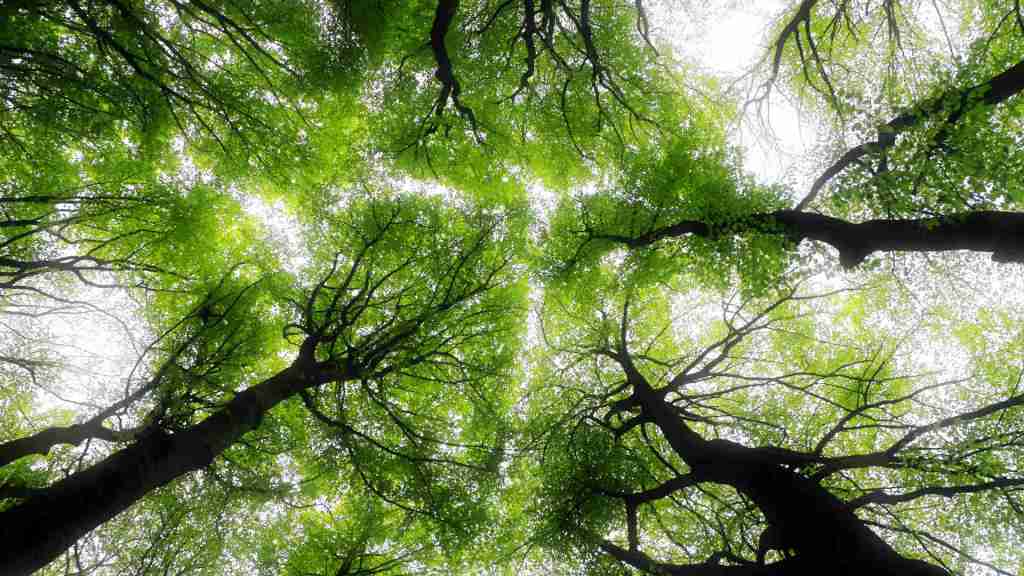
Growing up in Connecticut, the forest for me was a magical place. There was never a question in my mind that it was alive, and I don’t mean collectively – that is, an amalgamation of every living thing occupying its depths. Rather, the entirety of nature throbbed – a huge body boned with earth and rock; skinned with limbs and leaves, ferns and moss; sinewed with ctitters and birds and insects; and veined with rivers and rain and capillaries of mycelia pulsing beneath.
It’s the trees, however, which form the exoskeleton, propping up the entire air purifying system.
The greater Phoenix area, where I eventually moved, has no forests. There are trees, of course, but many are stunted and prickly while others, transplants. Even the stately palms are immigrants. Of the 30-odd years I lived there I rarely felt that magic. There is far too much treeless desert for the conjuring to take place.
Our backyard in Connecticut, by contrast, was bordered by a nature preserve, of sorts – 422 acres of wilderness camouflaging an ammunition dump. Owned and operated by Remington Arms, it was contained by chain link crowned with barbed wire. No Trespassing signs dotted a road that hugged the fence line and was patrolled by roving security guards in dark blue station wagons, none of which kept me out.
.
I loved it for both its arboreal silence as well as its promise of sheer solitude – nobody could ever find me in that forest. There was a lake stocked with fish for Remington employees and deer and other wildlife roamed freely. I took great delight in knowing that few beyond company men had ever witnessed its beauty or wandered its untrodden depths.
It was the trees, however, that I revered above all else, especially in the autumn, when the leaves seemed to be touched by rainbow runoff.
Bryan Farrell, in “Where Did the Phrase ‘Tree-Hugger’ Come From?”, states: “The first tree huggers were 294 men and 69 women belonging to the Bishnois branch of Hinduism, who, in 1730, died while trying to protect the trees in their village from being turned into the raw material for building a palace. They literally clung to the trees, while being slaughtered by the foresters.”
He goes on to point out, however, that “…their action led to a royal decree prohibiting the cutting of trees in any Bishnoi village. And now those villages are virtual wooded oases amidst an otherwise desert landscape… [and] …the Bishnois inspired the Chipko movement (chipko means ‘to cling’ in Hindi).” Begun in the 1970s, Himalayan women, in tribute to the massacre, were motivated to hug trees slated to be felled.
But if my first escape was forests, my second was books, especially Tolkien; the Ents in particular enthralled me – picture the Lorax lamenting atop a clear-cut stump to a vengeful, lethal army turned toward all things axe-wielding. And when The Silmarillion was posthumously published in 1977, I was thrilled to discover not only the origin of the Ents – who the goddess Yavanna referred to as the shepherds of the trees – but also that the entire mythology of Middle Earth revolved around trees – that indeed the root of the sun, moon, most of the stars, and even the Silmarils themselves, were trees.
The Silmarillion is not a cohesive narrative, but rather a patchwork of myths and legends leafed together from decades of meticulous writing. But there was one extremely minor character, Nellas, whom I loved above all others. Her story is not important beyond the fact that she was a wood elf living in an enchanted forest and loved an oafish man incapable of loving her back.
Nellas never went into the city that sat at the center of these woods, save once, and then to testify in favor of the man she loved, a testimony that began with; “Lord, I was sitting in a tree.”
This is one of my favorite lines in all of literature, not only because it was something I was fond of doing – the first time I played hooky I fell out of a tree and broke my wrist – but more because trees are the only creatures on earth that we can actually sit inside of.
No surprise, then, that their felling cuts huggers deeply. In 1962, Tolkien wrote: “Every tree has its enemy, few have an advocate. In all my works I take the part of trees against all their enemies.”
Spoken like a true tree hugger, but the term itself has become derisive, the blowback off the charts, ranging from outright silly – those ridiculous big-rig smokestacks installed in the bed of pickup trucks – to wantonly destructive; “Killing Wolves to Own the Libs,” a New Yorker piece, sums it up horrifically.
木木木木
I learned carpentry as a teenager. Framing homes in upstate Connecticut fortified my bond with trees, both their beauty and utility, like a poem that ambles us easily down forest paths. But wood is more popular than poetry. Much more. Look around you right now. How many gifts from trees do you see? From tires to paper to boxes to that fruit in your wooden bowl (a bowl whose colored webs of grain guarantees that there is not another on the planet like it), wood is our most ubiquitous yet underappreciated form of art.
Like trees, lumber also has personality, a piney smell, to start with, that’s ever-present. From first plank until the last corner of the roof is plied, that smell doesn’t dissipate until the drywall is up. Lumber will also fight back sometimes, cover your hands in sticky sap or shiv you with slivers. And even though it yields to both saw and nail, it’s rarely conquered – the fact that so many structures are still standing testifies to this.
Framing homes also strengthened my symbiosis with wood. I could climb a framed edifice as easily as most trees, my hammer, plunged headfirst into my pouch, giving my back an occasional, reassuring slap as I scaled two-by-four walls or danced across rafter rigging. I used a 28-ounce Vaughn waffle stomp framing hammer, and woe to your fingers when you miss. But this happened rarely as I grew accustomed to it, and the original blisters that arced across my palm morphed into whorled callouses that are present to this day. But blisters or no, the hickory handle was reassuring in my grasp, and much preferable to those steel or fiberglass jobs sporting black rubber grips. Yuck.
What’s important to both acknowledge and insist upon is that old-growth trees harvested for lumber need to be replaced and clearcutting banned outright. Nor is this solely for the health of us huggers. Planting trees is one of the key solutions to climate change, and many are indeed doing so. One such rather unique entity is 8 Billion Trees. Its cofounder, Jon Chambers, told me in an email that they have an edge: “While we debated for several months on whether to use a non-profit organizational structure vs. a social enterprise structure, we ultimately found that using a charity structure would severely limit our growth potential, especially when you become intimately aware of the deforestation crisis.”
But tree planting alone is no sylvan bullet. The complexities involved are many. According to Chambers, it’s more than just dropping seeds into dirt and walking away. The right kind of trees have to be planted in the right places at the right time, after which saplings must not only be nurtured, but so too guarded in most places.
Chambers himself is a tireless and impassioned forester: “I really do believe we are pioneering something no one else is doing: true reforestation projects in the Amazon that uplift decaying ecosystems, rebuild habitats for wildlife (many endangered), and empower local peoples to save their forest home.” He also reminded me that forests, rainforests in particular, are our most prodigious carbon sinks.
Twice annually I travel to Cali, Colombia, to get my rainforest fix. This year I rented an apartment in a northern barrio – a one bedroom, third-floor walkup with two stacked balconies. From the upper balcony I was able to look down onto the top of a Saman tree. Also known as the Dream Keeper or Rain Tree, it’s canopy can be as wide as the tree is tall, and from early spring through late summer it sports bright pink blooms which fan out atop it’s boughs, as if feather dusting the sky.
According to the article “To Confront the U.S. Border Crisis, Save Central America’s Forests,” by Jeremy Radachowsky, the biggest threat to rainforests throughout Central and South America is narco-ranching, which “accounts for some 90 percent of recent deforestation, driven largely by criminals who grab land from Indigenous and local communities and use it to launder drug money.” It is also Radachowsky’s assertion that this is why we have a refugee crisis on our border, as his title suggests.
It’s a similar story in South America. In “The Last Tress of the Amazon,” Nelly Luna Amancio points out that, just in Colombia, more than 2.26 million cubic feet of illicit lumber was confiscated from 2015 to 2017.
“Globally, illegal timber trafficking is an industry worth more than $50 billion … and represents up to 30 percent of the timber sold around the world. #MaderaSucia (‘dirty timber’) is an investigation aimed at analyzing the current situation of the Amazonian timber market and discovering the ways in which the traffickers launder their illegally obtained products into the global trade chain.” Separately, the drug war and ranching are environmentally devastating enough, but combining the two likens dirty timber to blood diamonds, with buyers just as guilty as sawyers.
木木木木
Carl Jung said, “Whenever we touch nature we get clean. People who have got dirty through too much civilization take a walk in the woods, or a bath in the sea.”
The Japanese have a term for this which, not coincidentally, meshes with my tree-hugging history: Shinrin Yoku – literally, Forest Bathing. The website healingforest.org mentions that, due to high levels of stress brought about by crowded cities, natural disasters, and intense work ethics, the “Japanese Ministry of Agriculture, Forestry and Fisheries came up with the idea of shinrin yoku in the early eighties.” The method is to immerse oneself in nature to alleviate stress and, since Japan is 70 percent forest, what better place to bathe?
“Healing Forests” also points out that the effects of forest bathing are beyond mere wellbeing: “Certain trees like conifers… emit oils and compounds to safeguard themselves from microbes and pathogens. These molecules known as Phytoncides are good for our immunity too. Breathing in the forest air boosts the level of natural killer (NK) cells in our blood. NK cells are used in our body to fight infections, cancers and tumors. So spending time with these trees is a special form of tree bathing.” Forests, then, are not only more alive than they seem, as I initially stated, but actually give life.
A technical term for tree hugger is nemophilist, which Webster’s defines as: “One who is fond of forest or forest scenery; a haunter of the woods.” While living in Arizona, forest deprivation was for me almost a physical pain. Akin to the agony all tree huggers suffer when we witness clearcutting, it was made more acute when I believed I was doomed to die there.
But in the summer of 2021, I was hired to teach writing at UC Berkeley, and overjoyed that not only the campus but large swaths of the Bay Area sport pockets of forest, which I regularly bathe in. The aroma alone is intoxicating, like a bee getting a whiff of pollen after a long drought. Most of these forests are dominated by redwoods, but even their prodigious girth is no defense against the avarice of the hewers. The remedy, then, is simple; we make our final stand now or much more than trees will be felled.
Copyright 2023 Matthew J. Parker
Matthew J. Parker teaches writing at UC Berkeley.
Discover more from Vox Populi
Subscribe to get the latest posts sent to your email.

I love this essay. We named our first daughter Sylvan and it was no surprise to those who know her that she and her husband were married quietly deep in the Olympic National Forest.
LikeLiked by 2 people
Very cool.
>
LikeLiked by 1 person
Mother oak by strength and massive reach
commands her hill only by chance and her
tenacious grasp of Gaia’s alible, hidden breast.
Sucking the flow of Gaia’s milk, her mammoth
face in breeze sings praise. The flow, not by beat,
but by constancy plays the melody of her song.
LikeLiked by 2 people
Lovely lines, Leo. Thank you for sharing them.
>
LikeLiked by 1 person
Matthew J. Parker, I feel with every sentence and have to read The Silmarillion again! I live in a coastal desert (Lima, Peru) and need some urgent cleansing.
LikeLiked by 2 people
Love Tolkien. Thank you.
>
LikeLiked by 1 person
So much here I want to go back to. And so many forests still pull. Lichen on one side of tall trees, ferns, rivers. From Big Sur to the greenhorn mountains. Somehow I must return. But that would also be a return to my youth Can one ever go back?
LikeLiked by 1 person
No, I don’t think we can go back except in memory.
>
LikeLiked by 1 person
Sent from my Galaxy
LikeLike