
Vox Populi
A curated webspace for Poetry, Politics, and Nature with over 6,000,000 visitors since 2014 and over 9,000 archived posts.
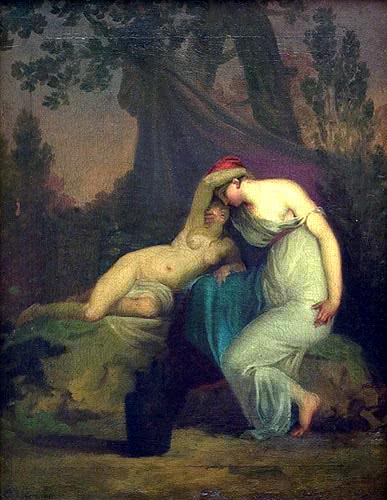
Sappho: Fragments, on Love and Desire
I
…You burn me…
II
Remembering those things
We did in our youth…
…Many beautiful things…
III
…Again and again…because those
I care for best, do me
Most harm…
IV
You came, and I was mad for you
And you cooled my mind that burned with longing…
V
Once long ago I loved you, Atthis,
A little graceless child you seemed to me
VI
Nightingale, herald of spring
With a voice of longing…
VII
Eros, again now, the loosener of limbs troubles me,
Bittersweet, sly, uncontrollable creature…
VIII
………but you have forgotten me…
IX
You and my servant Eros…
X
Like the sweet-apple reddening high on the branch,
High on the highest, the apple-pickers forgot,
Or not forgotten, but one they couldn’t reach…
XI
Neither for me the honey
Nor the honeybee…
XII
Come from heaven, wrapped in a purple cloak…
XIII
Of all the stars, the loveliest…
XIV
I spoke to you, Aphrodite, in a dream…
XV
Yet I am not one who takes joy in wounding,
Mine is a quiet mind…
XVI
Like the mountain hyacinth, the purple flower
That shepherds trample to the ground…
XVII
Dear mother, I cannot work the loom
Filled, by Aphrodite, with love for a slender boy…
Translation copyright 2005 A.S. Kline. Included in Vox Populi on a noncommercial license.
Sappho (c. 630 – c. 570 BC) was an Archaic Greek poet from Eresos or Mytilene on the island of Lesbos. Sappho is known for her lyric poetry, written to be sung while accompanied by music. In ancient times, Sappho was widely regarded as one of the greatest lyric poets and was given names such as the “Tenth Muse” and “The Poetess”. Most of Sappho’s poetry is now lost, and what is extant has mostly survived in fragmentary form; only the “Ode to Aphrodite” is certainly complete. As well as lyric poetry, ancient commentators claimed that Sappho wrote elegiac and iambic poetry. Three epigrams attributed to Sappho are extant, but these are actually Hellenistic imitations of Sappho’s style.
Little is known of Sappho’s life. She was from a wealthy family from Lesbos, though her parents’ names are uncertain. Ancient sources say that she had three brothers; Charaxos, Larichos and Eurygios. Two of them, Charaxos and Larichos, are also mentioned in the Brothers Poem discovered in 2014. She was exiled to Sicily around 600 BC, and may have continued to work until around 570 BC. According to legend, she killed herself by leaping from the Leucadian cliffs due to her love for the ferryman Phaon.
Sappho was a prolific poet, probably composing around 10,000 lines. Her poetry was well-known and greatly admired through much of antiquity, and she was among the canon of Nine Lyric Poets most highly esteemed by scholars of Hellenistic Alexandria. Sappho’s poetry is still considered extraordinary and her works continue to influence other writers. Beyond her poetry, she is well known as a symbol of love and desire between women, with the English word sapphic being derived from her own name and the English word lesbian derived from the name of her home island.
Discover more from Vox Populi
Subscribe to get the latest posts sent to your email.

Simply lovely.
LikeLiked by 1 person
Perhaps the greatest poet who has ever lived. Even in the fragments that have come down to us, we can see her elegant sensibility.
>
LikeLike
It reminds me of Fragments on Love by Barthes.
I purchased a translated copy into Arabic when was in Syria in the 1990s.
Ovid was the first to open this discourse on passion in his unique book “Ars Amatoria”. Translated as well in Egypt in the 1956s when Nasser was busy with his binary illusions: Israel and Arbs Unity. Some thing we do not fail to reconsider.
LikeLiked by 1 person
Thank you, Saleh!
>
LikeLike