
Vox Populi
A curated webspace for Poetry, Politics, and Nature with over 6,000,000 visitors since 2014 and over 9,000 archived posts.
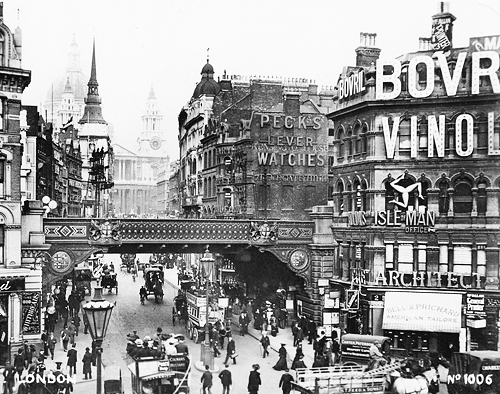
Amy Lowell: A London Thoroughfare. 2 A.M.
They have watered the street,
It shines in the glare of lamps,
Cold, white lamps,
And lies
Like a slow-moving river,
Barred with silver and black.
Cabs go down it,
One,
And then another,
Between them I hear the shuffling of feet.
Tramps doze on the window-ledges,
Night-walkers pass along the sidewalks.
The city is squalid and sinister,
With the silver-barred street in the midst,
Slow-moving,
A river leading nowhere.

Opposite my window,
The moon cuts,
Clear and round,
Through the plum-coloured night.
She cannot light the city:
It is too bright.
It has white lamps,
And glitters coldly.

I stand in the window and watch the
   moon.
She is thin and lustreless,
But I love her.
I know the moon,
And this is an alien city.
Public Domain.
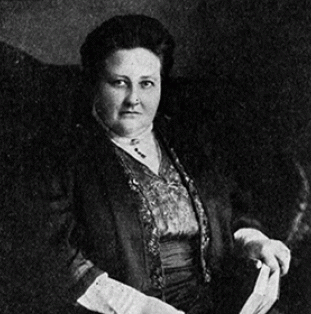
During a career that spanned just over a dozen years, Amy Lowell (1874-1925) wrote and published over 650 poems, yet scholars cite Lowell’s tireless efforts to awaken American readers to contemporary trends in poetry as her more influential contribution to literary history. “Poet, propagandist, lecturer, translator, biographer, critic . . . her verve is almost as remarkable as her verse,” opined poet Louis Untermeyer in his 1923 work American Poetry since 1900. A collection of Lowell’s work, published posthumously as What’s O’Clock?, was awarded the Pulitzer Prize for Poetry in 1926. She was survived by her secretary, Ada Dwyer Russell, with whom she had a long-term relationship.
Discover more from Vox Populi
Subscribe to get the latest posts sent to your email.

Good to see Lowell here. I’m just now reading two different books of her selected poetry. Also, I’d urge any reader of her poems to try and find her two-volume Keats biography, which I have; it’s as alive and valid today as anything she ever did. Here’s a poem from a sequence I’ve been working on, called On First Looking into Amy Lowell’s John Keats:
Lowell’s Own Keats
What is it Amy Lowell’s book does so well?
She gives us Keats the burdened, Keats the ebullient,
Endymion moon-high, brought low as hell,
The man of friends, poet erring to turn prescient,
The boy discoverer down cerebral paths
Untried yet; book-equipped, who still must think
In measures of star and ocean, subdue wraths
Pugnacious in his nature, trap with ink-
Receptors flavors: on the “strenuous tongue”
Burst not only grapes, but claret; sprinkle cayenne,
Scour budding taste buds. Only the young, so stung,
Probe all sensation’s boundaries, hop back again,
Both torment the palate and exquisitely dazzle it.
Who invented that concept, gusto? Wasn’t Hazlitt.
LikeLiked by 1 person
Thank you for this skilled sonnet, Thomas.
LikeLiked by 1 person
When a poem makes me feel cold ( or hot, or another physical sensing) it has struck me where I need poetry. Does that make sense?
LikeLiked by 1 person
Oh, yes, Barbara. It makes perfect sense. Very perceptive and well-said. Thank you.
LikeLiked by 2 people