
Vox Populi
A curated webspace for Poetry, Politics, and Nature with over 6,000,000 visitors since 2014 and over 9,000 archived posts.
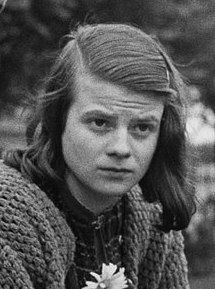
Sandy Solomon: Sophie Scholl from diary, letters, pamphlets
21-year-old Scholl, with her older brother Hans,
was guillotined on 22 February 1943 for being
part of the White Rose, a group of students
arrested for distributing anti-Nazi flyers.
—
April 1940
To politics, everything else must take
second place. We were politically educated,
after all. I’d just like to relax
in your company again and see and feel
nothing but the cloth of your suit.
—
July 1940
I went cycling for two hours
with Inge this afternoon. Beyond
Oberkirchberg, we turned off
into the woods. The tree tops
kept crashing into each other overhead.
Only the wind at work.
—
August 1941
I’ve got a nice job at present.
Herr Krele works at the munitions
factory, while his wife tends
the farm. I’ve looked after their little
home, and come to feel as if
it is my own. When my job assignment
changes next week, I’ll miss the way
his wife puts aside one or two
liters of milk for me each day
(the only thing they’ve got plenty of
aside from bread and jam).
—
September 1941
I feel immense pleasure, I feel
so strong, when I fool my superiors,
though I must enjoy this stolen sense
of freedom in secret.
.
My parents are still doing their best
to get me out of compulsory war work;
my father has already fired off
letters of appeal on my behalf—
the first request he sent denied,
the fate of the second still unknown.
—
November 1941
Although I can’t do as I please
or as I’d imagined, I’m well off here
teaching in the kindergarten, sleeping
in camp. I take a long solitary
walk to and from work
every morning and evening, amid
the snowy, twilit fields and hills.
—
January 1942
This evening, I listened to music on the radio
written in the time of Bach,
a lucid, joyous quartet, utterly
unsentimental. I longed to breathe
the same clear air as those
who played the piece, and that desire
took me away from the turmoil briefly.
The music reminded me of the saying,
have a hard head and a soft heart.
—
July 1942
My God, do not turn away from me if I fail
to hear you knock; open my deaf, deaf heart.
—
September 1942
I finished my factory work last Saturday.
Lisl and I will spend a few days
in a secluded farmhouse in the mountains
to be out of sight of man and his works.
I’ll find solace in nature, away
from the terrible things happening.
One gets the impression that, impelled
by some evil power, people
have lost control over themselves
and what they do. When I looked over
the factory floor, I could see
a hundred or so people standing
over their machines. I thought of them
as if sadly yet unwittingly obeying
a power they themselves had created.
—
October 1942
Now I’m delighting once more
in the last rays of the sun
and marveling at the incredible beauty
of all that wasn’t created by man:
red dahlias beside the white
garden gate, tall, solemn
fir trees, birches with their trembling
golden leaves. Their trunks gleam
against the green and copper foliage.
Colors intensify in the golden sunshine.
How mysterious—and frightening too—
that everything should be so beautiful despite
the terrible things that are happening?
—
November 1942
People must examine every word
from every angle before they speak.
Mistrust and caution have forcibly replaced
faith in other people. But, no,
I won’t let anything discourage me.
.
Today my father learned he can
no longer practice his profession.
The authorities find him unreliable
politically. He worries that his income
as a bookkeeper won’t provide enough
support, but he doesn’t want to give
the apartment up for just the year
or so before the war is over.
—
January 1943
Leaflet of the Resistance. A Call to All Germans!
Hitler is leading the German people
into the abyss….But what are the German people
doing? They will not see. They will not listen.
Blindly they follow their seducers into ruin.
—
February 1943
Rain drips on the windowsill.
I can hear the sound of a clock ticking
inside the wall—not often—mostly
close to midnight. Sometimes the ticking
is slow, sometimes faster and faster.
I have the feeling what I hear
is only the central heating. I can’t
remember a time when I felt so
unable to concentrate on my book.
.
Fellow Students—Men and Women!
Shaken and broken, our people behold
the loss of men at Stalingrad.
Three hundred and thirty thousand
German men senselessly
and irresponsibly driven to death…
by the inspired strategy of
our World War I Private First Class.
Fuhrer, we thank you.
.
I so look forward to the spring.
In that piece of Shubert’s I can feel
the breezes and smell the scents and hear
the birds. I can feel the whole
of creation cry out for joy.
Translations with some modifications from At the Heart of the White Rose, Letters and Diaries of Hans and Sophie Scholl, edited by Inge Jens, Harper and Row, New York 1984
Copyright 2019 Sandy Solomon
Discover more from Vox Populi
Subscribe to get the latest posts sent to your email.
