
Vox Populi
A curated webspace for Poetry, Politics, and Nature with over 6,000,000 visitors since 2014 and over 9,000 archived posts.
Bernice Yeung: The Women #MeToo Leaves Behind
Another day, another startling story about sexual harassment, or worse. The reality is that every day, about 50 people experience extreme sexual harassment when they are sexually assaulted or raped on the job.
It’s a problem that affects people in all types of work, extending beyond film, media and politics to the women who clean hotel rooms, tidy office buildings at night or pick vegetables.
At the heart of any sexual harassment accusation is the abuse of power. Hollywood mogul Harvey Weinstein had movie roles to offer. Reporter Glenn Thrush of The New York Times could help young journalists get in front of a top editor. Congressman John Conyers could open doors to a high-powered political career.
I’ve been reporting on these kinds of power dynamics since 2012 with one critical difference: The women I’ve talked to are immigrant women from the working class. They face the same kind of power imbalance as the women coming forward today, except the exploitation plays out differently.
Their bosses aren’t famous but they still have real influence on the people who work for them. These supervisors can hire and fire, mete out extra hours or take them away. For women living paycheck to paycheck, that’s a significant kind of power to wield.
Supervisors overseeing immigrant workers also know that there are specific ways to coerce and silence the women they oversee—women who might not be authorized to be in the country, who don’t speak English and who are purposely set up to work in isolation.
That sets up a dynamic in which women have been raped in the fields and sexually assaulted in the high-rises they clean, a phenomenon I sought to expose alongside my colleagues at the Investigative Reporting Program at University of California Berkeley, KQED-FM, PBS’ Frontline and Univision. My forthcoming book, “In a Day’s Work: The Fight to End Sexual Violence Among America’s Most Vulnerable Workers” (The New Press, 2018), draws from and expands on this work to look at how this issue plays out among domestic workers. In all of these industries, the dynamics that make women vulnerable to attack also make it difficult to speak up or file a complaint.
In this moment when all eyes are on sexual harassment among women with a certain level of privilege, here’s a few key things I’ve learned about why this issue has historically been so hard to bring to light among low-wage immigrant workers:
- Financial worries trap immigrant women in their jobs when they are sexually abused by their bosses. Single mothers or women supporting families in their home countries told us that they feel tethered to their jobs. That’s especially true for women not authorized to work in the U.S., because they worry that it will be difficult to find a new job.
- Immigrant workers don’t always know sexual harassment is against the law. The women we talked to knew that what was happening to them was wrong, but some didn’t initially know that they had a right to make a complaint. Making things even murkier, many workers in agriculture and janitorial work are employed by labor contractors, and they were confused about where they should report a problem.
- Isolation is a powerful weapon for abusive supervisors in low-wage work. Farmworkers said their bosses tried to rape them in their trucks after taking them to remote fields. Janitors on the night shift said bosses preyed on them in the bathrooms or in supply closets where they knew there weren’t security cameras. Companies have tried to eliminate this risk by having women work in pairs or forbidding supervisors from driving their workers.
Our reporting also found that low-wage immigrant workers have pushed back on sexual violence, despite the formidable barriers to confronting it. They’ve filed lawsuits, marched in rallies and given legislative testimony to denounce on-the-job sexual violence.
But even as a space has been cleared for more people to come forward, traps and barriers remain for the women I have been writing about. Immigration authorities are making more arrests, and police officials say fear of deportation has led to a drop in sexual assault reports.
We’re at the cusp of a cultural inflection point that could lead to improvements for working women. But it won’t be true progress if some of us, held back by poverty-level wages and immigration status, aren’t able to step forward to say #MeToo.
First published in Reveal.
.
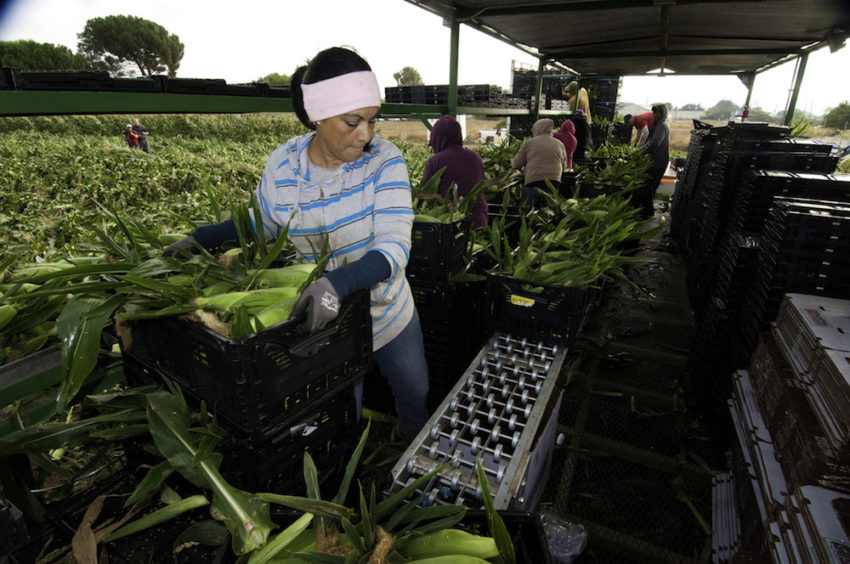
Migrant workers harvest corn in Gilroy, Calif. (USDA / CC 2.0)
Discover more from Vox Populi
Subscribe to get the latest posts sent to your email.
