
Vox Populi
A curated webspace for Poetry, Politics, and Nature with over 6,000,000 visitors since 2014 and over 9,000 archived posts.
Joan E. Bauer: Manzanar
Manzanar
for Jeanne Wakatsuki Houston,
author of Farewell to Manzanar
The word, Spanish for apple orchard
but by 1942, no orchards in the Owens Valley.
Water rights sold in the Twenties
to Los Angeles, the land left parched & dry.
You remember: snow-capped Sierra Nevadas,
high winds, tumbleweeds, dust storms, lousy food.
*
My cousin Blanche, most accomplished & brainy
of our Italian relatives. 1939 Berkeley grad.
At weddings & funerals, I’d study her glossy hair
pulled taut in a bun, her face, a powder-white mask.
Her husband sported a bow tie & swarmy smile.
Their first teaching jobs were at Manzanar.
*
Japanese subs off the coast. Blackouts, sirens. Panic
when the air patrol mistook weather balloons for attack.
For the war effort, families bought bonds, collected paper,
even rubber bands. Did it feel patriotic
teaching at Manzanar? Among the teachers, Quakers,
retirees, young college grads. Some were kindly
& nurturing, others, stern & rule-bound. I wonder
about my cousin: What kind of teacher was she?
*
If you had ‘Japanese blood’ & lived out West, even being
a citizen didn’t matter. 24 hours to sell everything.
At release, every man, woman & child given $25
& a train ticket to wherever you could find to go.
By then, Jeanne Wakatsuki’s father had grown so bitter,
he rarely spoke to a Caucasian again.
*
36 barracks made of tar paper without ceilings or toilets
or wallboard. Furnace in summer, icebox in winter.
Steel army cots, straw mattresses. Communal latrines
& showers. Families made furniture from orange crates,
created self-help societies & gardens amid guard houses,
armed MPs, desert & barbed wire.
Jeanne Wakatsuki Houston was married 15 years
before she told her husband James about Manzanar.
*
When is the best time to teach history?
When kids are ten or fifteen? When they go to college?
I think about Cousin Blanche, long dead, & wonder:
Did she ever tell her students, did she ever tell anyone
about Manzanar?
**********
He Smuggled a Lens into Manzanar
You can study his black & whites of the ’32 Olympics.
Lean runners on the track. Fans streaming
into the L.A. Coliseum beneath the flags.
Toyo Miyatake, foremost photographer in Little Tokyo.
His own studio. Edward Weston, his mentor & friend.
*
Manzanar. With scrap-wood frame, forbidden lens
& drain pipe (to secure & focus), he built a camera.
The camera was confiscated, then returned again & again.
After a time, the camp director relented, allowed Miyatake
to frame his photographs so long as a Caucasian
tripped the shutter & at day’s end, took the lens away.
After a time, the camp director again relented.
You know, I’m basically blind out of my left side
*
At the camp, Ansel Adams took Miyatake’s portrait:
angular face, wire-rimmed glasses, black beret.
It was 1943. This fall, on exhibit at the Whitney,
Miyatake’s own photographs from Manzanar.
Classroom scene: O beau-ti-ful for spacious skies
on a banner above the children. “Untitled” (1944):
Blurred guard tower as backdrop. Holding cutters
to the barbed wire, the hand of Miyatake’s son.
Copyright 2017 Joan E. Bauer
.
Manzanar was the best-known of the forced relocation and internment camps in which people of Japanese ancestry were held during World War II. To view a collection Toyo Miyatake’s photos of Manzanar at the Whitney in New York, click here.
To visit the the National Parks Service photo gallery of Manzanar. click here.
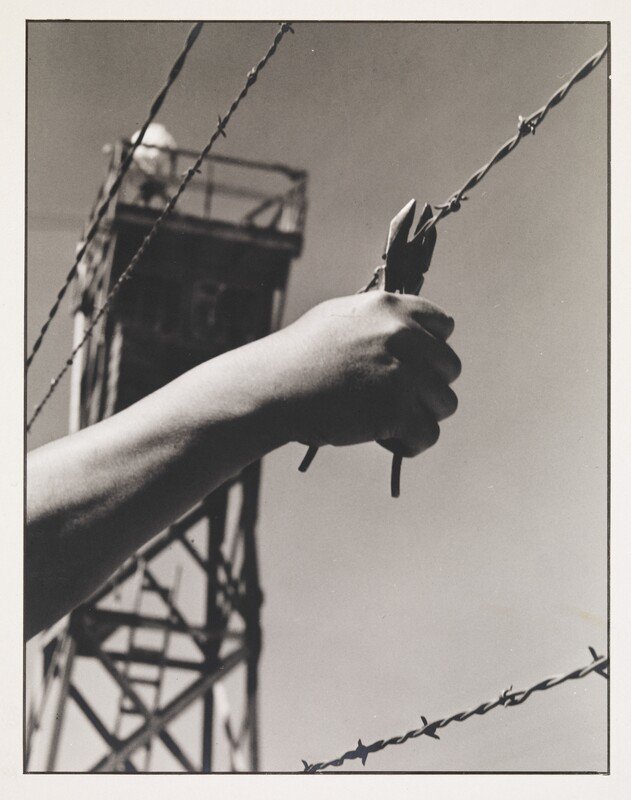
Toyo Miyatake’s photograph of his son’s hand.
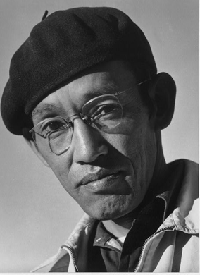
Ansel Adams’ photograph of Toyo Miyatake.
Discover more from Vox Populi
Subscribe to get the latest posts sent to your email.

An okay poem. This poet is known for her sing-songy voice and Wikipedia-style poems.
LikeLike
I disagree. Joan Bauer writes poems that turn history into poetry. Her language is precise and her lines are well-made.
LikeLike
What a pleasure to read Joan’s work. Always (as with Miyatake) a keen eye for detail, concision & empathy. And history. Not many poets plumb the depths of the history we mustn’t forget.
LikeLiked by 1 person