
Vox Populi
A curated webspace for Poetry, Politics, and Nature with over 6,000,000 visitors since 2014 and over 9,000 archived posts.
Video: Homer’s “The Iliad” translated and read by Stanley Lombardo
.
Stanley Lombardo, professor of classics at the University of Kansas, reads from his translation of “The Iliad.”
[Email subscribers may click on the title of this post to watch the video.]
.
The Iliad is an ancient Greek epic poem in dactylic hexameter, traditionally attributed to Homer. Set during the Trojan War, the ten-year siege of the city of Troy (Ilium) by a coalition of Greek states, it tells of the battles and events during the weeks of a quarrel between King Agamemnon and the warrior Achilles.
Although the main part of the story covers only a few weeks in the final year of the war, “The Iliad” mentions or alludes to many of the Greek legends about the siege, the gathering of warriors, and the cause of the war, as well as prophecies of Achilles’ death and the sack of Troy.
“The Iliad” is paired with a sequel, “The Odyssey,” also attributed to Homer. These long poems are the oldest extant works of Western literature, and the written versions are usually dated to around the 8th century BC. “The Iliad,” comprised of 15,693 lines, was composed in what is now known as Homeric Greek, a literary amalgam of Ionic Greek and other dialects.
Below is a sample of Professor Lombardo reading a section of “The Iliad” in the original Greek:
.
‘
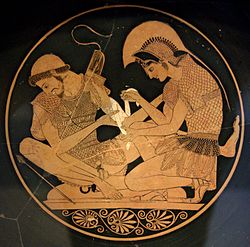
Achilles attending the wounded Patroclus (c. 500 BC).
,
Text adapted from Wikipedia.
Discover more from Vox Populi
Subscribe to get the latest posts sent to your email.
