
Vox Populi
A curated webspace for Poetry, Politics, and Nature with over 6,000,000 visitors since 2014 and over 9,000 archived posts.
Geoffrey of Monmouth: The Prophecy of Merlin
— adapted from the Latin by John Samuel Tieman
.
There will succeed a lion
of truth at whose demand
the castles of Flanders
and the dragon-standards
of the island will tremble;
that in his day gold
will be extorted
from the thistle and lily
and silver will flow
from the hooves of oxen;
that those who use curling irons
will affect various fleeces
so that the fashion
will betray the soul;
that the feet of the dog
will be mutilated,
the venison have peace,
and men lament fallenness;
and the coin of commerce
will be divided
and the half-penny will be round.
*
Geoffrey of Monmouth (c. 1100 – c. 1155) was a Welsh cleric and one of the major figures in the development of British historiography and the popularity of tales of King Arthur. He is best known for his chronicle History of the Kings of Britain, which was widely popular in its day and was credited, uncritically, well into the 16th century, being translated into various other languages from its original Latin. The popular image of Merlin today — the hooded magician in flowing black robes — is really a product of Thomas Malory, a Renaissance portrayal akin to Shakespeare’s Prospero or Marlowe’s Faustus. Geoffrey’s late medieval Merlin is a half-human madman living in the woods, a prophet more akin to John The Baptist “crying out in the wilderness.”
—
Adaptation copyright 2015 John Samuel Tieman
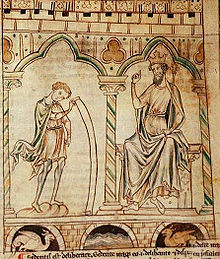
Merlin prophesies for Vortigern, from a manuscript of Geoffrey of Monmouth’s Historia Regum Britanniae.
Discover more from Vox Populi
Subscribe to get the latest posts sent to your email.
