Djelloul Marbrook: Auda Abu Tayi, Lord of the Howeitat
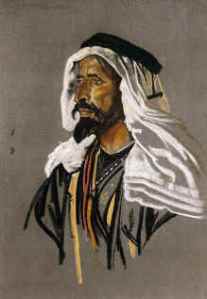
Arab consonants sail right to left bearing cargoes of vowels. The British artist and sculptor Eric Kennington may have had this in mind when he made this magnificent—left-facing— pastel portrait of Sheikh Auda Abu Tayi, lord of the Howeitat tribe.
Kennington served as a war artist in both world wars and was greatly influenced by his encounter with T.E. Lawrence, the British Army captain assigned the task of stirring the Arabs to revolt against their Ottoman Turk overlords. When Lawrence wrote The Seven Pillars of Wisdom, an account of that revolt, Kennington was his art editor, and this is one of Kennington’s drawings in that famous book.
The book, aside from its historical significance—it is a kind of handbook on guerrilla warfare and is read at war colleges—is a masterpiece of Edwardian English and its grammar.
Many people regard Auda as the true hero of the Arab Revolt, not Lawrence. There is little doubt that the revolt’s chief accomplishment, the spectacular taking of the port of Aqaba in the south of present-day Jordan, could not have been accomplished without Auda and his tribesmen. They crossed the Devil’s Anvil, the Nejd Desert, to attack Aqaba from land, knowing that all the artillery of the Turkish defenders was fixedly pointed seaward.
Auda is quoted in David Lean’s famous film, Lawrence of Arabia, as saying to Lawrence in exasperation, “You talk about Umm al Arabia, Arabs this and Arabs that, but I don’t know any Arabs, I know only Howeitat, Ruwallah, Harith…” The quote, whether apocryphal or not, has become a kind of truism about Arab society, which remains sharply divided between urban and Bedouin cultures. The problem with the quote is that Auda, as his heirs have pointed out, was a true patriot who believed in Arab independence. Like most Arabs, he knew the Turks had inherited Arab civilization and its empires, used its script and borrowed its words. But does knowing this cast doubt on the quotation attributed to Auda? Not necessarily. Islam burst out of the Arabian peninsula, Auda’s home, on the points of Bedouin spears and swords. Within 100 years these Bedouins turned the Mediterranean Sea into an Arab lake. The first great Arab, the first great Muslim empire, the Umayyad Empire, was essentially Bedouin, and its armies were organized along tribal lines.
So we must remain intrigued by what Auda would have made of Pan-Arabism, of modern Arab independence, of men like Gamal Abdel Nasser and Saddam Hussein. Auda is a haunting figure—all the more so today because of the turmoil in the Arab World, much of it rooted in the Anglo-French betrayal of the Arab Revolt—looking out in this memorable Kennington pastel as if in reproof of all that has happened.
As Auda reportedly was exasperated by Captain Lawrence’s speechifying about Arab destiny so Arab intelligentsias through the ages have been exasperated with the persistence of Bedouin ways. The toppling of the Umayyads by the Abbasids was inspired in part by this exasperation, a kind of contempt for the unwillingness of the Bedouin to change. And yet all these Arab intelligentsias understood—and understand today—that the Bedouin embodies much of what it means to be Arab. Auda could hardly have imagined Arab independence as meaning the demise of Bedouin culture.
Muammar Qadaffi, the fallen leader of Libya, attempted to keep intact his Bedouin roots, and this often struck his Western critics as a pretense. It was in fact down-home politics. He needed tribal support, and to get and keep it he needed to avoid looking like a member of the urban intelligentsia. The contemporary Algeria army, engaged in a bitter struggle with Islamist insurgents, is largely Bedouin. Bedouins have traditionally disliked fanatics and ideologues because they seem to bid fare to control people, and they smack of central authority. The Bedouin is at eternal war with central authority.
The emirs of the United Arab Emirates strive to keep their Bedouin credentials in good order for the same reasons. They seek, like Auda, to hark back to the Umayyad style of imposing a Bedouin sensibility on a sophisticated modern society. It took great skill to achieve this, and both Umayyad empires, the first camped in Damascus and the second camped in Cordoba, achieved this precarious balance to a remarkable degree. The Western Umayyad empire fell when it lost touch with its Bedouin soul; it fell to fanatics, as Syria and Iraq are now falling to fanatics. And it could not be rescued by the Bedouins with whom it had lost touch.
We should use Eric Kennington’s pastel of Auda Abu Tayi as a kind of touchstone as we contemplate the news from the Arab world. Not so much in wonderment of what Auda would have said—he was a man of his deeds—but because it is the Bedouin soul of the Arabs that is struggling so awfully to come to terms with the 21st Century.
————————
The matter with content
Yes, that’ s Auda Abu Tayi sitting there
among the exhibitionist students
as belonging as you are
in a small upstate town
sitting there beckoning
the fourth cone of your eye
You can’t get past his daggerness
to the sea scent of his gaze
no matter how you steady your head
the question of his dagger hand dements you
and the floor opens up
to all you’ve studied not to fear
Auda Abu Tayi lord of the Howeitat
sipping latte out of place
as a zarook in the desert or a camel
on a sterncastle snorting and yet
out of place is commonplace
for people with a fourth cone in the eye
His total effect eludes you
because of your fetish in his belt
and it might as well be the 7th Century
and your first encounter with Islam
for the savagery of your denial
that you wish to be stabbed by the man
stabbed repeatedly while smiling
in the knowledge you will not bleed out
not for him or anyone
stabbed repeatedly to assure you
the fourth cone is for unbelonging
enabling you to see
what is the matter with content
Discover more from Vox Populi
Subscribe to get the latest posts sent to your email.


Djelloul Marbrook: Auda Abu Tayi, Lord of the Howeitat
Arab consonants sail right to left bearing cargoes of vowels. The British artist and sculptor Eric Kennington may have had this in mind when he made this magnificent—left-facing— pastel portrait of Sheikh Auda Abu Tayi, lord of the Howeitat tribe.
Kennington served as a war artist in both world wars and was greatly influenced by his encounter with T.E. Lawrence, the British Army captain assigned the task of stirring the Arabs to revolt against their Ottoman Turk overlords. When Lawrence wrote The Seven Pillars of Wisdom, an account of that revolt, Kennington was his art editor, and this is one of Kennington’s drawings in that famous book.
The book, aside from its historical significance—it is a kind of handbook on guerrilla warfare and is read at war colleges—is a masterpiece of Edwardian English and its grammar.
Many people regard Auda as the true hero of the Arab Revolt, not Lawrence. There is little doubt that the revolt’s chief accomplishment, the spectacular taking of the port of Aqaba in the south of present-day Jordan, could not have been accomplished without Auda and his tribesmen. They crossed the Devil’s Anvil, the Nejd Desert, to attack Aqaba from land, knowing that all the artillery of the Turkish defenders was fixedly pointed seaward.
Auda is quoted in David Lean’s famous film, Lawrence of Arabia, as saying to Lawrence in exasperation, “You talk about Umm al Arabia, Arabs this and Arabs that, but I don’t know any Arabs, I know only Howeitat, Ruwallah, Harith…” The quote, whether apocryphal or not, has become a kind of truism about Arab society, which remains sharply divided between urban and Bedouin cultures. The problem with the quote is that Auda, as his heirs have pointed out, was a true patriot who believed in Arab independence. Like most Arabs, he knew the Turks had inherited Arab civilization and its empires, used its script and borrowed its words. But does knowing this cast doubt on the quotation attributed to Auda? Not necessarily. Islam burst out of the Arabian peninsula, Auda’s home, on the points of Bedouin spears and swords. Within 100 years these Bedouins turned the Mediterranean Sea into an Arab lake. The first great Arab, the first great Muslim empire, the Umayyad Empire, was essentially Bedouin, and its armies were organized along tribal lines.
So we must remain intrigued by what Auda would have made of Pan-Arabism, of modern Arab independence, of men like Gamal Abdel Nasser and Saddam Hussein. Auda is a haunting figure—all the more so today because of the turmoil in the Arab World, much of it rooted in the Anglo-French betrayal of the Arab Revolt—looking out in this memorable Kennington pastel as if in reproof of all that has happened.
As Auda reportedly was exasperated by Captain Lawrence’s speechifying about Arab destiny so Arab intelligentsias through the ages have been exasperated with the persistence of Bedouin ways. The toppling of the Umayyads by the Abbasids was inspired in part by this exasperation, a kind of contempt for the unwillingness of the Bedouin to change. And yet all these Arab intelligentsias understood—and understand today—that the Bedouin embodies much of what it means to be Arab. Auda could hardly have imagined Arab independence as meaning the demise of Bedouin culture.
Muammar Qadaffi, the fallen leader of Libya, attempted to keep intact his Bedouin roots, and this often struck his Western critics as a pretense. It was in fact down-home politics. He needed tribal support, and to get and keep it he needed to avoid looking like a member of the urban intelligentsia. The contemporary Algeria army, engaged in a bitter struggle with Islamist insurgents, is largely Bedouin. Bedouins have traditionally disliked fanatics and ideologues because they seem to bid fare to control people, and they smack of central authority. The Bedouin is at eternal war with central authority.
The emirs of the United Arab Emirates strive to keep their Bedouin credentials in good order for the same reasons. They seek, like Auda, to hark back to the Umayyad style of imposing a Bedouin sensibility on a sophisticated modern society. It took great skill to achieve this, and both Umayyad empires, the first camped in Damascus and the second camped in Cordoba, achieved this precarious balance to a remarkable degree. The Western Umayyad empire fell when it lost touch with its Bedouin soul; it fell to fanatics, as Syria and Iraq are now falling to fanatics. And it could not be rescued by the Bedouins with whom it had lost touch.
We should use Eric Kennington’s pastel of Auda Abu Tayi as a kind of touchstone as we contemplate the news from the Arab world. Not so much in wonderment of what Auda would have said—he was a man of his deeds—but because it is the Bedouin soul of the Arabs that is struggling so awfully to come to terms with the 21st Century.
————————
The matter with content
Yes, that’ s Auda Abu Tayi sitting there
among the exhibitionist students
as belonging as you are
in a small upstate town
sitting there beckoning
the fourth cone of your eye
You can’t get past his daggerness
to the sea scent of his gaze
no matter how you steady your head
the question of his dagger hand dements you
and the floor opens up
to all you’ve studied not to fear
Auda Abu Tayi lord of the Howeitat
sipping latte out of place
as a zarook in the desert or a camel
on a sterncastle snorting and yet
out of place is commonplace
for people with a fourth cone in the eye
His total effect eludes you
because of your fetish in his belt
and it might as well be the 7th Century
and your first encounter with Islam
for the savagery of your denial
that you wish to be stabbed by the man
stabbed repeatedly while smiling
in the knowledge you will not bleed out
not for him or anyone
stabbed repeatedly to assure you
the fourth cone is for unbelonging
enabling you to see
what is the matter with content
Discover more from Vox Populi
Subscribe to get the latest posts sent to your email.
share this:
Related